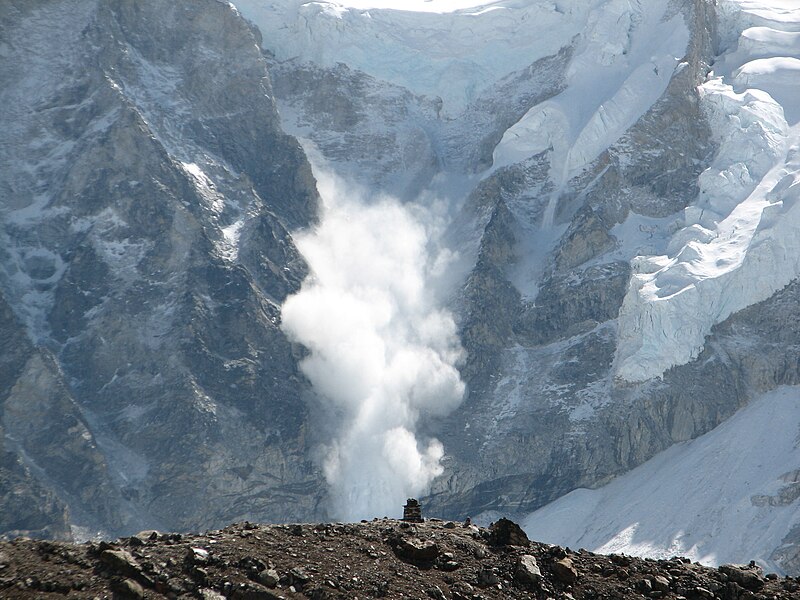
File:Avalanche_on_Everest.JPG · Wikimedia Commons · See Wikimedia Commons
alud
Sign in to savedesplazamiento de una capa de nieve ladera abajo
An avalanche is a rapid flow of snow down a slope such as a hill or mountain, which can be triggered by natural factors like heavy precipitation or snowpack weakening, or by external causes like humans, animals, and earthquakes. Large avalanches matter because they can capture and move not just snow and air, but also ice, rocks, and trees, making them potentially destructive events.
AI-generated from the Wikipedia summary — may contain errors.
Research
4,965 papers- [Avalanche rescue 2024-Current recommendations].Die Anaesthesiologie · 2025
- Avalanche burial pathophysiology - a unique combination of hypoxia, hypercapnia and hypothermia.The Journal of physiology · 2024
- Single Photon Avalanche Diode Arrays for Time-Resolved Raman Spectroscopy.Sensors (Basel, Switzerland) · 2021
- On-Site Medical Management of Avalanche Victims-A Narrative Review.International journal of environmental research and public health · 2021
- Effectiveness and use of avalanche airbags in mortality reduction among winter-recreationists.Journal of travel medicine · 2023
via PubMed
Wikidata facts
- Image
- Laviin MAL-Pamir 85 02.jpg
Show 7 more facts
- topic's main category
- Category:Avalanches
- Commons gallery
- Avalanche
- on focus list of Wikimedia project
- Wikipedia:Vital articles/Level/4
- facet of
- gravity
- different from
- Avalanche
- Commons category
- Avalanches
- exact match
- purl.obolibrary.org/obo/ENVO_01000691
Sources (5)
via Wikidata · CC0
Article · Español
Un alud, también conocido como avalancha, es el desplazamiento de una capa de nieve en una zona en pendiente que se dirige ladera abajo con una velocidad que puede variar. También se puede incorporar parte del sustrato y de la cobertura vegetal de la pendiente, usualmente son causados ya sea por la cantidad de nieve que se acumula en la zona de inicio de la avalancha, es decir por sobrecarga, lo que genera un colapso dentro del manto de nieve, normalmente a nivel de una capa débil; además debe existir un ángulo de ladera entre 25° y 45° preferentemente; también puede ser generadas por personas, esquiadores, montañistas, alpinistas, motos de nieve, snowcat, y animales como guanacos, y todo tiene relación con la sobrecarga del manto de nieve. Por otra parte, lluvias sobre el manto de nieve pueden ser la causa de una avalancha, y también puede haber avalanchas provocadas o inducidas con explosivos, que se clasifican como avalanchas artificiales.
Abstract from DBpedia / Wikipedia · CC BY-SA
Gallery (50)
Available in 120 languages
- Español
- Français
- Deutsch
- 中文
- 日本語
- Русский
- Português
- Italiano
- العربية
- हिन्दी
- abstract
- Afrikaans
- Albanian
- Albanian
- Angika
- Aragonese
- Armenian
- Arpitan
Show 101 more
- Assamese
- Asturian
- azb
- Azerbaijani
- Bahasa Indonesia
- Bangla
- Bashkir
- Basque
- bat_smg
- Bavarian
- be_x_old
- Belarusian
- Bosnian
- Bulgarian
- Burmese
- Catalan
- Central Kurdish
- Chechen
- Chuvash
- Croatian
- Czech
- Danish
- dty
- Egyptian Arabic
- Esperanto
- Estonian
- Fiji Hindi
- Filipino
- Finnish
- fiu_vro
- Galician
- Georgian
- Greek
- Hebrew
- Hungarian
- Icelandic
- Ido
- Ingush
- Interlingua
- Irish
- Karachay-Balkar
- Kazakh
- kbp
- Kikuyu
- Kurdish
- Kyrgyz
- Latin
- Latvian
- Limburgish
- Lithuanian
- Macedonian
- Malay
- Malayalam
- Marathi
- Mingrelian
- Mirandese
- nds_nl
- Nederlands
- Nepali
- Newari
- Northern Frisian
- Norwegian
- Norwegian Nynorsk
- Occitan
- Pashto
- Piedmontese
- Polski
- Punjabi
- Romanian
- Rusyn
- Sanskrit
- Scottish Gaelic
- Serbian
- Serbian (Latin)
- Sicilian
- simple
- Slovak
- Slovenian
- Svenska
- Swahili
- Tajik
- Tamil
- Tatar
- Telugu
- Tiếng Việt
- Türkçe
- Ukrainian
- Urdu
- Uzbek
- Venetian
- Waray
- Welsh
- Western Panjabi
- Wu Chinese
- Yiddish
- Zaza
- zh_min_nan
- zh_yue
- فارسی
- ไทย
- 한국어
via Wikidata sitelinks · CC0