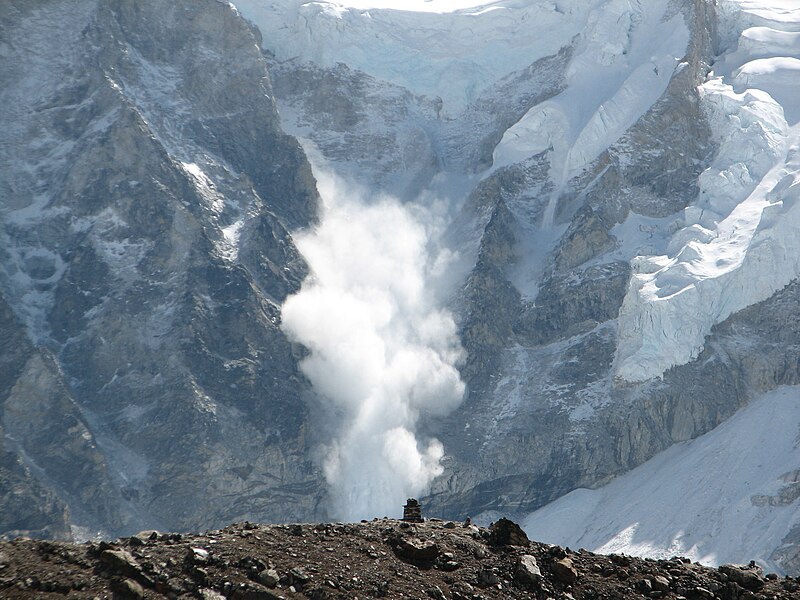
File:Avalanche_on_Everest.JPG · Wikimedia Commons · See Wikimedia Commons
An avalanche is a rapid flow of snow down a slope such as a hill or mountain, which can be triggered by natural factors like heavy precipitation or snowpack weakening, or by external causes like humans, animals, and earthquakes. Large avalanches matter because they can capture and move not just snow and air, but also ice, rocks, and trees, making them potentially destructive events.
AI-generated from the Wikipedia summary — may contain errors.
Research
4,965 papers- [Avalanche rescue 2024-Current recommendations].Die Anaesthesiologie · 2025
- Avalanche burial pathophysiology - a unique combination of hypoxia, hypercapnia and hypothermia.The Journal of physiology · 2024
- Single Photon Avalanche Diode Arrays for Time-Resolved Raman Spectroscopy.Sensors (Basel, Switzerland) · 2021
- On-Site Medical Management of Avalanche Victims-A Narrative Review.International journal of environmental research and public health · 2021
- Effectiveness and use of avalanche airbags in mortality reduction among winter-recreationists.Journal of travel medicine · 2023
via PubMed
Wikidata facts
- Image
- Laviin MAL-Pamir 85 02.jpg
Show 7 more facts
- topic's main category
- Category:Avalanches
- Commons gallery
- Avalanche
- on focus list of Wikimedia project
- Wikipedia:Vital articles/Level/4
- facet of
- gravity
- different from
- Avalanche
- Commons category
- Avalanches
- exact match
- purl.obolibrary.org/obo/ENVO_01000691
Sources (5)
via Wikidata · CC0
Article · 中文
雪崩,是在雪山中常有的自然災害,是指大量的雪由斜坡表面上快速滑動下來,產生原因通常是積雪處於一種「危險」的平衡狀態下,如果稍微有外力作用,就會失去平衡,造成雪塊滑動,進而引起更多積雪運動,使大量的瞬間傾盆而下;附近的人及村莊往往不能倖免。 雪崩一般而言是由某一區域的積雪重量超過其強度所成(板状雪崩,slab avalanche),但也有時是是因為積雪漸漸的變寬所造成(鬆雪崩,loose snow avalanche)。雪崩在開始後,其速度會迅速的變快,也會帶走路徑上的雪,因此其重量及體積也會越來越大。若雪移動的夠快,雪可能會混合一些空氣,形成粉末狀的雪崩,是一種密度流。 有關雪崩有許多的分類方式,但還沒有一種廣為接受的分類,會因為不同的目的而為雪崩做不同的分類。雪崩可以用其大小、破壞力、啟動機制、組成及動態特性來描述。 第一次世界大战期间,约有40000至80000名士兵在参与意大利战役的过程中死于阿尔卑斯山的雪崩,这场雪崩是由炮火引发的。
Abstract from DBpedia / Wikipedia · CC BY-SA
Gallery (50)
Available in 120 languages
- Español
- Français
- Deutsch
- 中文
- 日本語
- Русский
- Português
- Italiano
- العربية
- हिन्दी
- abstract
- Afrikaans
- Albanian
- Albanian
- Angika
- Aragonese
- Armenian
- Arpitan
Show 101 more
- Assamese
- Asturian
- azb
- Azerbaijani
- Bahasa Indonesia
- Bangla
- Bashkir
- Basque
- bat_smg
- Bavarian
- be_x_old
- Belarusian
- Bosnian
- Bulgarian
- Burmese
- Catalan
- Central Kurdish
- Chechen
- Chuvash
- Croatian
- Czech
- Danish
- dty
- Egyptian Arabic
- Esperanto
- Estonian
- Fiji Hindi
- Filipino
- Finnish
- fiu_vro
- Galician
- Georgian
- Greek
- Hebrew
- Hungarian
- Icelandic
- Ido
- Ingush
- Interlingua
- Irish
- Karachay-Balkar
- Kazakh
- kbp
- Kikuyu
- Kurdish
- Kyrgyz
- Latin
- Latvian
- Limburgish
- Lithuanian
- Macedonian
- Malay
- Malayalam
- Marathi
- Mingrelian
- Mirandese
- nds_nl
- Nederlands
- Nepali
- Newari
- Northern Frisian
- Norwegian
- Norwegian Nynorsk
- Occitan
- Pashto
- Piedmontese
- Polski
- Punjabi
- Romanian
- Rusyn
- Sanskrit
- Scottish Gaelic
- Serbian
- Serbian (Latin)
- Sicilian
- simple
- Slovak
- Slovenian
- Svenska
- Swahili
- Tajik
- Tamil
- Tatar
- Telugu
- Tiếng Việt
- Türkçe
- Ukrainian
- Urdu
- Uzbek
- Venetian
- Waray
- Welsh
- Western Panjabi
- Wu Chinese
- Yiddish
- Zaza
- zh_min_nan
- zh_yue
- فارسی
- ไทย
- 한국어
via Wikidata sitelinks · CC0