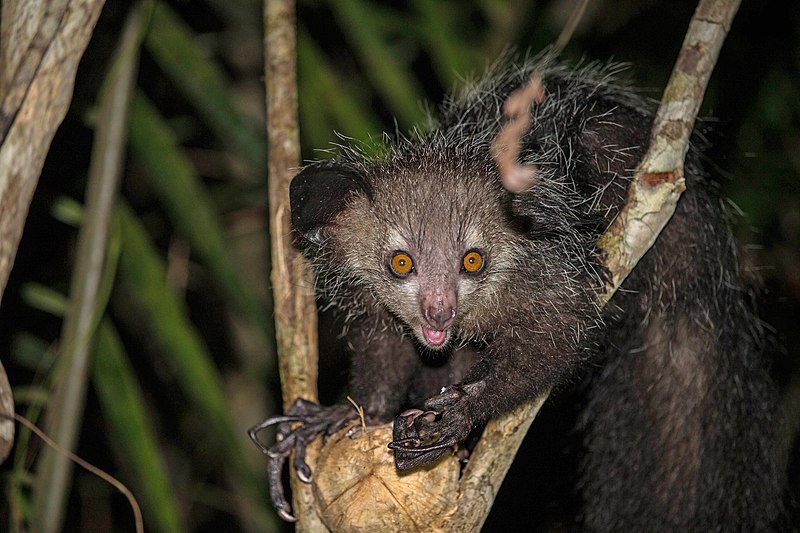
File:Wild_aye_aye.jpg · Wikimedia Commons · See Wikimedia Commons
aye-aye
Sign in to saveAlso known as Daubentonia madagascariensis
The aye-aye (, Daubentonia madagascariensis) is a long-fingered lemur, a strepsirrhine primate native to Madagascar with rodent-like teeth that perpetually grow and a special thin middle finger that they can use to catch grubs and larvae out of tree trunks.
The aye-aye is a long-fingered lemur native to Madagascar that has rodent-like teeth that never stop growing and a uniquely thin middle finger it uses to extract grubs and larvae from inside tree trunks. It represents an unusual evolutionary adaptation among primates, combining specialized physical features that allow it to fill a ecological niche typically occupied by rodents in other parts of the world.
AI-generated from the Wikipedia summary — may contain errors.
Species
EndangeredMaximum longevity: 23.3 years (captivity) Observations: One captive specimen lived 23.3 years at Amsterdam Zoo (Richard Weigl 2005).
via IUCN
Wikidata facts
- Instance of
- taxon
- Parent taxon
- Daubentonia
- Mass
- 2.5
- Image
- Aye-aye (Daubentonia madagascariensis), Tsimbazaza Zoo, Madagascar (3897947810).jpg
Show 15 more facts
- taxon rank
- species
- IUCN conservation status
- Endangered status
- taxon name
- Daubentonia madagascariensis
- Commons category
- Daubentonia madagascariensis
- Commons gallery
- Daubentonia madagascariensis
- taxon common name
- madagaskarski dolgoprstež
- endemic to
- Madagascar
- described by source
- Granat Encyclopedic Dictionary
- gestation period
- 165
- litter size
- 1
- longest observed lifespan
- 32.3
- CITES Appendix
- Appendix I of CITES
- different from
- Aye
- short name
- D. madagascariensis
- has characteristic
- evil
via Wikidata · CC0
~14 min read
Encyclopedic overview
13 sectionsContents
- Etymology
- Evolutionary history and taxonomy
- Anatomy and morphology
- Behaviour and lifestyle
- Diet and foraging
- Social systems
- Distribution and habitat
- Conservation
- Folk belief
- Captive breeding
- References
- Literature cited
- External links
The aye-aye (, Daubentonia madagascariensis) is a long-fingered lemur, a strepsirrhine primate native to Madagascar with rodent-like teeth that perpetually grow and a special thin middle finger that they can use to catch grubs and larvae out of tree trunks.
It is the world's largest nocturnal primate. It is characterized by its unusual method of finding food: it taps on trees to find grubs, then gnaws holes in the wood using its forward-slanting incisors to create a small hole into which it inserts its narrow middle finger to pull the grubs out. This foraging method is called percussive foraging, and takes up 5–41% of foraging time. The only other living mammal species known to find food in this way are the striped possum and trioks (genus Dactylopsila) of northern Australia and New Guinea, which are marsupials. From an ecological perspective, the aye-aye fills the niche of a woodpecker, as it is capable of penetrating wood to extract the invertebrates within.
Excerpted from Wikipedia’s “aye-aye” article, available under the CC BY-SA 4.0 licence.
Gallery (28)
Available in 69 languages
- Español
- Français
- Deutsch
- 中文
- 日本語
- Русский
- Português
- Italiano
- العربية
- Armenian
- azb
- Azerbaijani
- Bahasa Indonesia
- Balinese
- Basque
- Bulgarian
- Catalan
- Cebuano
Show 50 more
- Croatian
- Czech
- Danish
- Egyptian Arabic
- Esperanto
- Estonian
- Filipino
- Finnish
- Galician
- Georgian
- Greek
- Hebrew
- Hungarian
- Irish
- Kazakh
- Kotava
- Latvian
- Ligurian
- Lithuanian
- Madurese
- Malagasy
- Malay
- Malayalam
- Navajo
- Nederlands
- Northern Frisian
- Norwegian
- Norwegian Nynorsk
- Polski
- Punjabi
- Romanian
- Scots
- Serbian
- Serbian (Latin)
- simple
- Slovenian
- Svenska
- Tamil
- Tiếng Việt
- Türkçe
- Udmurt
- Ukrainian
- Uzbek
- Waray
- Western Panjabi
- Wu Chinese
- zh_yue
- فارسی
- ไทย
- 한국어
via Wikidata sitelinks · CC0