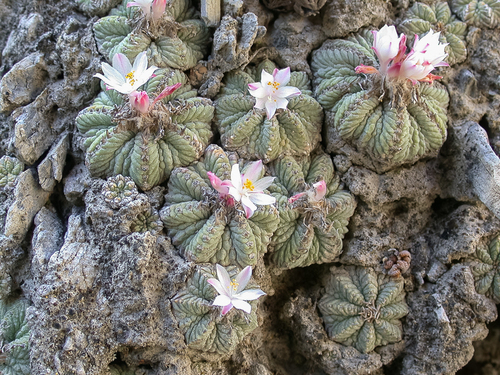
(c) Juan Miguel Artigas Azas, all rights reserved, uploaded by Juan Miguel Artigas Azas
Aztekium
Sign in to saveThe genus Aztekium contains two species of small globular cactus. Discovered in 1929 by F. Ritter, in Rayones, Nuevo León, Mexico, this genus was thought to be monotypic (with Aztekium ritteri) until a second species (Aztekium hintonii) was discovered by George S. Hinton, in Galeana, Nuevo León in 1991. A further possible species, Aztekium valdezii, was described in 2011, but is considered to be a synonym of A. ritteri.
Species
GENUS
- KingdomPlantae
- PhylumTracheophyta
- ClassMagnoliopsida
- OrderCaryophyllales
- FamilyCactaceae
皺棱球屬(屬名:Aztekium)是包含3個种的小型球狀仙人掌。皺棱球屬原本只有在墨西哥發現的Aztekium ritteri一個種。1992年,乔治·S.辛顿(George S. Hinton)在墨西哥新萊昂州发现该属第二个物种Aztekium hintonii。该属的第三个物种Aztekium valdesii是在墨西哥新萊昂州山区发现的[1]。 皺棱球屬植物生長非常緩慢,需要大約兩年才能達到3毫米的直徑,但栽種並不困難。它們通常通過種子繁殖。 下属的種 A. ritteri A. hintonii A. valdesii 参考资料 ^ Xerophilia Special issue no 2 (PDF). 2013-04-01. 维基共享资源中相关的多媒体资源:皺棱球屬 维基物种中的分类信息:皺棱球屬 物種識別信息 維基數據: Q131705 維基物種: Aztekium BioLib: 105564 EoL: 5187553 EPPO: 1AZTG GBIF: 3960195 GRIN: 1212 iNaturalist: 184454 IPNI: 295156-2 IRMNG: 1271177 ITIS: 907025 NCBI: 130099 POWO: urn:lsid:ipni.org:names:295156-2 Tropicos: 40023629 这是一篇與植物相關的小作品。你可以通过编辑或修订扩充其内容。 查 论 编 取自“https://zh.wikipedia.org/w/index.php?title=皺棱球屬&oldid=53023895” 分类: 仙人掌科 盆栽 隐藏分类: 物种微格式条目 含有英語的條目 全部小作品 植物小作品
via GBIF · Kew POWO
Wikidata facts
Show 7 more facts
- taxon rank
- genus
- Commons category
- Aztekium
- taxonomic type
- Aztekium ritteri
- taxon name
- Aztekium
- topic's main category
- Category:Aztekium
- taxon common name
- 皱棱球属
Sources (1)
via Wikidata · CC0
~2 min read
Encyclopedic overview
8 sectionsContents
- Description
- Species
- Etymology
- Distribution
- Cultivation
- Phytochemistry
- References
- External links
The genus Aztekium contains two species of small globular cactus. Discovered in 1929 by F. Ritter, in Rayones, Nuevo León, Mexico, this genus was thought to be monotypic (with Aztekium ritteri) until a second species (Aztekium hintonii) was discovered by George S. Hinton, in Galeana, Nuevo León in 1991. A further possible species, Aztekium valdezii, was described in 2011, but is considered to be a synonym of A. ritteri.
==Description== Aztekium ritteri is a plant that is around 20 mm wide, with 9 to 11 ribs, which typically have transverse wrinkles. Its color varies from pale green to grayish-green. The center of the cactus contains white wool. Flowers are less than 10 mm wide, with white petals and pinkish sepals. The plants bear pinkish berry-like fruit. A. hintonii is larger, to 10 cm in diameter, 10 to 18 grooved ribs, flowers magenta to 3 cm. It grows only on gypsum.
Excerpted from Wikipedia’s “Aztekium” article, available under the CC BY-SA 4.0 licence.