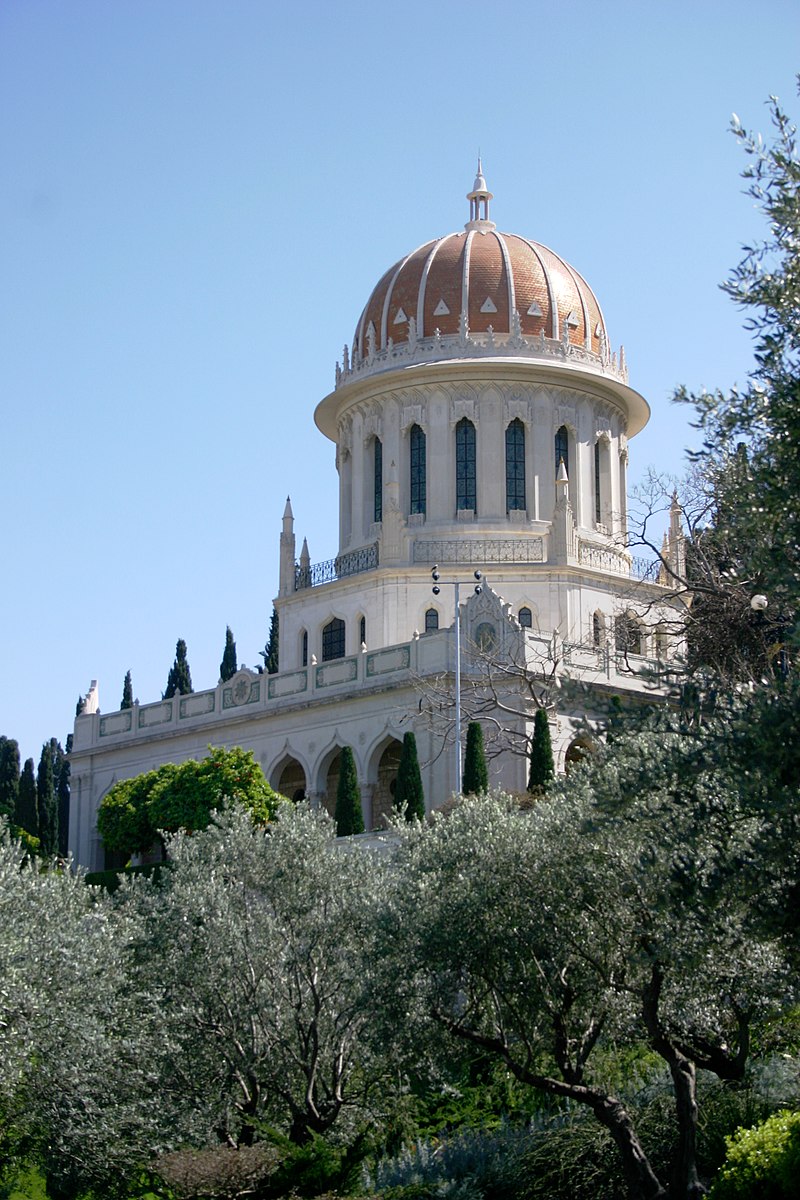
File:Shrine_Bab_North_West.jpg · Wikimedia Commons · See Wikimedia Commons
Also known as Bab, Nuqtah-i Ula, Ali Mukhamed Bab, Ali Muhammad ibn Rida al-Bazzazz, Ali Muhammad Rida al-Shirazi, the Báb, the Bab, ʻAlí-Muḥammad
The Báb (born ʻAlí-Muḥammad; ; ; 20 October 1819 – 9 July 1850) was an Iranian religious leader who founded Bábism, and is also one of the central figures of the Baháʼí Faith. The Báb gradually and progressively revealed his claim in his extensive writings to be a Manifestation of God, of a status as great as Moses, Jesus, and Muhammad, receiving revelations as profound as the Torah, Gospel, and Quran. This new revelation, he claimed, would release the creative energies and capacities necessary for the establishment of global unity and peace.
The Báb was a 19th-century Iranian religious leader who founded Bábism and claimed to be a Manifestation of God comparable to Moses, Jesus, and Muhammad, with revelations he believed would be as significant as the Torah, Gospel, and Quran. He is venerated as a central figure in the Baháʼí Faith, and his teachings emphasized that his new revelation would unlock the spiritual and creative forces needed to bring about global unity and peace.
AI-generated from the Wikipedia summary — may contain errors.
Key facts
- Religious biography.name
- The Báb
- Religious biography.religion
- Bábism
- Religious biography.image
- Shrine Bab North West.jpg
- Religious biography.caption
- Shrine of the Báb in Haifa, Israel
- Religious biography.birth_name
- ʻAlí-Muḥammad
- Religious biography.birth_place
- Shiraz, Iran
- Religious biography.death_place
- Tabriz, Iran
- Religious biography.death_cause
- Execution by firing squad
- Religious biography.occupation
- MerchantReligious leader
- Religious biography.known_for
- Founder of BábismCentral figure in Baháʼí Faith
- Religious biography.nationality
- Iranian
- Religious biography.spouse
- Khadíjih-Sultán (1842–1850)
- Religious biography.children
- Ahmad (1843–1843)
- Religious biography.parents
- Mirzá Muhammad Ridá (father) Fátimih Bagum (mother)
- Religious biography.relatives
- Afnán
- Religious biography.disciples
- Notable students:
- Religious biography.successor
- Baháʼu'lláh (for Baháʼís)Subh-i-Azal (for Azalis)
via Wikipedia infobox
Wikidata facts
- Instance of
- human
- Gender
- male
- Citizenship
- Qajar Iran
- Place of birth
- Shiraz
- Place of death
- Tabriz
- Occupation
- poet
- Religion
- Bábism
- Image
- Bahai center Haifa 2.jpg
Show 9 more facts
- Commons category
- Báb
- date of birth
- 1819-01-01
- date of death
- 1849-00-00
- place of burial
- Shrine of the Báb
- cause of death
- gunshot wound
- name in native language
- الْبَاب
- manner of death
- capital punishment
- birth name
- عَلیمُحَمَّد شیرازی
- on focus list of Wikimedia project
- Wikipedia:Vital articles/Level/4
Sources (2)
via Wikidata · CC0
~56 min read
Encyclopedic overview
34 sectionsContents
- Background
- Early life
- Marriage
- Shaykhi movement
- Personality and appearance
- Declaration
- Declaration to Mullá Husayn
- Letters of the Living
- Pilgrimage to Mecca
- Return to Shiraz
- Confinement
- Trial in Tabríz
- Proclamation
- Execution
- Teachings and legacy
- Key Principles
- Succession
- Commemorations in the Baháʼí Faith
- Impact
- Writings
- Three Stages
- Writings before his declaration
- Shiraz, May – September 1844
- Pilgrimage, September 1844 – June 1845
- Bushehr and Shiraz, March 1845 – September 1846
- Isfahan, September 1846 – March 1847
- Maku, late summer 1847 – May 1848
- C͟hihríq, May 1848 – July 1850
- See also
- Notes
- Citations
- References
- Further reading
- External links
The Báb (born ʻAlí-Muḥammad; ; ; 20 October 1819 – 9 July 1850) was an Iranian religious leader who founded Bábism, and is also one of the central figures of the Baháʼí Faith. The Báb gradually and progressively revealed his claim in his extensive writings to be a Manifestation of God, of a status as great as Moses, Jesus, and Muhammad, receiving revelations as profound as the Torah, Gospel, and Quran. This new revelation, he claimed, would release the creative energies and capacities necessary for the establishment of global unity and peace.
He referred to himself by the traditional Muslim title "Báb" (meaning the gate) although it was apparent from the context that he intended by this term a spiritual claim very different from any which had previously been associated with it. He proclaimed that the central purpose of his mission was to prepare for the coming of a spiritual luminary greater than himself — the promised one of the world's great religions; he referred to this promised deliverer as "he whom God will make manifest". The Báb was the "gateway" to this messianic figure, whose message would be carried throughout the world.
Excerpted from Wikipedia’s “Báb” article, available under the CC BY-SA 4.0 licence.
Gallery (18)
On the map
2 mapped locations
Available in 76 languages
- Español
- Français
- Deutsch
- 中文
- 日本語
- Русский
- Português
- Italiano
- العربية
- हिन्दी
- Afrikaans
- Albanian
- Angika
- Aragonese
- Armenian
- Asturian
- azb
- Azerbaijani
Show 57 more
- Bahasa Indonesia
- Bangla
- Bashkir
- Basque
- Bosnian
- Catalan
- Central Kurdish
- Croatian
- Czech
- Egyptian Arabic
- Esperanto
- Filipino
- Finnish
- Galician
- Georgian
- Greek
- Hausa
- Hebrew
- Hungarian
- Icelandic
- Interlingua
- Kazakh
- Latin
- Latvian
- Lithuanian
- Low German
- Luxembourgish
- Malagasy
- Malayalam
- Mirandese
- Nederlands
- Norwegian
- Norwegian Nynorsk
- Polski
- Punjabi
- Romanian
- Scots
- Serbian
- Serbian (Latin)
- simple
- Slovak
- Svenska
- Swahili
- Tajik
- Tiếng Việt
- Türkçe
- Ukrainian
- Urdu
- Uzbek
- Waray
- Western Panjabi
- Wu Chinese
- zh_min_nan
- zh_yue
- فارسی
- ไทย
- 한국어
via Wikidata sitelinks · CC0