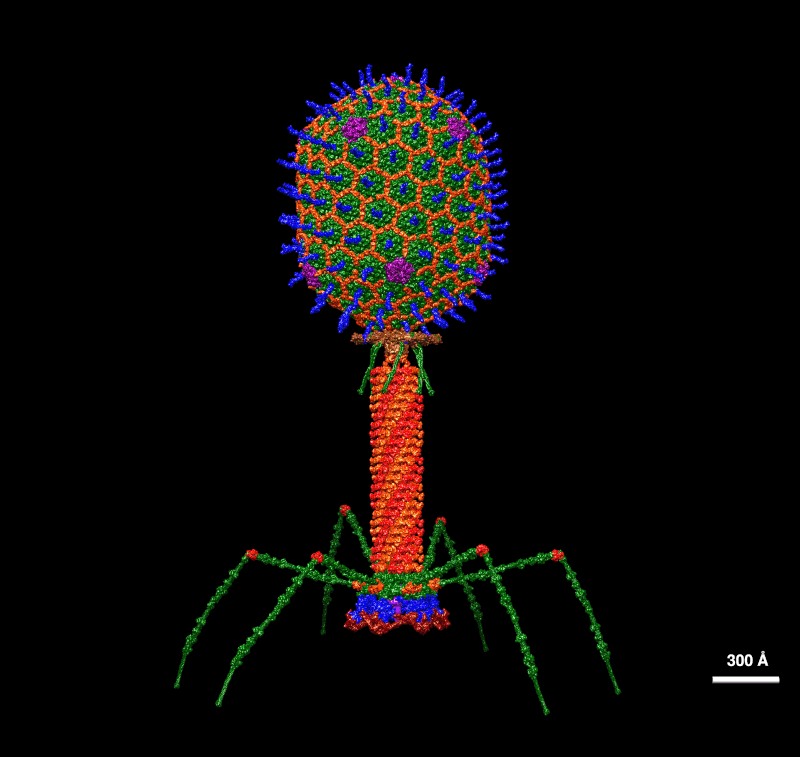
File:T4_Bacteriophage.gif · Wikimedia Commons · See Wikimedia Commons
bacteriophage
Sign in to saveAlso known as bacterial virus, bacteriophages, phage
thumb|Structure at atomic resolution of Escherichia virus T4|bacteriophage T4 right|thumb|The structure of a typical Myoviridae|myovirus bacteriophage thumb|Anatomy and infection cycle of Escherichia virus T4|bacteriophage T4.
A bacteriophage is a virus that infects and replicates inside bacteria by injecting its genetic material into bacterial cells. Bacteriophages are important because understanding their structure and infection cycles helps scientists study how viruses work and may lead to new ways to combat bacterial infections.
AI-generated from the Wikipedia summary — may contain errors.
In the Vinony graph
Within Vinony's link graph, bacteriophage is referenced by 989 other articles, and connects out to lysogenic cycle, Enterobacteria phage T4 and primary nutritional group.
It is catalogued under the topic Bacteriophages.
Its subject is documented across 70 Wikipedia language editions.
Research
85,027 papers- Bacteriophage Virus-Like Particles: Platforms for Vaccine Design.ReviewMethods in molecular biology (Clifton, N.J.) · 2024Tumban EDOI: 10.1007/978-1-0716-3549-0_24
- Mechanisms and clinical importance of bacteriophage resistance.ReviewFEMS microbiology reviews · 2022Egido JE, Costa AR, Aparicio-Maldonado C et al.DOI: 10.1093/femsre/fuab048
- Bacteriophage Production in Compliance with Regulatory Requirements.ReviewMethods in molecular biology (Clifton, N.J.) · 2024Pirnay JP, Merabishvili M, De Vos D et al.DOI: 10.1007/978-1-0716-3523-0_6
- Bacteriophage production processes.ReviewApplied microbiology and biotechnology · 2019Jurač K, Nabergoj D, Podgornik ADOI: 10.1007/s00253-018-9527-y
- Bacteriophage Receptor Recognition and Nucleic Acid Transfer.ReviewSub-cellular biochemistry · 2024van Raaij MJDOI: 10.1007/978-3-031-65187-8_17
- Bacteriophage's Dualism in Therapy.ReviewTrends in microbiology · 2019Krylov VN, Bourkaltseva MV, Pleteneva EADOI: 10.1016/j.tim.2019.05.001
- Guidelines to Compose an Ideal Bacteriophage Cocktail.ReviewMethods in molecular biology (Clifton, N.J.) · 2024Merabishvili M, Pirnay JP, De Vos DDOI: 10.1007/978-1-0716-3523-0_4
- Bacteriophage-Encoded DNA Polymerases-Beyond the Traditional View of Polymerase Activities.ReviewInternational journal of molecular sciences · 2022Morcinek-Orłowska J, Zdrojewska K, Węgrzyn ADOI: 10.3390/ijms23020635
via PubMed
Wikidata facts
- Subclass of
- virus
- Image
- PhageExterior.svg
- Has use
- phage therapy
Show 4 more facts
- discoverer or inventor
- Félix d'Hérelle
- topic's main category
- Category:Bacteriophages
- Commons category
- Bacteriophages
- Dewey Decimal Classification (works and editions)
- 579.26
via Wikidata · CC0
~34 min read
Encyclopedic overview
36 sectionsContents
- Classification
- History
- Nobel prizes awarded for phage research
- Uses
- Phage therapy
- Other
- Food industry
- Water indicators
- Diagnostics
- Counteracting bioweapons and toxins
- Bacterium sensing and identification
- Phage display
- Antimicrobial drug discovery
- Basic research
- Agriculture
- Detriments
- Dairy industry
- Replication
- Attachment and penetration
- Synthesis of proteins and nucleic acid
- Virion assembly
- Release of virions
- Communication
- Genome structure
- Systems biology
- Host resistance and anti-phage defense
- Bacteriophage–host symbiosis
- In the environment
- In humans
- Commonly studied bacteriophages
- Bacteriophage databases and resources
- See also
- Notes
- References
- Bibliography
- External links
thumb|Structure at atomic resolution of Escherichia virus T4|bacteriophage T4 right|thumb|The structure of a typical Myoviridae|myovirus bacteriophage thumb|Anatomy and infection cycle of Escherichia virus T4|bacteriophage T4.
A bacteriophage (), also known informally as a phage (), is a virus that infects and replicates within bacteria. The term is derived . Bacteriophages are composed of proteins that encapsulate a DNA or RNA genome, and may have structures that are either simple or elaborate. Their genomes may encode as few as four genes (e.g. MS2) and as many as hundreds of genes. Phages replicate within the bacterium following the injection of their genome into its cytoplasm.
Excerpted from Wikipedia’s “bacteriophage” article, available under the CC BY-SA 4.0 licence.
Gallery (351)
Available in 70 languages
- Español
- Français
- Deutsch
- 中文
- 日本語
- Русский
- Português
- Italiano
- العربية
- हिन्दी
- Armenian
- Azerbaijani
- Bahasa Indonesia
- Bangla
- Basque
- Belarusian
- Bosnian
- Bulgarian
Show 51 more
- Catalan
- Central Kurdish
- Croatian
- Czech
- Danish
- Esperanto
- Estonian
- Finnish
- Galician
- Georgian
- Greek
- Hebrew
- Hungarian
- Icelandic
- Irish
- Kannada
- Kazakh
- Kurdish
- Kyrgyz
- Latin
- Latvian
- Lithuanian
- Macedonian
- Mingrelian
- Nederlands
- Norwegian
- Norwegian Nynorsk
- Occitan
- Polski
- Punjabi
- Romanian
- Rusyn
- Serbian
- Serbian (Latin)
- simple
- Slovak
- Slovenian
- Svenska
- Swahili
- Tajik
- Tamil
- Tiếng Việt
- Türkçe
- Ukrainian
- Uzbek
- Wu Chinese
- zh_min_nan
- zh_yue
- فارسی
- ไทย
- 한국어
via Wikidata sitelinks · CC0