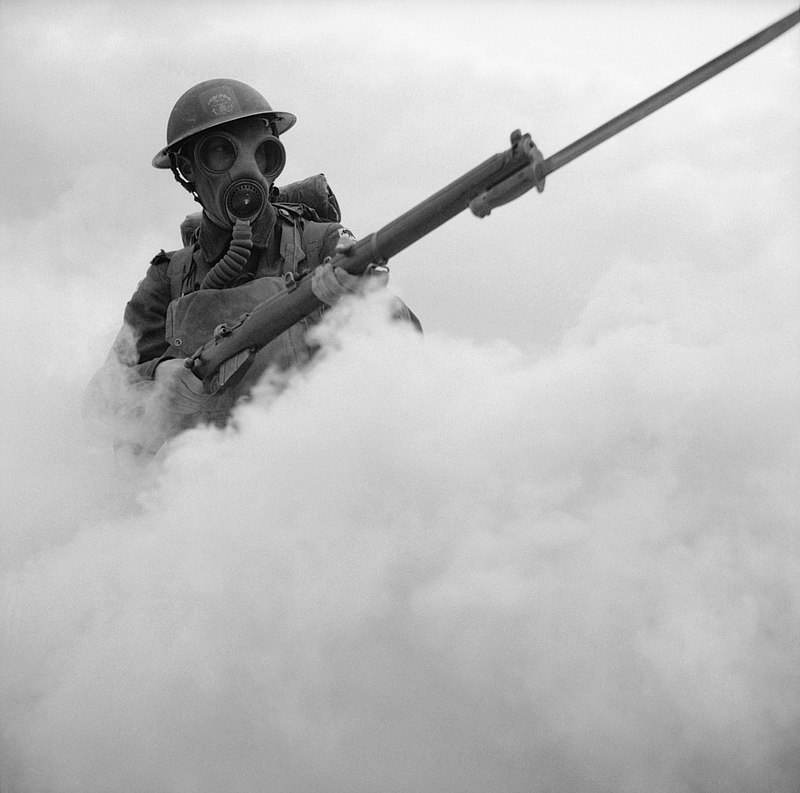
File:The_British_Army_in_Britain,_1941_H10633.jpg · Wikimedia Commons · See Wikimedia Commons
bayonet
Sign in to savethumb| British infantryman in 1941 with a Pattern 1907 bayonet affixed to his [[Lee–Enfield rifle]] A bayonet (from Old French , now spelt ) is a knife, dagger, sword, or spike-shaped melee weapon designed to be mounted on the end of the barrel of a rifle, carbine, musket or similar long firearm, allowing the gun to be utilized as a spear in close combat.
A bayonet is a knife, dagger, sword, or spike-shaped weapon that attaches to the end of a rifle barrel, turning the firearm into a spear for close-range fighting. It mattered historically because it allowed soldiers armed with guns to engage in hand-to-hand combat without needing a separate melee weapon.
AI-generated from the Wikipedia summary — may contain errors.
Wikidata facts
- Subclass of
- cold weapon
- Image
- US-Bajonette verschiedener Epochen.jpg
Show 5 more facts
- Commons category
- Bayonets
- topic's main category
- Category:Bayonets
- MCN code
- 9307.00.00
- time of discovery or invention
- 1700-00-00
- on focus list of Wikimedia project
- Wikipedia:Vital articles/Level/4
via Wikidata · CC0
~42 min read
Encyclopedic overview
33 sectionsContents
- History
- Plug bayonets
- Socket bayonets
- Sword bayonets
- Multipurpose bayonets
- Contemporary bayonets
- Photo gallery
- Linguistic impact
- Badges and insignias
- Bayonet charge
- Napoleonic wars
- American Civil War
- Going over the top
- Banzai charges
- Human wave attack
- Modern usage
- Usage
- "Reach" controversy
- Reversal in opinion
- Current deployments
- Soviet Union
- United States
- People's Republic of China
- Belgium
- United Kingdom
- Germany
- Austria
- France
- See also
- References
- Bibliography
- Further reading
- External links
thumb| British infantryman in 1941 with a Pattern 1907 bayonet affixed to his [[Lee–Enfield rifle]] A bayonet (from Old French , now spelt ) is a knife, dagger, sword, or spike-shaped melee weapon designed to be mounted on the end of the barrel of a rifle, carbine, musket or similar long firearm, allowing the gun to be utilized as a spear in close combat.
The term is derived from the town of Bayonne in southwestern France, where bayonets were supposedly first used by Basques in the 17th century. From the early 17th to the early 20th century, it was an infantry melee weapon used for both offensive and defensive tactics, usually when charging in mass formations (human wave attacks). In contemporary times, bayonets are considered a weapon of last resort and are rarely used in combat, although they are still used regularly for non-combat purposes such as military parades, crowd control and as utility knives.
Excerpted from Wikipedia’s “bayonet” article, available under the CC BY-SA 4.0 licence.
Gallery (52)
Available in 70 languages
- Español
- Français
- Deutsch
- 中文
- 日本語
- Русский
- Português
- Italiano
- العربية
- हिन्दी
- Afrikaans
- Albanian
- Armenian
- Asturian
- Azerbaijani
- Bahasa Indonesia
- Bangla
- Bashkir
Show 51 more
- Basque
- be_x_old
- Belarusian
- Bosnian
- Breton
- Bulgarian
- Catalan
- Croatian
- Czech
- Danish
- Esperanto
- Estonian
- Finnish
- Galician
- Greek
- Hebrew
- Hungarian
- Ido
- Irish
- Javanese
- Lithuanian
- Lombard
- Macedonian
- Malay
- Malayalam
- Nederlands
- Norwegian
- Norwegian Nynorsk
- Occitan
- Piedmontese
- Polski
- Romanian
- Scottish Gaelic
- Serbian
- Serbian (Latin)
- Silesian
- simple
- Slovenian
- Svenska
- Tamil
- Tiếng Việt
- Türkçe
- Ukrainian
- Urdu
- Welsh
- Wu Chinese
- Yakut
- zh_yue
- فارسی
- ไทย
- 한국어
via Wikidata sitelinks · CC0