
OverviewAI-generated
Belize is a sovereign state and country in North America, specifically located in the subregion of Central America. Its capital is Belmopan, and it shares borders with Guatemala and Mexico. The country is a member of the United Nations, the Commonwealth of Nations, the World Trade Organization, and the Caribbean Community. It is also a Commonwealth realm with Charles III and Elizabeth II as heads of state.
The official language is English, and the currency is the Belize dollar. The highest point in the country is Doyle's Delight. Belize contains administrative entities including the Belize District, Cayo District, Corozal District, and Orange Walk District. The population is recorded as 417,634, with an area of 22,966. The legislative body is the National Assembly.
Belize uses the top-level Internet domain .bz and the telephone country code +501. It is located in the UTC−06:00 time zone. The country has a forest area percentage of 54.5186321788689 and an urban population percentage of 41.7532107338224. Its life expectancy is 73.739 years, and the unemployment rate is 8.856 percent.
Synthesized by Vinony from 67 facts across 9 sources: Wikidata, REST Countries, Openweathermap, Open Meteo, World Bank, OpenStreetMap, PubMed, Vinony graph, Geo. Generated from structured data (not the Wikipedia text) and checked against those facts — may still contain errors.
In the Vinony graph
Belize appears in Vinony's Countries collection — one of 215 entries.
Vinony's link graph records 8,068 inbound references to Belize, and connects out to Garifuna, Geography of Belize and Yucatec Maya.
The entry is geolocated on the map in city_region, across 60 mapped points.
It is catalogued under topics including Belize, Countries and territories where English is an official language and Countries in Central America.
Weather now
cached 3h ago7-day forecast
via Open-Meteo
Country
- Capital
- Belmopan
- Population
- 417,634
- Region
- Americas · Central America
- Demonym
- Belizean
- Currencies
- BZD ($)
- Languages
- Belizean Creole, English, Spanish
- Calling code
- +501
- Drives on
- Right
- Gini
- 53.3 (1999)
- FIFA code
- BLZ
- TLD
- .bz
- Timezones
- UTC-06:00
- Borders
- GTM, MEX
via REST Countries
Indicators · World Bank
- GDP
- $3.2B(2024)
- Population
- 417,072(2024)
- Life expectancy
- 73.7 yrs(2024)
- Unemployment
- 8.9 %(2025)
- Urban population
- 41.8 %(2024)
- Internet users
- 80 %(2024)
- Forest area
- 54.5 %(2023)
- Renewable energy
- 30.8 %(2022)
via World Bank Open Data · CC BY 4.0
Wikipedia views (30d)
117,216 totalvia Wikimedia Pageviews API
Key facts
- Country.conventional_long_name
- Belize
- Country.common_name
- Belize
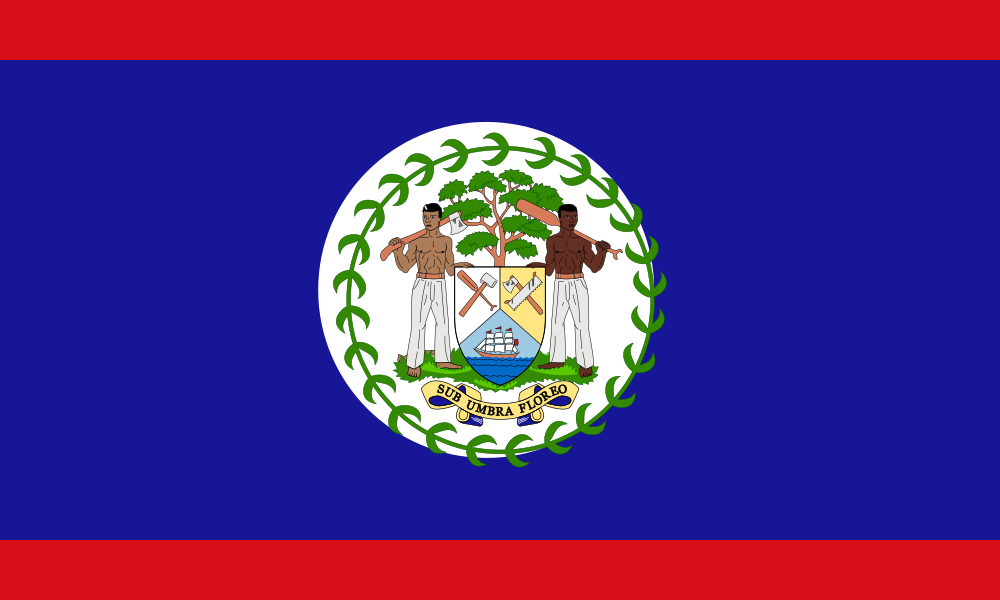
- Country.image_flag
- Flag of Belize.svg
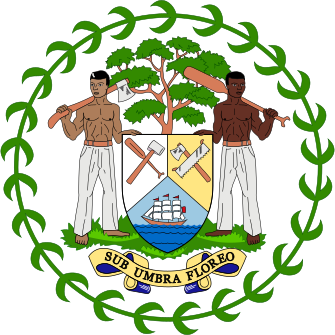
- Country.image_coat
- Coat of arms of Belize.svg
- Country.symbol_type
- Coat of arms
- Country.national_motto
- "Under the shade I flourish"
- Country.royal_anthem
- "God Save the King"File:United States Navy Band - God Save the King.oga
- Country.national_anthem
- "Land of the Free"
- Country.capital
- Belmopan
- Country.largest_city
- Belize City
- Country.official_languages
- English
- Country.religion
- 61.9% Christianity 31.8% no religion 6.3% other
- Country.religion_year
- 2022
- Country.demonym
- Belizean
- Country.government_type
- Unitary parliamentary constitutional monarchy
- Country.leader_title1
- Monarch
- Country.leader_title2
- Governor-General
- Country.leader_name2
- Froyla Tzalam
via Wikipedia infobox
Research
1,490 papers- Belize.Department of State publication. Background notes series · 1987United States. Department of State. Bureau of Public Affairs
- Malaria eliminated in Belize.The Lancet. Microbe · 2023Venkatesan PDOI: 10.1016/S2666-5247(23)00251-3
- Cancer Demographics and Time-to-Care in Belize.The oncologist · 2023Wong W, Dickerson JC, Valtis YK et al.DOI: 10.1093/oncolo/oyad030
- Traditional therapies of Belize.ReviewBritish journal of nursing (Mark Allen Publishing) · 2003Walsh RDOI: 10.12968/bjon.2003.12.Sup1.11253
- La farmacia.Annals of emergency medicine · 2004Glazer JLDOI: 10.1016/j.annemergmed.2004.05.020
- Healing practices of the people of Belize.ReviewHolistic nursing practice · 2001Blanchard DS, Bean ADOI: 10.1097/00004650-200101000-00010
- Coral Gardens Reef, Belize: An Acropora spp. refugium under threat in a warming world.PloS one · 2023Greer L, Curran HA, Wirth K et al.DOI: 10.1371/journal.pone.0280852
- Voices of those living with type 2 diabetes in Belize: barriers to care before and during the COVID-19 pandemic.International journal for equity in health · 2023Allen LP, Ellis L, Engleton C et al.DOI: 10.1186/s12939-023-01987-3
via PubMed
Wikidata facts
- Instance of
- sovereign state
- Named after
- Belize River
- Official name
- Belize
- Demonym
- بيليزية
- Country
- Belize
- Contains
- Toledo District
- Continent
- North America
- Capital
- Belmopan
- Official language
- English language
- Currency
- Belize dollar
- Population
- 411106
- Area
- 22966
- Head of government
- Manuel Esquivel
- Head of state
- Elizabeth II
- Form of government
- parliamentary monarchy
- Legislature
- National Assembly
- Anthem
- God Save the King
- Shares border with
- Guatemala
- Highest point
- Doyle's Delight
- Follows
- British Honduras
- Official website
- www.belize.gov.bz
- Image
- Belize Topography.png
- Life expectancy
- 71
Show 58 more facts
- Nominal GDP
- 3066850000
- Unemployment rate
- 12
- Calling code
- +501
- Licence plate code
- BH
- Electrical plug type
- BS 1363
- Mains voltage
- 220
- Motto
- Mother Nature's Best-Kept Secret
- Flag
- flag of Belize
- Coat of arms
- coat of arms of Belize
- topic's main Wikimedia portal
- Portal:Belize
- top-level Internet domain
- .bz
- Commons category
- Belize
- topic's main category
- Category:Belize
- inception
- 1981-09-21
- category for people born here
- Category:Births in Belize
- category for films shot at this location
- Category:Films shot in Belize
- diplomatic relation
- Kosovo
- history of topic
- history of Belize
- IPA transcription
- bɛˈliːs
- Commons gallery
- Belize
- lowest point
- Caribbean Sea
- driving side
- right
- geography of topic
- Geography of Belize
- described by source
- New International Encyclopedia
- central bank
- Central Bank of Belize
- mobile country code
- 702
- marriageable age
- 18
- language used
- Yucatec Maya
- number of out-of-school children
- 11080
- has characteristic
- free country
- total fertility rate
- 2.579
- maritime identification digits
- 312
- category of associated people
- Category:Belizean people
- Unicode character
- 🇧🇿
- literacy rate
- 70
- suicide rate
- 5.5
- VAT rate
- 12.5
- economy of topic
- economy of Belize
- demographics of topic
- demographics of Belize
- native label
- Belize
- different from
- Belize
- Human Development Index
- 0.683
- P11012
- vanadium
- hashtag
- Belize
- on focus list of Wikimedia project
- Wikipedia:Vital articles/Level/4
- Gini coefficient
- 53.3
- Inequality-adjusted Human Development Index
- 0.535
- P12749
- Cansano
- birth rate
- 17.763
- male population
- 203747
- death rate
- 6.253
- rural population
- 217242
- female population
- 201525
- urban population
- 188030
- Commonwealth Sport country code
- BIZ
- located in/on physical feature
- Caribbean
Sources (15)
via Wikidata · CC0
Travel guide
Understand
Belize, formerly British Honduras, is the only country in Central America without a coastline on the Pacific Ocean (only the Caribbean Sea to its east). With its British colonial history and a long Caribbean coast, it's culturally similar to many of Britain's former West Indian island colonies, with a majority creole or Afro-Caribbean population. But it also includes a large native Mayan population, especially in the north and northwest of the country. As a result, although English is the official language, Spanish is also often spoken. In the south east along the Caribbean coast live the Garifuna (Black Caribs), an Afro-Amerindian culture.
After long journeys starting in what is now the Netherlands in 1790, via Germany, Southern Russia, Canada, the United States, and Mexico, several thousand German-speaking Mennonite Christians arrived in Belize in 1958 after long and detailed discussions with the government regarding specific exemptions and privileges. They are easily recognizable by their speech (somewhat distinctive from modern standard German) and "quaint" dress.
Marine tourism is the cornerstone of Belize's economy, driven primarily by the Belize Barrier Reef, the second-largest coral reef system in the world and a UNESCO World Heritage Site. Key local marine attractions are primarily accessed via the Northern Cayes or the Southern Peninsula.
Get in
thumb|450px|Visa free entry = countries marked in blue
Get around
thumb|The Hummingbird Highway Belize is a fairly small country, and transportation between most destinations is rarely long or tedious.
See
thumb|St.John's cathedral in Belize City The Belize Barrier Reef is a scuba diving paradise, rich in aquatic life including colorful tropical fish, rays, and sharks (along with a couple of shipwrecks). The reef stretches along the whole coast of Belize. It is part of the Great Mesoamerican Reef System, often called the Mayan Reef, which stretches north to the tip of the Yucatan Peninsula in Mexico and south along the coasts of Guatemala and Honduras. Numerous dive shops in coastal towns can arrange escursions to dive sites on the reef. Mayan archaeological sites in Belize tend to be less crowded than the well-known sites in neighboring Mexico and Guatemala, but the smaller crowds make the sites more tranquil and easier to explore. Some of the sites are among the oldest of the Maya civilization. Significant sites include: Lamanai - one of the oldest Mayan cities, established around 1600 B.C., much of the ruins seen today were built in the late Pre-Classic period (arouind 400 BC to 100 AD). Unlike many Mayan cities, it was not abandoned in the 10th century AD, nor in the period following the Spanish conquest or the British occupation, and continued to be occupied by the Maya up to the 20th century. Xunantunich - large site in Western Belize on the Mopan River near the Guatemala border. The site is known for its myriad plazas and temples and a 133 meter tall pyramid (second highest in Belize). Altun Ha - was a ceremonial site constructed in the Pre-Classic era with the oldest st…
Buy
The currency of Belize is the dollar (ISO code BZD), divided into 100 cents.
The Belizean dollar — sometimes written as "BZ$" or just as a dollar sign: "$" — has been fixed to the US dollar (USD) at a 2:1 ratio since 1978 (i.e. BZ$2 = US$1).
Because of this consistent exchange rate, US dollars are widely accepted, but you should be careful to clarify which "dollars" you're talking about when negotiating prices. It's often better to assume Belize dollars because many merchants will jump on your uncertainty and attempt to double their price by saying, "No, in US dollars". Change can also be given in US dollars or a combination of US and Belizean dollar bills and coins. Belize dollars come in denominations of BZ$2, 5, 10, 20, 50, and 100. Coins in Belize are issued in denominations of 1, 5, 10, 25 and 50 cents and B$1. The 25-cents coin is often called a shilling.
Three banks' ATMs in Belize accept Mastercard: the Belize Bank, Scotiabank, and Atlantic Bank. Atlantic Bank offers free cash withdrawals with Visa.
Eat
thumb|Traditional Belizean breakfast The primary meal found virtually everywhere is red beans, clean rice, and chicken. Most chicken in the country is prepared and served on the bone. Rice and beans is a mixed dish with some spices and usually coconut milk added to make a sweet and hot staple of the Belizean diet. Beans and rice is white cooked rice with a side of stewed pinto beans. Citrus plantations are numerous, so fresh oranges and grapefruit are abundant. Pineapples, papayas, bananas and plantains are also grown and sold in roadside markets. A famous hot sauce in Belize is Marie Sharp's made from the very spicy local habanero pepper. It comes in a variety of flavours (mild, hot, extremely hot). That odd looking salsa on your table is really ceviche. Ceviche -also spelled as cebiche or seviche- is a citrus-marinated seafood dish. The Belizeans use fresh raw conch and vegetables. Papusas are maize pancakes with different toppings sold in stalls on the streets in San Pedro town. It is the cheapest option if you want to eat on a budget. "Beef Patty" or "Chicken Patty" is very similar to a British pasty or an American hand pie Both Tamales and Bollos can be found as street food. They are very similar, but bollos use a courser grained corn mix. Both of them often include a piece of chicken inside the tamale/bollo - typically still on the bone; eat carefully! Garnaches, Salbutes, Panades, and Tostadas are all corn-based street foods - try them each to find your favorite Fry J…
Drink
Belikin is the national beer and comes in four varieties: Premium, Beer, Stout, and Lighthouse Lager. Guinness Stout is also available in Belize but it's also brewed by the Belikin Brewing Co. All are sold in returnable bottles, so make sure you are aware of the deposit if you are taking your beverages to go.
One Barrel Rum is the locally distilled molasses-tasting rum and Traveller's Liquors' distillery is on the Northern Highway about 6 miles from Belize City with a gift shop and hospitality bar. You can purchase rum in a variety of colours and sizes, up to a 70-gallon cask.
Both are widely available around the country. But if you also like wine there is cashew wine (which is very popular in Belize), ginger wine, sorrel wine and blackberry wine.
Stay safe
Belize City is the most dangerous area in Belize, although it's very easy to be safe there. Remain in the tourist zone that runs just north of the marina to the southern extension to the east of the main canal. There are plenty of khaki tourist police monitoring the area and, should you have a problem, feel free to approach them. Just exercise common sense and do not go wandering around alone after dark. Stay near tourist areas or other commercial zones. The south side of Belize City is beautiful as well as dangerous. Otherwise, Belize City is a great place to go if you want to eat, learn, or shop.
Other areas of Belize are generally safe, but like any other place in the world, one should always have some skepticism when dealing with strangers. Most are genuinely helpful, but it never hurts to be cautious.
By law, the government can deny LGBT travellers entry to Belize. There are also no legal protections in place for victims of anti-gay discrimination.
Stay healthy
Belize is a relatively healthy country. Bottled water is a must in most areas. And, unless you eat only at ultra-touristic restaurants, travellers' diarrhea will probably strike at some point; be prepared with over-the-counter medication and prescription antibiotics.
The WHO declared Belize malaria-free in 2023, and anti-malarial drugs are no longer recommended. However, bite prevention remains essential. Dengue fever and Zika are both risks in Belize. Other drugs may also be recommended in certain circumstances - consult a qualified professional specialist.
Insect/mosquito bites should be prevented with appropriate clothing, repellents and insecticides, and bed nets if sleeping in non-air-con/unscreened rooms.
The sun, as anywhere else in the tropics, is very intense. Wear a long-sleeve shirt, a hat, and sunglasses, and apply high-SPF sunscreen regularly. If you are spending significant time on boats or in water, such as fishing or snorkeling, take extra precautions: covered shoes (not sandals), swim shirt/rash guard, neck gaiter, and sun gloves.
Many places in Belize are very hot and humid, and dehydration is a risk. An expat suggests to drink as much water as you want, and then drink that much again.
The adult HIV/AIDS prevalence rate is 2.5% or one in every forty adults, this is notably higher than in most of Europe or Anglo-America and also quite a bit higher than in other parts of Central America like Nicaragua or Costa Rica.
Respect
Belizeans are some of the most socially relaxed people in the world, especially if you venture inland away from the tourist islands of Ambergris Caye and Caye Caulker. The pace of life is generally slower in Belize, so it's good practice to begin any social interaction, even to ask a quick question, with eye contact and a genuinely pleasant greeting. Most rural Belizeans enjoy casual conversation and you could easily find yourself chatting for a few hours.
The Maya communities can be a little more reserved at times. As always, a little respect and politeness will carry you through.
Travel guide from Wikivoyage (CC BY-SA 4.0)
Article · Italiano
Il Belize o Belise è uno Stato indipendente dell'America centro-settentrionale che si estende per 22966 km² con una popolazione di 377968 abitanti (stimati nel luglio 2016). La sua capitale è Belmopan. Confina a nord con il Messico, a est si affaccia sul mar dei Caraibi e sul golfo dell'Honduras, a sud e ovest confina con il Guatemala. Un tempo colonia con il nome di Honduras britannico, è indipendente dal 1981 ma è amministrativamente uno dei quindici reami del Commonwealth e il suo capo di Stato è il sovrano del Regno Unito Re Carlo III. La lingua ufficiale è l'inglese.
Abstract from DBpedia / Wikipedia · CC BY-SA
Gallery (639)
On the map
60 mapped locations
Available in 247 languages
- Español
- Français
- Deutsch
- 中文
- 日本語
- Русский
- Português
- Italiano
- العربية
- हिन्दी
- Abkhazian
- abstract
- Achinese
- Adyghe
- Afrikaans
- Albanian
- Albanian
- Amharic
Show 228 more
- ami
- Angika
- Aragonese
- Armenian
- Arpitan
- Asturian
- Aymara
- azb
- Azerbaijani
- Bahasa Indonesia
- Balinese
- Bambara
- Bangla
- Bashkir
- Basque
- bat_smg
- Batak Toba
- Bavarian
- be_x_old
- Belarusian
- Betawi
- Bhojpuri
- Bikol
- Bishnupriya
- Bislama
- Bosnian
- Breton
- Bulgarian
- Buriat
- Burmese
- Catalan
- cbk_zam
- cdo
- Cebuano
- Central Kurdish
- Chechen
- Cherokee
- Chuvash
- Cornish
- Corsican
- Crimean Tatar
- Croatian
- Czech
- dag
- Danish
- Divehi
- dty
- Dzongkha
- Egyptian Arabic
- Erzya
- Esperanto
- Estonian
- Ewe
- Extremaduran
- Faroese
- Fiji Hindi
- Filipino
- Finnish
- fiu_vro
- Gagauz
- Galician
- gcr
- Georgian
- Gilaki
- Goan Konkani
- Greek
- Guarani
- Gujarati
- Haitian Creole
- Hakka Chinese
- Hausa
- Hebrew
- Hungarian
- hyw
- Icelandic
- Ido
- Iloko
- Inari Sami
- Interlingua
- Interlingue
- Irish
- Jamaican Creole English
- Javanese
- Kabyle
- Kannada
- Kara-Kalpak
- Karachay-Balkar
- Kashmiri
- Kashubian
- Kazakh
- kbp
- Kinyarwanda
- Kotava
- Kurdish
- Kyrgyz
- Ladino
- Lao
- Latin
- Latvian
- Ligurian
- Limburgish
- Lingala
- Lingua Franca Nova
- Lithuanian
- lld
- Lojban
- Lombard
- Low German
- Lower Sorbian
- Luxembourgish
- Macedonian
- Madurese
- Maithili
- Malagasy
- Malay
- Malayalam
- Maltese
- Manipuri
- Manx
- Māori
- map_bms
- Marathi
- Mari
- Mazanderani
- Minangkabau
- Mingrelian
- Moksha
- Mongolian
- Moroccan Arabic
- nds_nl
- Neapolitan
- Nederlands
- Nepali
- Newari
- Northern Frisian
- Northern Sami
- Norwegian
- Norwegian Nynorsk
- Novial
- nup
- Occitan
- Odia
- Old English
- olo
- Oromo
- Ossetic
- Pampanga
- Papiamento
- Pashto
- Picard
- Piedmontese
- Polski
- ppl
- Punjabi
- Quechua
- roa_rup
- Romanian
- Romansh
- Rusyn
- Samoan
- Sanskrit
- Santali
- Sardinian
- Saterland Frisian
- Scots
- Scottish Gaelic
- Serbian
- Serbian (Latin)
- Shan
- Shona
- Sicilian
- Silesian
- simple
- Sindhi
- Sinhala
- Slovak
- Slovenian
- Somali
- Standard Moroccan Tamazight
- Sundanese
- Svenska
- Swahili
- Swati
- szy
- Tachelhit
- Tajik
- Talysh
- Tamil
- Taroko
- Tatar
- tay
- Telugu
- Tetum
- Tibetan
- Tiếng Việt
- Toki Pona
- Tongan
- Türkçe
- Turkmen
- Udmurt
- Ukrainian
- Upper Sorbian
- Urdu
- Uyghur
- Uzbek
- Venetian
- Veps
- Volapük
- Waray
- Welsh
- Western Frisian
- Western Mari
- Western Panjabi
- Wolof
- Wu Chinese
- Yakut
- Yiddish
- Yoruba
- Zaza
- Zeelandic
- zh_classical
- zh_min_nan
- zh_yue
- Zhuang
- Zulu
- فارسی
- ไทย
- 한국어
via Wikidata sitelinks · CC0