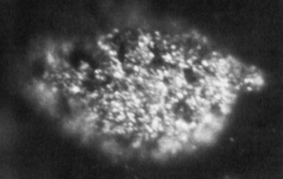
File:Berkelium_metal.jpg · Wikimedia Commons · See Wikimedia Commons
berkelium
Sign in to saveAlso known as Bk, element 97, 97Bk
Berkelium is a synthetic chemical element; it has symbol Bk and atomic number 97. It is a member of the actinide and transuranium element series. It is named after the city of Berkeley, California, the location of the Lawrence Berkeley National Laboratory (then the University of California Radiation Laboratory) where it was discovered in December 1949. Berkelium was the fifth transuranium element discovered after neptunium, plutonium, curium and americium.
OverviewAI-generated
Berkelium is a chemical element with the symbol Bk and atomic number 97. It was discovered in 1949. The element has an electronegativity of 1.3 and an ionic radius of 0.96. Its canonical SMILES representation is [Bk], and it is associated with the Unicode character 鉳.
The substance has a chemical formula of Bk and a molecular weight of 247.07031. It possesses zero hydrogen bond donors and acceptors, with a topological polar surface area of 0 and a charge of 0. In academic literature, the term "berkelium" appears in 36 PubMed records. Additionally, the subject is referenced by 680 other encyclopedia articles.
Synthesized by Vinony from 22 facts across 4 sources: Wikidata, PubChem, PubMed, Vinony graph. Generated from structured data (not the Wikipedia text) and checked against those facts — may still contain errors.
Chemical data
- Formula
- Bk
- Molecular weight
- 247.07031 g/mol
- IUPAC name
- berkelium
- SMILES
- [Bk]
- InChIKey
- PWVKJRSRVJTHTR-UHFFFAOYSA-N
- Polar surface area
- 0 Ų
- H-bond donors
- 0
- H-bond acceptors
- 0
- Formal charge
- 0
via PubChem
Research
36 papers- Contemporary Chemistry of Berkelium and Californium.ReviewChemistry (Weinheim an der Bergstrasse, Germany) · 2019White FD, Dan D, Albrecht-Schmitt TEDOI: 10.1002/chem.201900586
- Berkelium-carbon bonding in a tetravalent berkelocene.Science (New York, N.Y.) · 2025Russo DR, Gaiser AN, Price AN et al.DOI: 10.1126/science.adr3346
- Spectroscopic Characterization of Tetravalent Berkelium.Angewandte Chemie (International ed. in English) · 2026Woods JJ, Wacker JN, Gunther SO et al.DOI: 10.1002/anie.202513479
- Transient Radiation-Induced Berkelium(III) and Californium(III) Redox Chemistry in Aqueous Solution.Inorganic chemistry · 2022Horne GP, Rotermund BM, Grimes TS et al.DOI: 10.1021/acs.inorgchem.2c01106
- Peaceful berkelium.Nature chemistry · 2017Trabesinger ADOI: 10.1038/nchem.2845
- Chelation and stabilization of berkelium in oxidation state +IV.Nature chemistry · 2017Deblonde GJ, Sturzbecher-Hoehne M, Rupert PB et al.DOI: 10.1038/nchem.2759
- Creation of an unexpected plane of enhanced covalency in cerium(III) and berkelium(III) terpyridyl complexes.Nature communications · 2021Gaiser AN, Celis-Barros C, White FD et al.DOI: 10.1038/s41467-021-27576-y
- Electronic Structure and Properties of Berkelium Iodates.Journal of the American Chemical Society · 2017Silver MA, Cary SK, Garza AJ et al.DOI: 10.1021/jacs.7b05569
via PubMed
Wikidata facts
- Instance of
- synthetic element
- Part of
- actinide
- Named after
- Berkeley
- Image
- Berkelium metal.jpg
Show 17 more facts
- topic's main category
- Category:Berkelium
- atomic number
- 97
- element symbol
- Bk
- Commons category
- Berkelium
- discoverer or inventor
- Stanley Gerald Thompson
- time of discovery or invention
- 1949-01-01
- location of discovery
- University of California, Berkeley
- Commons gallery
- Berkelium
- described by source
- Armenian Soviet Encyclopedia
- canonical SMILES
- [Bk]
- chemical formula
- Bk
- Unicode character
- 鉳
- electronegativity
- 1.3
- different from
- Berkel
- ionic radius
- 0.93
- on focus list of Wikimedia project
- Wikipedia:Vital articles/Level/4
- topic has template
- Template:Infobox berkelium
Sources (6)
via Wikidata · CC0
~30 min read
Encyclopedic overview
22 sectionsContents
- Characteristics
- Physical
- Allotropes
- Chemical
- Isotopes
- Occurrence
- History
- Synthesis and extraction
- Preparation of isotopes
- Separation
- Bulk metal preparation
- Compounds
- Oxides
- Halides
- Other inorganic compounds
- Organoberkelium compounds
- Applications
- Nuclear fuel cycle
- Health issues
- References
- Bibliography
- External links
Berkelium is a synthetic chemical element; it has symbol Bk and atomic number 97. It is a member of the actinide and transuranium element series. It is named after the city of Berkeley, California, the location of the Lawrence Berkeley National Laboratory (then the University of California Radiation Laboratory) where it was discovered in December 1949. Berkelium was the fifth transuranium element discovered after neptunium, plutonium, curium and americium.
The major isotope of berkelium, 249Bk, is synthesized in minute quantities in dedicated high-flux nuclear reactors, mainly at the Oak Ridge National Laboratory in Tennessee, United States, and at the Research Institute of Atomic Reactors in Dimitrovgrad, Russia. The longest-lived and second-most important isotope, 247Bk, can be synthesized via irradiation of 244Cm with high-energy alpha particles.
Excerpted from Wikipedia’s “berkelium” article, available under the CC BY-SA 4.0 licence.
Gallery (163)
Available in 132 languages
- Español
- Français
- Deutsch
- 中文
- 日本語
- Русский
- Português
- Italiano
- العربية
- हिन्दी
- Afrikaans
- Albanian
- Amharic
- Angika
- Armenian
- Asturian
- Azerbaijani
- Bahasa Indonesia
Show 113 more
- Balinese
- Bangla
- Basque
- be_x_old
- Belarusian
- Bhojpuri
- Bosnian
- Breton
- Bulgarian
- Burmese
- Catalan
- cdo
- Cebuano
- Central Kurdish
- Chuvash
- Cornish
- Corsican
- Croatian
- Czech
- Danish
- Egyptian Arabic
- Esperanto
- Estonian
- Faroese
- Fiji Hindi
- Filipino
- Finnish
- Friulian
- Galician
- Georgian
- Greek
- Gujarati
- Haitian Creole
- Hakka Chinese
- Hebrew
- Hungarian
- Icelandic
- Ido
- Interlingua
- Irish
- Javanese
- Kalmyk
- Kannada
- Kazakh
- Komi
- Kyrgyz
- Latin
- Latvian
- Ligurian
- Limburgish
- Lithuanian
- Lojban
- Luxembourgish
- Macedonian
- Malay
- Malayalam
- Manx
- Marathi
- Mongolian
- Moroccan Arabic
- Nederlands
- Newari
- Northern Frisian
- Norwegian
- Norwegian Nynorsk
- Novial
- Odia
- olo
- Pashto
- Piedmontese
- Polski
- Punjabi
- Quechua
- roa_rup
- Romanian
- Sanskrit
- Sardinian
- Saterland Frisian
- Scottish Gaelic
- Serbian
- Serbian (Latin)
- Sicilian
- simple
- Slovak
- Slovenian
- Sundanese
- Svenska
- Swahili
- Tajik
- Tamil
- Tatar
- Telugu
- Tiếng Việt
- Türkçe
- Ukrainian
- Urdu
- Uyghur
- Uzbek
- Veps
- Waray
- Welsh
- Western Mari
- Western Panjabi
- Wu Chinese
- Yakut
- Yoruba
- zh_classical
- zh_min_nan
- zh_yue
- Zulu
- فارسی
- ไทย
- 한국어
via Wikidata sitelinks · CC0