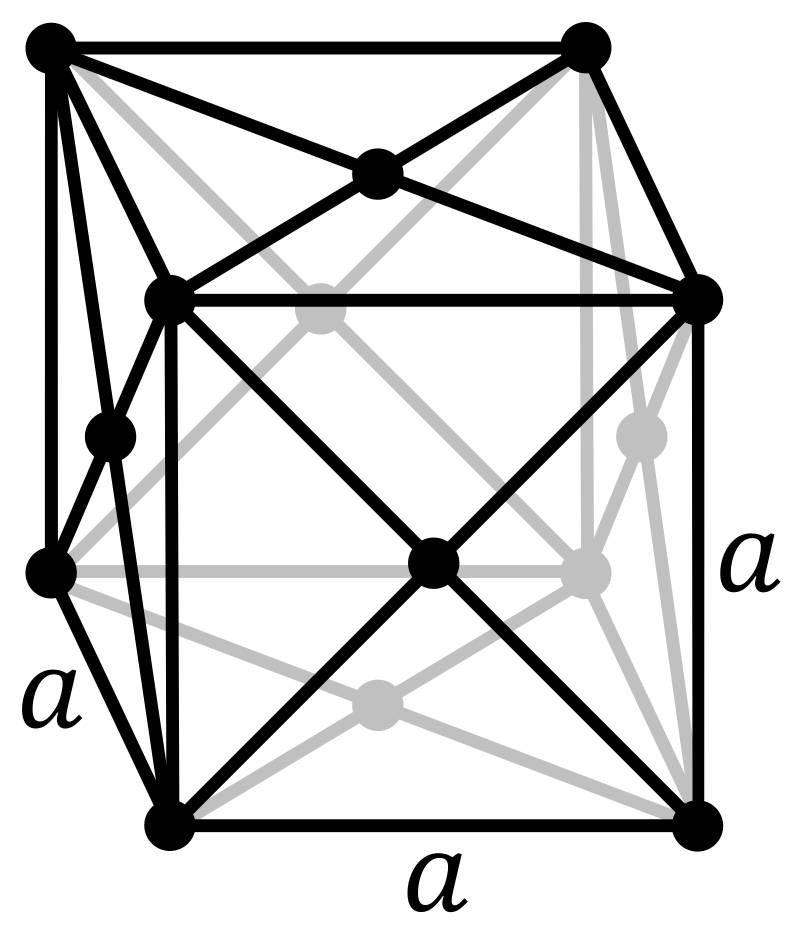
File:Cubic-face-centered.svg · Wikimedia Commons · See Wikimedia Commons
oganesson
Sign in to saveAlso known as Og, element 118, eka-radon, ununoctium, Uuo
Oganesson is a synthetic chemical element; it has symbol Og and atomic number 118. It was first synthesized in 2002 at the Joint Institute for Nuclear Research (JINR) in Dubna, near Moscow, Russia, by a joint team of Russian and American scientists. In December 2015, it was recognized as one of four new elements by the Joint Working Party of the international scientific bodies IUPAC and IUPAP. It was formally named on 28 November 2016. The name honors the nuclear physicist Yuri Oganessian, who played a leading role in the discovery of the heaviest elements in the periodic table.
Oganesson is a human-made chemical element (symbol Og, atomic number 118) that was first created in 2002 by Russian and American scientists at a research institute in Russia. It was officially recognized and named in 2015-2016 in honor of nuclear physicist Yuri Oganessian, who made major contributions to discovering the heaviest elements on the periodic table.
AI-generated from the Wikipedia summary — may contain errors.
Wikidata facts
- Instance of
- synthetic element
- Subclass of
- transactinide element
- Part of
- noble gases
- Named after
- Yuri Oganessian
Show 16 more facts
- Unicode character
- 鿫
- has characteristic
- radioactivity
- electron configuration
- [Rn] 5f¹⁴ 6d¹⁰ 7s² 7p⁶
- element symbol
- Uuo
- Commons category
- Oganesson
- topic's main category
- Category:Oganesson
- Commons gallery
- Oganesson
- atomic number
- 118
- time of discovery or invention
- 2002-06-00
- discoverer or inventor
- Joint Institute for Nuclear Research
- ionization energy
- 1560000
- oxidation state
- 6
- density
- 4.9
- boiling point
- 80
- molar fusion enthalpy
- 23501
- on focus list of Wikimedia project
- Wikipedia:Vital articles/Level/4
via Wikidata · CC0
~25 min read
Encyclopedic overview
17 sectionsContents
- Introduction
- History
- Early speculation
- Unconfirmed discovery claims
- Discovery reports
- Confirmation
- Naming
- Characteristics
- Nuclear stability and isotopes
- Calculated atomic and physical properties
- Predicted compounds
- See also
- Notes
- References
- Bibliography
- Further reading
- External links
Oganesson is a synthetic chemical element; it has symbol Og and atomic number 118. It was first synthesized in 2002 at the Joint Institute for Nuclear Research (JINR) in Dubna, near Moscow, Russia, by a joint team of Russian and American scientists. In December 2015, it was recognized as one of four new elements by the Joint Working Party of the international scientific bodies IUPAC and IUPAP. It was formally named on 28 November 2016. The name honors the nuclear physicist Yuri Oganessian, who played a leading role in the discovery of the heaviest elements in the periodic table.
Oganesson has the highest atomic number and highest atomic mass of all known elements. On the periodic table of the elements it is a p-block element, a member of group 18, and the last member of period 7. Its only known isotope, oganesson-294, is highly radioactive, with a half-life of 0.7 ms. This half-life is too short for chemical studies. Because of relativistic effects, theoretical studies predict that it would be a solid at room temperature, and significantly reactive, unlike the other members of group 18 (the noble gases).
Excerpted from Wikipedia’s “oganesson” article, available under the CC BY-SA 4.0 licence.
Gallery (18)
Available in 131 languages
- Español
- Français
- Deutsch
- 中文
- 日本語
- Русский
- Português
- Italiano
- العربية
- हिन्दी
- Afrikaans
- Albanian
- Albanian
- Amharic
- Angika
- Aragonese
- Armenian
- Asturian
Show 112 more
- Azerbaijani
- Bahasa Indonesia
- Balinese
- Bangla
- Basque
- be_x_old
- Belarusian
- Bhojpuri
- Bosnian
- Breton
- Bulgarian
- Burmese
- Catalan
- cdo
- Cebuano
- Central Kurdish
- Chuvash
- Cornish
- Corsican
- Croatian
- Czech
- Danish
- Egyptian Arabic
- Esperanto
- Estonian
- Faroese
- Fiji Hindi
- Filipino
- Finnish
- Friulian
- Galician
- Gan Chinese
- Georgian
- Greek
- Hakka Chinese
- Hebrew
- Hungarian
- Icelandic
- Interlingua
- Irish
- Kalmyk
- Kannada
- Kazakh
- kbp
- Komi
- Latin
- Latvian
- Ligurian
- Limburgish
- Lingua Franca Nova
- Lithuanian
- Low German
- Luxembourgish
- Macedonian
- Malay
- Malayalam
- Manx
- Marathi
- Minangkabau
- Mongolian
- Nederlands
- Northern Frisian
- Norwegian
- Norwegian Nynorsk
- Novial
- Occitan
- Pashto
- Polski
- Quechua
- roa_rup
- Romanian
- Sardinian
- Saterland Frisian
- Scots
- Scottish Gaelic
- Serbian
- Serbian (Latin)
- Sicilian
- simple
- Sindhi
- Sinhala
- Slovak
- Slovenian
- Somali
- Svenska
- Tajik
- Tamil
- Tatar
- Telugu
- Tiếng Việt
- Türkçe
- Ukrainian
- Urdu
- Uyghur
- Uzbek
- Venetian
- Veps
- Volapük
- Waray
- Welsh
- Western Frisian
- Western Mari
- Wu Chinese
- Yakut
- Yoruba
- zh_classical
- zh_min_nan
- zh_yue
- Zulu
- فارسی
- ไทย
- 한국어
via Wikidata sitelinks · CC0