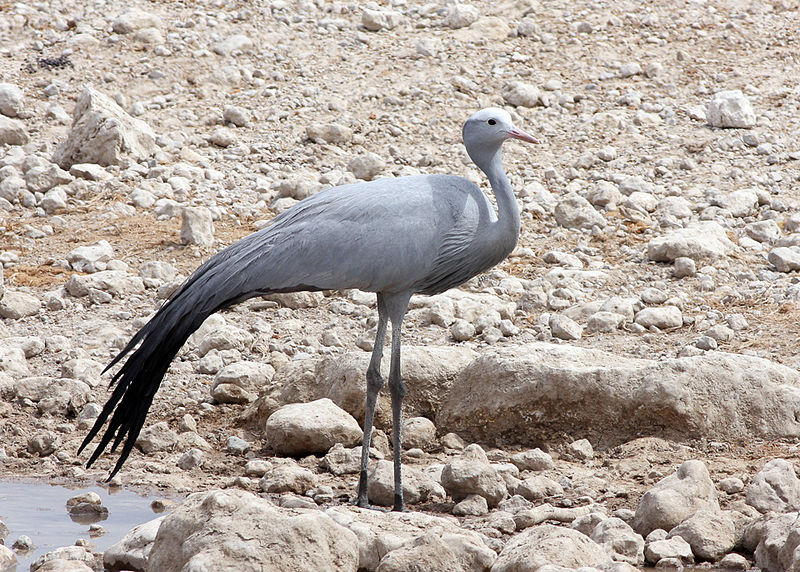
File:Grus_paradisea_Etosha_1.jpg · Wikimedia Commons · See Wikimedia Commons
blue crane
Sign in to saveAlso known as Anthropoides paradiseus, paradise crane, Stanley crane
species of bird
OverviewAI-generated
The blue crane (*Anthropoides paradiseus*) is a species of bird classified within the order Aves. It belongs to the genus *Anthropoides* and is also associated with the genus *Grus*. The species is known by several common names, including Blue Crane, Grulla Azul, Grulla de Paraiso, and Grue bleue.
This bird has a wingspan of 190 and a mass of 5.1. Its range is located in Africa. The blue crane is listed as Vulnerable on the IUCN Red List, a status recorded in 2021. Reproductive characteristics include an egg incubation period of 31 and a litter size of 2.
Synthesized by Vinony from 21 facts across 4 sources: Wikidata, iNaturalist, IUCN Red List, Vinony graph. Generated from structured data (not the Wikipedia text) and checked against those facts — may still contain errors.
In the Vinony graph
blue crane is indexed among the 16,386 entries in Vinony's Vulnerable Species collection.
Within Vinony's link graph, blue crane is referenced by 104 other articles, and connects out to beak, Agreement on the Conservation of African-Eurasian Migratory Waterbirds and South Africa.
It sits within the topics Birds described in 1793, Birds of Southern Africa and Cite IUCN without doi.
Its subject is documented across 46 Wikipedia language editions.
Species
VulnerableBlue Crane
species
This crane feeds mainly on the seeds of grasses and sedges, waste grains, insects and a range of small vertebrates (8). Unlike other species of crane that probe the ground with their bills, the blue crane tends to take above-ground resources (6). Courtship involves a 'dance' in which the male chases the female, interrupted with leaps, bows and bouts of calling (6). Nesting occurs during summer, usually from September to February, and the typical nesting site is secluded grassland at high elevations. The eggs are laid in the grass or on bare ground (8). Nesting occasionally occurs in wetlands, in which case a platform nest of reeds is constructed (8). Two eggs are usually produced per clutch, and these are incubated for 30 to 33 days. The young become fully fledged after 3-5 months (8). Blue cranes undertake local migrations, moving to lower elevations in autumn and winter with their chicks. Flocking is known to occur throughout the year but is more common during the winter when large flocks of several hundred birds form (8).
via IUCN
Wikidata facts
- Instance of
- taxon
- Parent taxon
- Grus
- Mass
- 5.1
- Image
- Anthropoides paradiseus -Etosha National Park, Namibia-8.jpg
Show 10 more facts
- taxon rank
- species
- IUCN conservation status
- Vulnerable
- taxon name
- Anthropoides paradiseus
- Commons category
- Grus paradisea
- Commons gallery
- Grus paradisea
- taxon common name
- modri žerjav
- wingspan
- 190
- egg incubation period
- 31
- litter size
- 2
- taxon range
- Africa
via Wikidata · CC0
~7 min read
Encyclopedic overview
The blue crane (Grus paradisea), also known as the Stanley crane and the paradise crane, is the national bird of South Africa. The species is listed as Vulnerable by the IUCN.
Description
Excerpted from Wikipedia’s “blue crane” article, available under the CC BY-SA 4.0 licence.