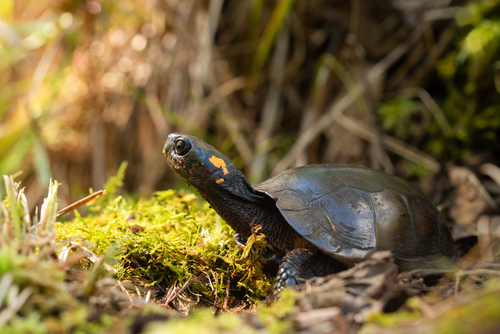
(c) Patrick Randall, some rights reserved (CC BY-NC-SA) · cc-by-nc-sa
Species
Critically EndangeredBog Turtle
SPECIES
- KingdomArchaea
- PhylumHalobacteriota
Die Moorschildkröte (Glyptemys muhlenbergii) ist eine Art der Neuwelt-Sumpfschildkröten. Sie gehört wie die Waldbachschildkröte zu den Amerikanischen Wasserschildkröten. Bis vor wenigen Jahren wurden die beiden Arten noch zur Gattung Clemmys gerechnet, die heute als monogenerische Gattung nur noch die Tropfenschildkröte enthält.[1] Die Moorschildkröte gehört zu den kleinsten nordamerikanischen Schildkröten. Inhaltsverzeichnis 1 Erscheinungsbild 2 Verbreitung und Lebensraum 3 Fortpflanzung 4 Bestand 5 Nachweise 5.1 Einzelnachweise 5.2 Literatur 5.3 Weblinks Erscheinungsbild Die Moorschildkröte hat eine Carapaxlänge zwischen 7,6 und 8,9 Zentimeter. Sehr große und alte Individuen erreichen in seltenen Ausnahmefällen auch eine Carapaxlänge von 11,5 Zentimeter. Der Rückenpanzer weist eine braune bis dunkelrotbraune Färbung auf. Der Hinterrand ist nicht gesägt. Auffälliges Kennzeichen der Moorschildkröte ist ein leuchtend gelber oder oranger Farbfleck an beiden Seiten des Halses sowie im Nacken. Auch der Kopf weist eine leicht bräunliche Färbung auf. Der Bauchpanzer ist dunkelbraun bis schwarz. Männchen können anhand des konkav geformten Bauchpanzers identifiziert werden. Verbreitung und
via GBIF · IUCN
Wikidata facts
Show 10 more facts
- taxon rank
- species
- IUCN conservation status
- Critically Endangered
- taxon name
- Glyptemys muhlenbergii
- Commons category
- Glyptemys muhlenbergii
- taxon common name
- Bog Turtle
- endemic to
- United States
- start time
- 5000000-00
- CITES Appendix
- Appendix I of CITES
- diel cycle
- diurnality
- short name
- G. muhlenbergii
Sources (1)
via Wikidata · CC0
~28 min read
Encyclopedic overview
The bog turtle (Glyptemys muhlenbergii), also known commonly as Muhlenberg's turtle, is a critically endangered species of semiaquatic turtle in the family Emydidae. The species is native to the eastern United States. It was first scientifically described in 1801 after an 18th-century survey of Pennsylvania. The smallest North American turtle, it measures about 10 centimeters (4 in) in straight carapace length when fully grown. Although the bog turtle is similar in appearance to the painted turtle (Chrysemys picta) and the spotted turtle (Clemmys guttata), its closest relative is actually the somewhat larger wood turtle (Glyptemys insculpta). The bog turtle can be found from Vermont in the north, south to Georgia, and west to Pennsylvania. Diurnal and secretive, it spends most of its time buried in mud and – during the winter months – in hibernation. The bog turtle is omnivorous, feeding mainly on small invertebrates. The bog turtle is the state reptile of New Jersey.
An adult bog turtle weighs 110 grams (3.9 oz) on average. Its skin and shell are typically dark brown, with a distinctive orange spot on each side of the neck. Considered threatened at the federal level, the bog turtle is protected under the United States' Endangered Species Act. Invasive plants and urban development have eradicated much of the bog turtle's habitat, substantially reducing its numbers. Demand for the bog turtle is high in the black market pet trade, partly because of its small size and unique characteristics. Various private projects have been undertaken in an attempt to reverse the decline in the turtle's population.
Excerpted from Wikipedia’s “Bog turtle” article, available under the CC BY-SA 4.0 licence.