
OverviewAI-generated
Botswana, officially the Republic of Botswana, is a sovereign landlocked country in Southern Africa. Its capital is Gaborone. The nation shares borders with Namibia, South Africa, Zambia, and Zimbabwe. It is named after the Tswana people. The official language is English, and the currency is the Botswana pula. Mokgweetsi Masisi and Duma Boko serve as heads of state.
The country has a population of 2,359,609 and covers an area of 582,000. Its highest point is Otse Hill. Botswana contains administrative entities including the Central District, Ghanzi District, Kgalagadi District, and Kgatleng District. It is a member of the United Nations, African Union, Commonwealth of Nations, and World Trade Organization. The anthem is Fatshe leno la rona, and its top-level Internet domain is .bw.
Synthesized by Vinony from 67 facts across 9 sources: Wikidata, REST Countries, Openweathermap, Open Meteo, World Bank, OpenStreetMap, PubMed, Vinony graph, Geo. Generated from structured data (not the Wikipedia text) and checked against those facts — may still contain errors.
Weather now
7-day forecast
via Open-Meteo
Country
- Capital
- Gaborone
- Population
- 2,359,609
- Region
- Africa · Southern Africa
- Demonym
- Motswana
- Currencies
- BWP (P)
- Languages
- English, Tswana
- Calling code
- +267
- Drives on
- Left
- Gini
- 53.3 (2015)
- FIFA code
- BOT
- TLD
- .bw
- Timezones
- UTC+02:00
- Borders
- NAM, ZAF, ZMB, ZWE
via REST Countries
Indicators · World Bank
- GDP
- $19.4B(2024)
- Population
- 2,521,139(2024)
- Life expectancy
- 69.3 yrs(2024)
- Unemployment
- 24.5 %(2025)
- Urban population
- 67.5 %(2024)
- Internet users
- 57.5 %(2024)
- Forest area
- 26.3 %(2023)
- Renewable energy
- 27.4 %(2021)
via World Bank Open Data · CC BY 4.0
Wikipedia views (30d)
99,173 totalvia Wikimedia Pageviews API
Key facts
- Country.conventional_long_name
- Republic of Botswana
- Country.common_name
- Botswana
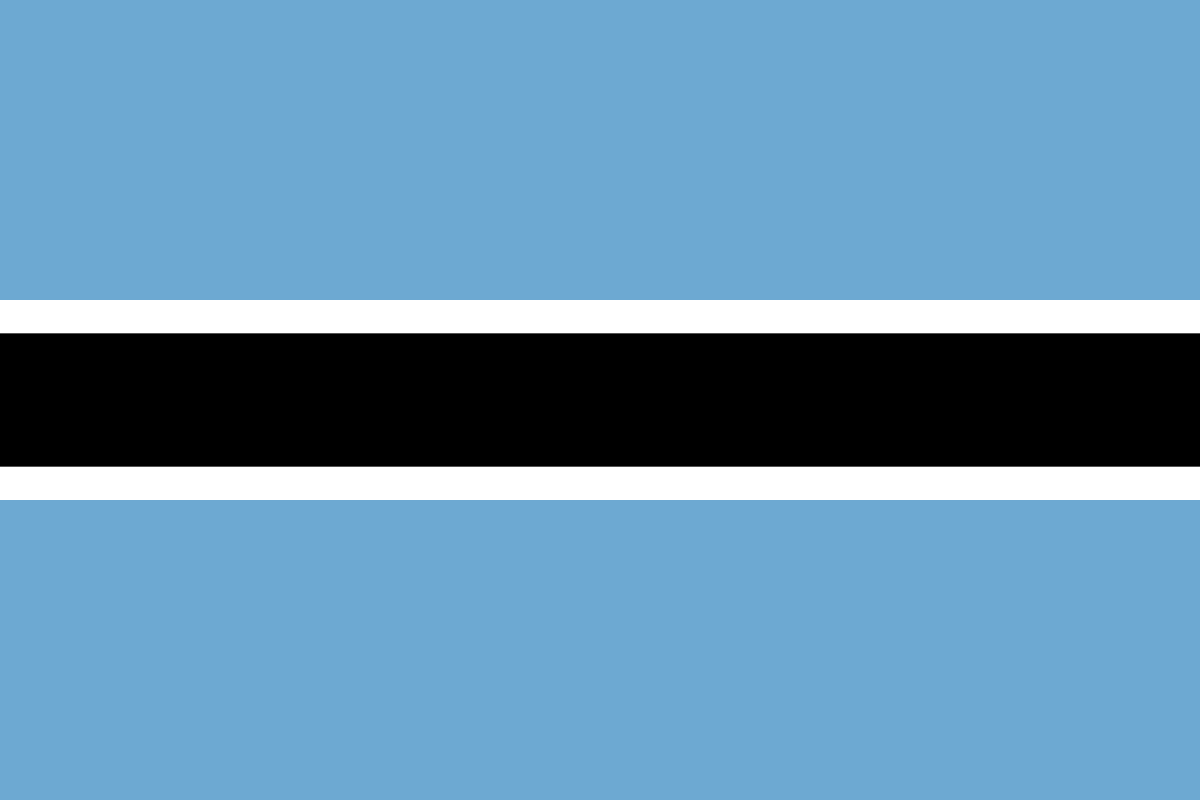
- Country.image_flag
- Flag of Botswana.svg
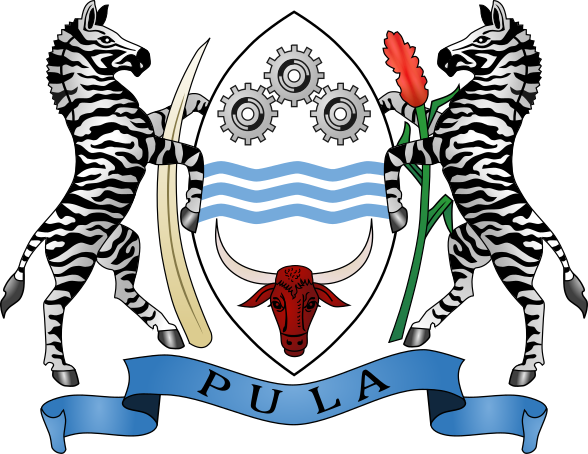
- Country.image_coat
- Coat of arms of Botswana.svg
- Country.coa_size
- 90
- Country.national_motto
- "Rain"
- Country.national_anthem
- """This Land of Ours"
- Country.capital
- Gaborone
- Country.largest_city
- capital
- Country.official_languages
- English
- Country.languages_type
- National language
- Country.languages
- Tswana
- Country.ethnic_groups_year
- 2024
- Country.religion_year
- 2021
- Country.government_type
- Unitary parliamentary republic with an executive presidency
- Country.leader_title1
- President
- Country.leader_name1
- Duma Boko
- Country.leader_title2
- Vice-President
via Wikipedia infobox
Research
6,395 papers- Reaching 90-90-90 in Botswana.ReviewCurrent opinion in HIV and AIDS · 2019Essex M, Makhema J, Lockman SDOI: 10.1097/COH.0000000000000580
- Botswana's HIV/AIDS success.Lancet (London, England) · 2022Thornton JDOI: 10.1016/S0140-6736(22)01523-9
- Mental health research in Botswana: a semi-systematic scoping review.The Journal of international medical research · 2020Opondo PR, Olashore AA, Molebatsi K et al.DOI: 10.1177/0300060520966458
- Cancer control in Botswana.The Lancet. Oncology · 2022Das MDOI: 10.1016/S1470-2045(22)00125-5
- How Botswana discovered the omicron variant.BMJ (Clinical research ed.) · 2023Thobega KDOI: 10.1136/bmj.p1653
- Botswana plans first-ever national cancer control programme.The Lancet. Oncology · 2023Makoni MDOI: 10.1016/S1470-2045(22)00784-7
- Bibliometric analysis of cancer research outputs in Botswana between 2009 and 2021.ReviewJournal of cancer policy · 2023Koobotse MO, Zachariah M, Senabye B et al.DOI: 10.1016/j.jcpo.2023.100405
- The Decriminilisation of Homosexuality in Botswana.Journal of homosexuality · 2023Dinokopila BRDOI: 10.1080/00918369.2022.2051118
via PubMed
Wikidata facts
- Instance of
- country
- Part of
- Southern Africa
- Named after
- Tswana people
- Official name
- Botswanská republika
- Demonym
- Bocvanka
- Participant in
- Kivu conflict
- Country
- Botswana
- Contains
- Southern District
- Continent
- Africa
- Capital
- Gaborone
- Official language
- English language
- Currency
- Botswana pula
- Population
- 2480244
- Area
- 581737
- Head of state
- Mokgweetsi Masisi
- Form of government
- parliamentary republic
- Legislature
- National Assembly of Botswana
- Anthem
- Fatshe leno la rona
- Shares border with
- Zimbabwe
- Highest point
- Otse Hill
- Follows
- Bechuanaland Protectorate
- Official website
- gov.bw
- Image
- Okavango Delta, Botswana (2674364913).jpg
- Life expectancy
- 66.797
Show 68 more facts
- Nominal GDP
- 20352322157
- GDP per capita
- 6710.99
- Unemployment rate
- 18
- Calling code
- +267
- Licence plate code
- BW
- Mains voltage
- 230
- Motto
- Ein balchder, eich cyrchfan
- Flag
- flag of Botswana
- Coat of arms
- Coat of arms of Botswana
- top-level Internet domain
- .bw
- Commons category
- Botswana
- member of
- African Continental Free Trade Area
- topic's main category
- Category:Botswana
- category for people who died here
- Category:Deaths in Botswana
- category for people born here
- Category:Births in Botswana
- category for films shot at this location
- Category:Films shot in Botswana
- category of associated people
- Category:Botswana people
- diplomatic relation
- Zambia
- Commons gallery
- Botswana
- mobile country code
- 652
- lowest point
- Limpopo River
- driving side
- left
- geography of topic
- Geography of Botswana
- emergency phone number
- 999
- central bank
- Bank of Botswana
- marriageable age
- 21
- topic's main Wikimedia portal
- Portal:Botswana
- language used
- Kuhane
- office held by head of state
- President of Botswana
- number of out-of-school children
- 78309
- has characteristic
- free country
- located in/on physical feature
- Southern Africa
- total fertility rate
- 2.836
- maritime identification digits
- 611
- inception
- 1966-09-30
- Unicode character
- 🇧🇼
- native label
- Botswana
- literacy rate
- 88
- suicide rate
- 11.8
- water as percent of area
- 2.5
- history of topic
- history of Botswana
- culture
- culture of Botswana
- VAT rate
- 12
- different from
- Bophuthatswana
- BTI Status Index
- 7.59
- BTI Governance Index
- 6.81
- economy of topic
- economy of Botswana
- replaces
- Bechuanaland Protectorate
- demographics of topic
- demographics of Botswana
- Democracy Index
- 7.62
- separated from
- United Kingdom
- Human Development Index
- 0.693
- hashtag
- Botswana
- on focus list of Wikimedia project
- Wikipedia:Vital articles/Level/4
- Gini coefficient
- 53.3
- Happy Planet Index score
- 31.9
- Inequality-adjusted Human Development Index
- 0.426
- described by source
- Pax Leksikon
- P12749
- Veneto
- birth rate
- 23.036
- male population
- 1298807
- death rate
- 6.897
- rural population
- 730591
- female population
- 1331489
- urban population
- 1899705
- Commonwealth Sport country code
- BOT
Sources (15)
via Wikidata · CC0
Travel guide
Get in
thumb|375px|Countries in light blue can travel to Botswana visa free; all other countries will require a visa
Get around
thumb|Street scene in Gaborone Very few locals know street names and addresses, and you are likely to have to get directions in terms of landmarks. Botswana doesn't have a postal delivery system to addresses (just to centralised mail collection points), so even when streets are well-marked, the names may be unfamiliar to residents.
Through a combination of coaches and combies (minivans) and taxies, you can get anywhere in Botswana without any trouble, though public transport is spotty away from big cities and major routes but hitchhiking is popular and very easy. However, hitchhiking should only be done in desperate circumstances, as Botswana driving is often very erratic and it can be a harrowing experience to have a stranger drive you somewhere. It is advisable to arrive at the bus station quite early, as the buses do fill up quickly, and it is not uncommon to spend several hours standing in the aisle waiting for a seat to free up (remember to bring water, as the buses are often not air conditioned).Apart from Public transport you can opt to call a private cab which can take you anywhere you want in around and around the city, phone numbers for cabs can be found anywhere around the city in pamphlets pasted on bus stops or can be found in notice boards mainly located in shopping malls.
See
thumb|Wading elephant spotted in the Okavango Delta Wildlife is Botswana's main draw. Wildlife parks compose nearly one-fifth of the country. In these parks you will find lions, cheetahs, crocodiles, hippos, elephants, antelopes, wild dogs, and hundreds of species of birds. Visitors can take safaris and stay in lodges running the gamut from inexpensive dorms for backpackers with tour buses to $1,000+/night private lodges with your own maid & driver.
Among Southern Africa's most impressive—and popular—wildlife destinations is the Okavango Delta where the Okavango River widens into the world's largest inland delta. Lying in the middle of the arid Kalahari, the swamps & water channels attract animals from thousands of kilometres around and triples in size (to 100,000 km2!) during floods in July and August. Nearby Chobe National Park has a large population of elephants and it's also easy to spot many of Africa's well-known species, especially zebras and lions. The bleak salt pans of Makgadikgadi Pans National Park attract a large number and variety of birds year-round. Other great game parks include Nxai Pan National Park, Mokolodi Nature Reserve, & Gemsbok National Park.
Most of the native tribes in Botswana only dress in traditional outfits and perform for tourists. The villages of D'Kar and Xai-Xai have many offerings, including arts, crafts, and the opportunity to participate in various performances. Tsodilo Hills contain one of the largest collections of r…
Eat
thumb|Seswaa with bogobe porridge The cuisine of Botswana is unique but also shares some characteristics with other cuisine of Southern Africa. Examples of Botswana food include Pap, Samp, Vetkoek and Mopane worms.
A food unique to Botswana includes Seswaa, a meat dish made of beef, goat or lamb meat. The fatty meat is generally boiled until tender in any pot, with "just enough salt", and shredded or pounded. It is often served with pap (maize meal) or sorghum meal porridge. The lerotse melon, which resembles a watermelon, is a staple unique to the country. The flesh is crunchy and neutral when raw, but greatly resembles a butternut squash when cooked. A traditional dish is bogobe jwa lerotse, sorghum porridge and melon.
Drink
Many soft drinks and alcoholic drinks are produced in factories in Botswana, including Fanta and Coca-Cola. Local brands are Castle and Lion beers. Milk is fermented to make madila (sour milk) which is eaten on its own or added to porridge. A favourite non alcoholic home made drink is ginger beer. A local company Native Foods also produces a variety of refreshments including Mosukujane Iced Tea.
Sleep
Most of the accommodation establishments in Botswana are located near the larger towns and cities, but there are also many secluded game lodges tucked away in the wilderness areas. A few places have backpackers hotels and there are many campsites.
Stay safe
People in Botswana are very friendly and the crime rate is low. Nevertheless, crime has been on the rise over the past several years, so always be aware of your surroundings. Basic common sense will keep you safe from the predatory wildlife in rural areas. Botswana is one of the safest countries in Africa, no civil war, less corruption, more human rights, no natural disasters e.g. earthquakes or tsunamis.
Stay healthy
Generally speaking, medical care in Botswana is quite good compared to other African countries. Botswana has a universal healthcare system and the vast majority of people live within five kilometers of a healthcare facility. Cities like Gaborone have wonderful hospitals, but quality healthcare is non-existent in rural areas.
In case of an emergency and you want to be assisted quickly, it is best to find a private hospital rather than a government hospital, though this might cost you. If it's a small emergency that doesn't need medical attention quickly, it is best to go to a government owned hospital/clinic.
If you run out of your prescription pills/medicines and you have a form of proof that you need them, be it a letter from your doctor or your prescription bill, you can go to the nearest pharmacy (dubbed chemist by locals) and present your proof to the Pharmacist so they can assist. The fee depends on the pills/medicine you need.
Perhaps the biggest health danger is HIV/AIDS. Botswana has been experiencing one of the most severe HIV/AIDS epidemics in the world. As of 2022, the country's HIV/AIDS prevalence rate among adults is at 22.2%, which is the third highest HIV/AIDS prevalence rate in the world. Take the necessary precautions, including not sharing needles and never having unprotected sex. If you form a serious relationship with a local, you both should consider getting an HIV test before taking things further.
The northern part of Botswana, including Chobe Natio…
Connect
Botswana's country code is +267 which was allocated to the country by the International Telecommunications Union in the late 1960s, Fixed line numbers in Botswana are seven digits long in a closed telephone numbering plan, with the geographical area being indicated by the first two or three digits, meaning that there are no area codes.
Travel guide from Wikivoyage (CC BY-SA 4.0)
Article · Español
Botsuana, cuyo nombre oficial es República de Botswana (en inglés: Republic of Botswana; en setsuana: Lefatshe la Botswana), es un país soberano sin salida al mar del sur de África cuya forma de Gobierno es la república presidencialista y unitaria. Su territorio está dividido en quince distritos, nueve rurales y seis urbanos. La capital del país es la ciudad de Gaborone. Geográficamente el país se extiende sobre terreno llano, con un 70 % de su superficie cubierta por el desierto de Kalahari.[cita requerida] Limita al norte con Zambia, al este con Zimbabue, al sur con Sudáfrica y al oeste y al norte con Namibia. Ocupa el puesto 48 en países por superficie. Botsuana fue uno de los países más pobres de África en el momento en que se independizó del Reino Unido en 1966, cuando exhibía un PIB per cápita de alrededor de los 70 dólares. No obstante, Botsuana es una nación que ha logrado un incremento importante en el nivel de ingresos, con una de las economías de más rápido crecimiento en el mundo. Según estimaciones del FMI en 2018, Botsuana presentaba una tasa de crecimiento promedio anual de 9 %, y posee un PIB (PPA) per cápita de alrededor de 18,843 dólares, siendo uno de los más altos de África. La alta inversión en educación, un 21 % del PIB, ha logrado importantes conquistas como la provisión de educación casi universal y gratuita, así como también mejoras notables en el sector salud para disminuir la mortalidad por enfermedades. Esto ha permitido a Botsuana tener un desarrollo humano relativamente alto y es considerado uno de los más altos del África subsahariana. El nivel democrático del Estado es muy elevado, el índice de democracia es el segundo más alto de África solamente por detrás de Mauricio, ocupando el puesto 30º de ranking mundial por delante de países como Italia o Bélgica. Los ingresos familiares son mucho más bajos en las zonas rurales que en las urbanas (HIES 2002/03). Aunque la tasa de pobreza rural ha disminuido, sigue siendo significativamente más alta que en las urbanas. La tasa de infección por VIH/sida se ha reducido, como resultado de una agresiva intervención del Gobierno en la lucha contra la enfermedad, donde los medicamentos son proporcionados gratuitamente a los ciudadanos.[cita requerida] En 2021 se estimaba un total de 360 000 ciudadanos infectados. El país ha tratado de diversificar su economía en los últimos años. En 2008 dependía en gran medida de los servicios (45.2 %), la industria (52.9 %), y agricultura (1.9 %) estrechamente vinculadas con el comercio con Sudáfrica.
Abstract from DBpedia / Wikipedia · CC BY-SA
Gallery (639)
On the map
60 mapped locations
Available in 268 languages
- Español
- Français
- Deutsch
- 中文
- 日本語
- Русский
- Português
- Italiano
- العربية
- हिन्दी
- Abkhazian
- abstract
- Achinese
- Afrikaans
- Akan
- Albanian
- Albanian
- Amharic
Show 249 more
- ami
- Angika
- Aragonese
- Armenian
- Arpitan
- Assamese
- Asturian
- Aymara
- azb
- Azerbaijani
- Bahasa Indonesia
- Balinese
- Bambara
- Bangla
- Banjar
- Bashkir
- Basque
- bat_smg
- Bavarian
- be_x_old
- Belarusian
- Betawi
- Bhojpuri
- Bikol
- Bishnupriya
- Bislama
- Bosnian
- Breton
- Bulgarian
- Buriat
- Burmese
- Catalan
- cbk_zam
- cdo
- Cebuano
- Central Kurdish
- Chechen
- Cherokee
- Cheyenne
- Chuvash
- Colognian
- Cornish
- Corsican
- Crimean Tatar
- Croatian
- Czech
- dag
- Danish
- Divehi
- dty
- Dzongkha
- Egyptian Arabic
- Esperanto
- Estonian
- Ewe
- Extremaduran
- Faroese
- Fiji Hindi
- Filipino
- Finnish
- fiu_vro
- Frafra
- Fula
- Gagauz
- Galician
- Ganda
- gcr
- Georgian
- Gilaki
- gpe
- Greek
- Guarani
- Gujarati
- guw
- Haitian Creole
- Hakka Chinese
- Hausa
- Hawaiian
- Hebrew
- Hungarian
- hyw
- Iban
- Icelandic
- Ido
- Igbo
- Iloko
- Inari Sami
- Interlingua
- Interlingue
- Inupiaq
- Irish
- Jamaican Creole English
- Javanese
- Kabyle
- kai
- Kannada
- Kanuri
- Kara-Kalpak
- Kazakh
- kbp
- Kikuyu
- Kinyarwanda
- Kongo
- Kotava
- Kurdish
- Kyrgyz
- Ladino
- Lao
- Latgalian
- Latin
- Latvian
- Lezghian
- Ligurian
- Limburgish
- Lingala
- Lingua Franca Nova
- Lithuanian
- lld
- Lojban
- Lombard
- Low German
- Lower Sorbian
- Luxembourgish
- Macedonian
- Malagasy
- Malay
- Malayalam
- Maltese
- Manipuri
- Manx
- Māori
- map_bms
- Marathi
- Mazanderani
- Minangkabau
- Mingrelian
- Mirandese
- Moksha
- Mongolian
- Moroccan Arabic
- N’Ko
- Navajo
- nds_nl
- Nederlands
- Nepali
- Newari
- Nigerian Pidgin
- Northern Frisian
- Northern Sami
- Northern Sotho
- Norwegian
- Norwegian Nynorsk
- Novial
- nup
- Obolo
- Occitan
- Old English
- olo
- Oromo
- Ossetic
- Pampanga
- Papiamento
- Pashto
- Pennsylvania German
- Piedmontese
- Polski
- Punjabi
- Quechua
- roa_rup
- Romanian
- Romansh
- Rusyn
- Sango
- Sanskrit
- Santali
- Sardinian
- Saterland Frisian
- Scots
- Scottish Gaelic
- Serbian
- Serbian (Latin)
- Shan
- Shona
- Sicilian
- Silesian
- simple
- Sindhi
- Sinhala
- Slovak
- Slovenian
- Somali
- South Ndebele
- Southern Sotho
- Standard Moroccan Tamazight
- Sundanese
- Svenska
- Swahili
- Swati
- szy
- Tachelhit
- Tajik
- Talysh
- Tamil
- Taroko
- Tatar
- tay
- Telugu
- Tibetan
- Tiếng Việt
- Tigrinya
- Toki Pona
- Tongan
- Tsonga
- Tswana
- Tumbuka
- Türkçe
- Turkmen
- Tyap
- Udmurt
- Ukrainian
- Upper Sorbian
- Urdu
- Uyghur
- Uzbek
- Venda
- Venetian
- Veps
- Volapük
- Walloon
- Waray
- Welsh
- Western Frisian
- Western Panjabi
- Wolof
- Wu Chinese
- Xhosa
- Yakut
- Yiddish
- Yoruba
- Zaza
- Zeelandic
- zh_classical
- zh_min_nan
- zh_yue
- Zhuang
- Zulu
- فارسی
- ไทย
- 한국어
via Wikidata sitelinks · CC0