
Brunéi
Also known as bn, BRN, Nation of Brunei, the Abode of Peace, Negara Brunei Darussalam, BRU, Brunei Darussalam
país de Asia
AI overview
Brunei Darussalam is a small Southeast Asian country on the northern coast of Borneo that is almost completely surrounded by the Malaysian state of Sarawak, making it the only fully independent nation on the island. With a population of around 466,000 people, it is strategically located on the South China Sea and represents a unique political entity in a region otherwise divided among Malaysia and Indonesia.
AI-generated from the Wikipedia summary — may contain errors.
Weather now
cached 8h ago35°scattered clouds
45% 1.2 m/s OpenWeatherMap
7-day forecast
via Open-Meteo
Country
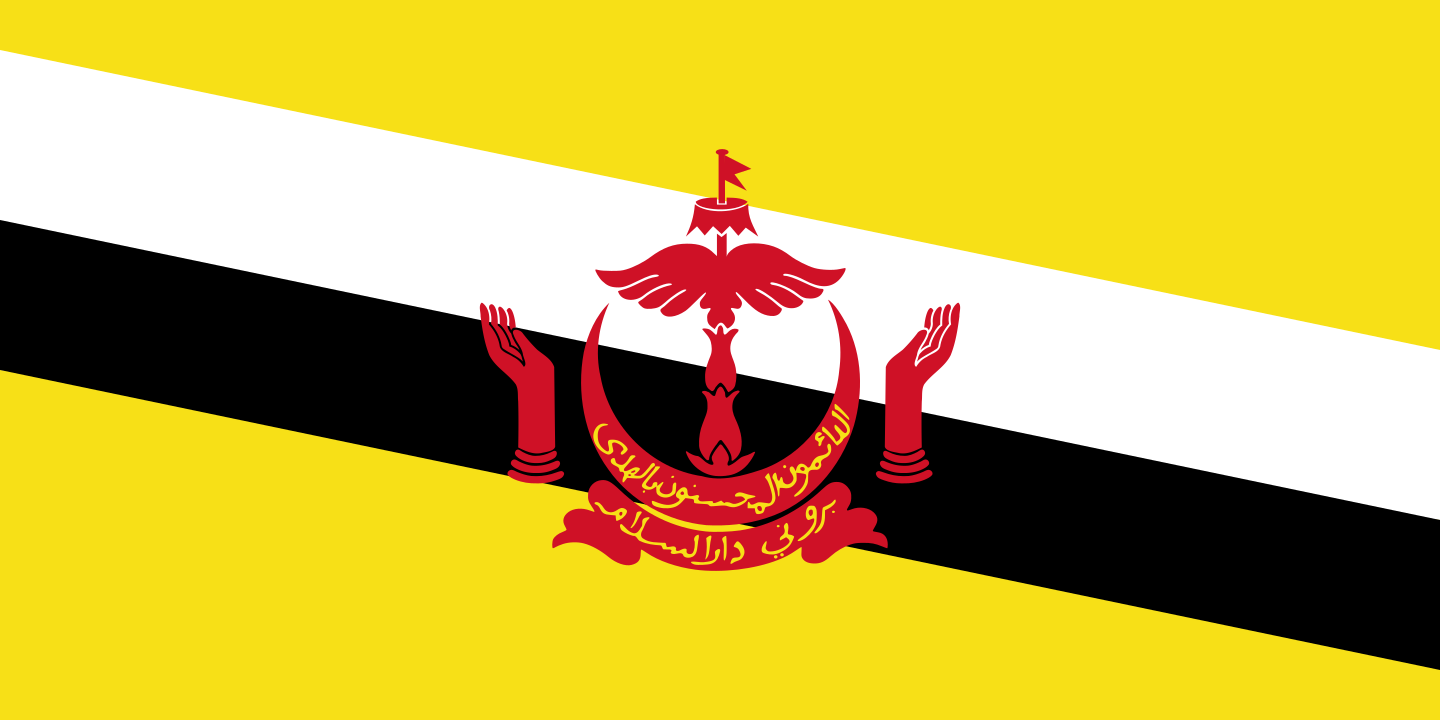
- Capital
- Bandar Seri Begawan
- Population
- 455,500
- Region
Travel guide
Understand
Brunei is a pint-sized oil-rich sultanate with a population of 450,000 as of 2016, strategically positioned on the South China Sea, close to vital sea lanes linking the Indian and Pacific Oceans. Its oil resources have generated great wealth for the Sultan and some of the local people, and the best evidence of this is seen in the palaces and mosques. However many Bruneians, including those who live in the water village (Kampong Ayer), still have relatively simple, albeit comfortable livelihoods.
The description of an "oil-rich sultanate" might conjure the images of the United Arab Emirates or Qatar, but travellers with such expectations will likely be disappointed. Brunei does not have much in terms of grandiose man-made attractions, and although excellent diving and jungle trekking are available, it does not have mind-blowing natural parks as the neighbouring Malaysian states of Sabah and Sarawak do. Many people that visit Brunei actually do so only for the sake of "country collection" or "passport stamp collection".
If there are attractions particular to Brunei, it is perhaps the absence of crowds, the comfortable but relaxed atmosphere, and the way that society remains religious and conservative, refusing to embrace modernity and globalisation despite having the material wealth to do so.
Get in
Compared to other nations in Southeast Asia, Brunei's visa policy is a bit more restrictive.
Get around
thumb|Route bus Use caution when asking locals for transportation information. People here are friendly and very helpful, but when asking about transportation, you'll get three different answers from three different people, even people whose job it is to help tourists.
See
Istana Nurul Iman in Bandar Seri Begawan, the residence of the Sultan and the world's largest occupied residential palace, built at an estimated cost of US$600 million and occupying 300 acres of prime real estate on a man-made hill. Ulu Temburong National Park in Temburong The Omar Ali Saifuddien Mosque in Bandar Seri Begawan Bandar Seri Begawan has a couple of museums dedicated to the history of Brunei and that of the monarchy.
Do
thumb|View of Jerudong Park For things to do in and in the near vicinity of Bandar Seri Begawan, see Bandar Seri Begawan.
Article · Español
Brunéi o Brunei —oficialmente, Brunei Darussalam o Estado de Brunéi, Morada de la Paz (en malayo, Negara Brunei Darussalam en alfabeto latino y بروني دارالسلام en alfabeto jawi, ambos oficiales; — es uno de los cuarenta y nueve países que componen el continente asiático. Su capital y ciudad más poblada es Bandar Seri Begawan. Está ubicado en la zona centro de la subregión del Sudeste Asiático, en el norte de la isla de Borneo, limitando al norte con el mar de la China Meridional y, hacia los demás puntos cardinales, con Malasia. Tiene una extensión de 5765 km² y una población en 2012 de 415 717 habitantes, lo que supone una densidad de población de 67,3 hab/km². Su forma de gobierno es el sultanato, y está organizado en cuatro distritos y treinta y ocho subdistritos, que se encuentran separados en dos territorios. La historia oficial del país afirma que los orígenes de Brunéi se remontan al siglo VII d. C., cuando su territorio era un estado llamado , dependiente del imperio Srivijaya, con centro en la isla de Sumatra. Tiempo después pasó a ser un estado vasallo del Imperio mayapajit, con capital en la isla de Java. En el siglo XIV, Brunéi se convirtió en sultanato bajo el gobierno de un sultán recién convertido al islam, Muhammad Shah. En la cima de su poder, durante el reinado del sultán Bolkiah (r. 1485–1528), el Imperio bruneano tuvo el control del norte de la isla de Borneo y del archipiélago de Joló, al noreste de la isla, del reino de Seludong (actual Manila) y de las islas situadas frente a la costa noroeste de Borneo. Este Imperio marítimo recibió en 1521 la visita de la expedición de Fernando de Magallanes y Juan Sebastián Elcano y luchó contra el Imperio español en la denominada Guerra de Castilla (Perang Kastila), que se libró en 1578 y en la que el sultanato resultó derrotado. A pesar de ello, la ocupación española solo duró 72 días hasta que se retiraron. En los siglos posteriores, el Imperio bruneano experimentó un lento declive. En el siglo XIX cedió Sarawak al británico James Brooke como pago a su ayuda en la supresión de una rebelión y el territorio de Sabah a la Compañía privilegiada británica del Norte de Borneo. En 1888, Brunéi pasó a ser un protectorado británico. Tras un período de ocupación japonesa en la Segunda Guerra Mundial, en 1959, se redactó una nueva constitución. Poco después, en 1962, estalló una revuelta contra la monarquía que fue sofocada con ayuda del Reino Unido. Brunéi obtuvo la total independencia del país británico el 1 de enero de 1984. Desde la década de 1970, el sultanato ha experimentado un crecimiento económico espectacular que ha convertido a Brunéi en un país industrializado. Su riqueza actual proviene esencialmente de sus enormes yacimientos de petróleo y gas natural, por lo que el sultanato registra el segundo índice de desarrollo humano más alto de todo el sudeste asiático, tras Singapur. Según datos del Fondo Monetario Internacional, Brunéi es el quinto país del mundo en ingresos per cápita según la paridad de poder adquisitivo. La revista financiera Forbes afirma que es la quinta nación más rica de una lista de 182, gracias a sus yacimientos de petróleo y gas, y CNN asegura que es el país del mundo con menor deuda pública. Su población es de 443 593 habitantes (julio de 2017 est.) y tiene una superficie de 5 765 km².
Gallery (639)
On the map
60 mapped locations