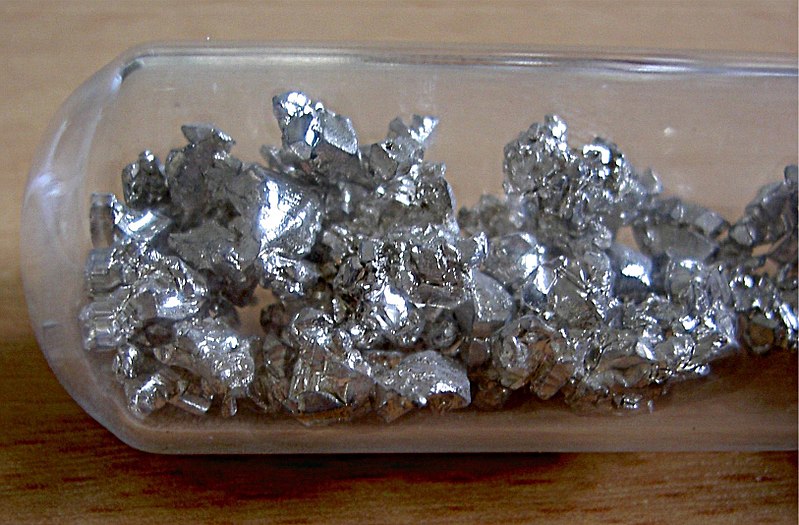
File:Calcium_unter_Argon_Schutzgasatmosphäre.jpg · Wikimedia Commons · See Wikimedia Commons
OverviewAI-generated
Calcium is a chemical element with the symbol Ca and atomic number 20. It has an atomic mass of 40.078 and a standard oxidation state of 2. The element was discovered in 1808. Its electron configuration is [Ar] 4s² or 1s² 2s² 2p⁶ 3s² 3p⁶ 4s². The ionic radius is 134, and its electronegativity is 1.00.
Physically, calcium has a melting point of 838.85 and a boiling point of 1483.85. It exhibits an electrical conductivity of 28200000 and a standard molar entropy of 41.6. The canonical SMILES representation is [Ca]. In Unicode, the character is "鈣".
In scientific literature, the term "calcium" appears in 713,024 PubMed records. It is referenced by 4,896 other encyclopedia articles. PubChem lists its weight as 40.08 and its charge as 0. It has zero hydrogen bond donors and acceptors, with a topological polar surface area of 0.
Synthesized by Vinony from 29 facts across 4 sources: Wikidata, PubMed, PubChem, Vinony graph. Generated from structured data (not the Wikipedia text) and checked against those facts — may still contain errors.
Key facts
- Calcium.engvar
- en-GB
via Wikipedia infobox
Chemical data
- Formula
- Ca
- Molecular weight
- 40.08 g/mol
- IUPAC name
- calcium
- SMILES
- [Ca]
- InChIKey
- OYPRJOBELJOOCE-UHFFFAOYSA-N
- Polar surface area
- 0 Ų
- H-bond donors
- 0
- H-bond acceptors
- 0
- Formal charge
- 0
via PubChem
Research
713,024 papers- Calcium Absorption from Food Products: Food Matrix Effects.Nutrients · 2021
- Calcium's Role and Signaling in Aging Muscle, Cellular Senescence, and Mineral Interactions.International journal of molecular sciences · 2023
- Calcium's Role in Orchestrating Cancer Apoptosis: Mitochondrial-Centric Perspective.International journal of molecular sciences · 2023
- Ionized calcium.Clinica chimica acta; international journal of clinical chemistry · 2011
- The Significance of Calcium in Photosynthesis.International journal of molecular sciences · 2019
via PubMed
Wikidata facts
- Subclass of
- alkaline earth metal
- Part of
- alkaline earth metal
- Named after
- lime
- Mass
- 40.078
- Image
- Calcium 1.jpg
- Has use
- essential medicine
Show 20 more facts
- subject has role
- essential medicine
- melting point
- 838.85
- boiling point
- 1483.85
- atomic number
- 20
- Commons category
- Calcium
- topic's main category
- Category:Calcium
- oxidation state
- 2
- element symbol
- Ca
- discoverer or inventor
- Humphry Davy
- Commons gallery
- Calcium
- canonical SMILES
- [Ca]
- chemical formula
- Ca
- time of discovery or invention
- 1808-00-00
- standard molar entropy
- 41.6
- electrical conductivity
- 28200000
- Unicode character
- 鈣
- electronegativity
- 1.00
- electron configuration
- 1s² 2s² 2p⁶ 3s² 3p⁶ 4s²
- ionic radius
- 134
- on focus list of Wikimedia project
- Wikipedia:Vital articles/Level/4
Sources (9)
via Wikidata · CC0
Article · Español
El calcio (del latín calx, calis, cal) es un elemento químico, de símbolo Ca y de número atómico 20. Su masa atómica es 40,078 u. El calcio es un metal blando, grisáceo, y es el quinto más abundante en masa de la corteza terrestre. También es el ion más abundante disuelto en el agua de mar, tanto como por su molaridad y como por su masa, después del sodio, cloruros, magnesio y sulfatos. Se encuentra en el medio interno de los organismos como ion calcio (Ca2+) o formando parte de otras moléculas; en algunos seres vivos se halla precipitado en forma de esqueleto interno (huesos de los vertebrados) o externo (concha de los moluscos). Los iones de calcio actúan de cofactor en muchas reacciones enzimáticas, intervienen en el metabolismo del glucógeno y, junto al potasio y el sodio, regulan la contracción muscular. El porcentaje de calcio en los organismos es variable y depende de las especies, pero por término medio representa el 2,45 % en el conjunto de los seres vivos; en los vegetales, solo representa el 0,007 %. En el habla vulgar se utiliza la voz calcio para referirse a sus sales por ejemplo, esta agua tiene mucho calcio; en las tuberías se deposita mucho calcio, etc.
Abstract from DBpedia / Wikipedia · CC BY-SA
Gallery (20)
Available in 179 languages
- Español
- Français
- Deutsch
- 中文
- 日本語
- Русский
- Português
- Italiano
- العربية
- हिन्दी
- abstract
- Afrikaans
- Albanian
- Amharic
- Angika
- Aragonese
- Armenian
- Asturian
Show 160 more
- Awadhi
- azb
- Azerbaijani
- Bahasa Indonesia
- Balinese
- Bangla
- Bashkir
- Basque
- Bavarian
- be_x_old
- Belarusian
- Betawi
- Bhojpuri
- Bikol
- blk
- Bosnian
- Breton
- Bulgarian
- Burmese
- Catalan
- cdo
- Cebuano
- Central Kurdish
- Cherokee
- Chuvash
- Cornish
- Corsican
- Croatian
- Czech
- Danish
- Divehi
- Egyptian Arabic
- Esperanto
- Estonian
- Extremaduran
- Faroese
- Fiji Hindi
- Fijian
- Filipino
- Finnish
- Friulian
- Galician
- Gan Chinese
- Ganda
- Georgian
- Greek
- Guarani
- Gujarati
- Haitian Creole
- Hakka Chinese
- Hawaiian
- Hebrew
- Hungarian
- hyw
- Icelandic
- Ido
- Interlingua
- Irish
- Javanese
- Kalmyk
- Kannada
- Kazakh
- kbp
- Kikuyu
- Komi
- Kurdish
- Kyrgyz
- Lao
- Latin
- Latvian
- Ligurian
- Limburgish
- Lingua Franca Nova
- Lithuanian
- Lojban
- Lombard
- Low German
- Luxembourgish
- Macedonian
- Malagasy
- Malay
- Malayalam
- Manx
- Māori
- Marathi
- Moksha
- Mongolian
- Moroccan Arabic
- nah
- Navajo
- Nederlands
- Nepali
- Newari
- Northern Frisian
- Norwegian
- Norwegian Nynorsk
- Novial
- Occitan
- Odia
- olo
- Oromo
- Ossetic
- Papiamento
- Pashto
- Piedmontese
- Polski
- Punjabi
- Quechua
- roa_rup
- Romanian
- Sanskrit
- Sardinian
- Saterland Frisian
- Scots
- Scottish Gaelic
- Serbian
- Serbian (Latin)
- Shona
- Sicilian
- simple
- Sindhi
- Sinhala
- Slovak
- Slovenian
- Somali
- Standard Moroccan Tamazight
- Sundanese
- Svenska
- Swahili
- Tachelhit
- Tajik
- Tamil
- Tatar
- Telugu
- Tibetan
- Tiếng Việt
- Toki Pona
- Türkçe
- Ukrainian
- Urdu
- Uyghur
- Uzbek
- Veps
- Volapük
- Walloon
- Waray
- Welsh
- Western Mari
- Western Panjabi
- Wu Chinese
- Yakut
- Yiddish
- Yoruba
- zh_classical
- zh_min_nan
- zh_yue
- Zulu
- فارسی
- ไทย
- 한국어
via Wikidata sitelinks · CC0