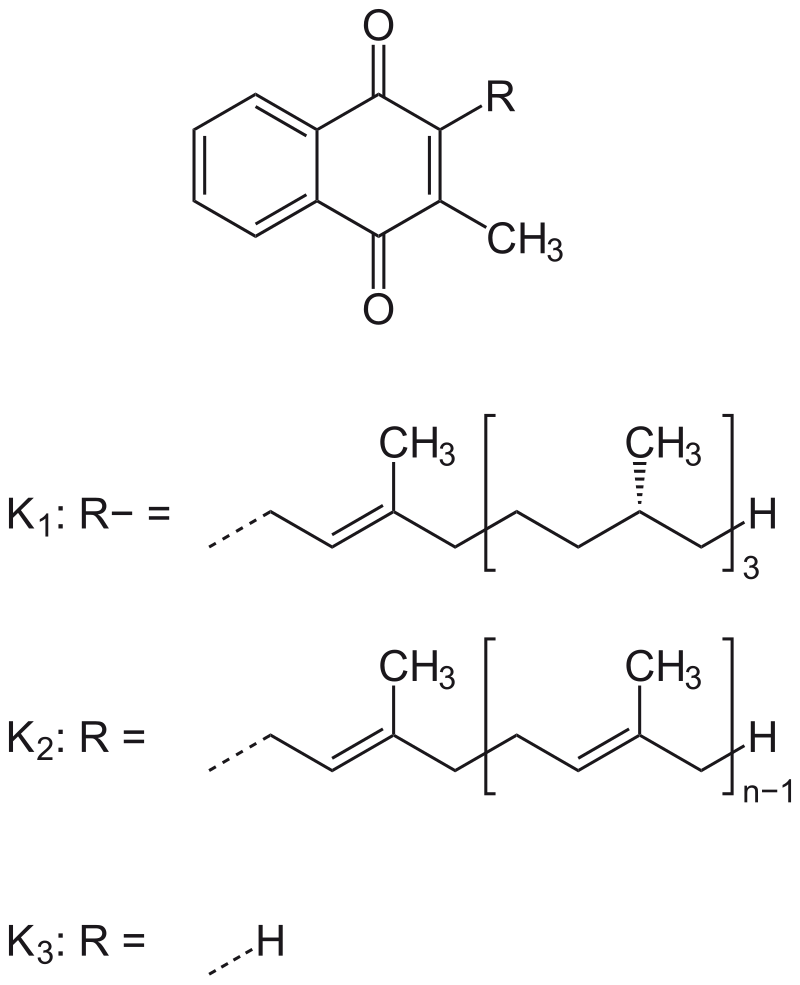
File:K-Vitamine.svg · Wikimedia Commons · See Wikimedia Commons
vitamin K
Sign in to savefat-soluble vitamins found in foods and marketed as dietary supplements
Vitamin K is a fat-soluble vitamin found naturally in foods and also available as a dietary supplement. It plays important roles in your body, particularly in blood clotting and bone health.
AI-generated from the Wikipedia summary — may contain errors.
Research
34,383 papers- Vitamin K: A novel cancer chemosensitizer.ReviewBiotechnology and applied biochemistry · 2022Gul S, Maqbool MF, Maryam A et al.DOI: 10.1002/bab.2312
- Vitamin K in dermatology.ReviewClinics in dermatology · 2026Bapna M, Deng MDOI: 10.1016/j.clindermatol.2026.02.010
- Vitamin K.ReviewLancet (London, England) · 1995Shearer MJDOI: 10.1016/s0140-6736(95)90227-9
- Vitamin K metabolism.ReviewSub-cellular biochemistry · 1998Newman P, Shearer MJDOI: 10.1007/978-1-4899-1789-8_19
- Vitamin K and the newborn.ReviewNutrition reviews · 1972DOI: 10.1111/j.1753-4887.1972.tb04015.x
- Vitamin K and tissue mineralization.ReviewBibliotheca nutritio et dieta · 2001Vermeer C, Thijssen HH, Hamulyák KDOI: 10.1159/000059474
- Vitamin K at birth.BMJ (Clinical research ed.) · 1996Zipursky ADOI: 10.1136/bmj.313.7051.179
- Neonatal vitamin K.BMJ (Clinical research ed.) · 1991von Kries RDOI: 10.1136/bmj.303.6810.1083
via PubMed
Wikidata facts
Show 4 more facts
- topic's main category
- Category:Vitamin K
- Commons category
- Vitamin K
- medical condition treated
- vitamin K deficiency
- NCI Thesaurus ID
- C943
Sources (6)
via Wikidata · CC0
~29 min read
Encyclopedic overview
Vitamin K is a family of structurally similar, fat-soluble vitamers found in foods and marketed as dietary supplements. The human body requires vitamin K for post-synthesis modification of certain proteins that are required for blood coagulation ("K" from Danish koagulation, for "coagulation") and for controlling binding of calcium in bones and other tissues. The complete synthesis involves final modification of these so-called "Gla proteins" by the enzyme gamma-glutamyl carboxylase that uses vitamin K as a cofactor.
Vitamin K is used in the liver as the intermediate VKH2 to deprotonate a glutamate residue and then is reprocessed into vitamin K through a vitamin K oxide intermediate. The presence of uncarboxylated proteins indicates a vitamin K deficiency. Carboxylation allows them to bind (chelate) calcium ions, which they cannot do otherwise. Without vitamin K, blood coagulation is seriously impaired, and uncontrolled bleeding occurs. Research suggests that deficiency of vitamin K may also weaken bones, potentially contributing to osteoporosis, and may promote calcification of arteries and other soft tissues.
Excerpted from Wikipedia’s “vitamin K” article, available under the CC BY-SA 4.0 licence.
Gallery (8)
Available in 75 languages
- Español
- Français
- Deutsch
- 中文
- 日本語
- Русский
- Português
- Italiano
- العربية
- हिन्दी
- Afrikaans
- Albanian
- Armenian
- Asturian
- azb
- Azerbaijani
- Bahasa Indonesia
- Balinese
Show 56 more
- Bangla
- Basque
- Bikol
- Bosnian
- Bulgarian
- Burmese
- Catalan
- Croatian
- Czech
- Danish
- Divehi
- Esperanto
- Estonian
- Finnish
- Galician
- Georgian
- Greek
- Hebrew
- hyw
- Icelandic
- Javanese
- Kyrgyz
- Lao
- Latin
- Latvian
- Lithuanian
- Macedonian
- Malay
- Malayalam
- Marathi
- Nederlands
- Nepali
- Norwegian
- Norwegian Nynorsk
- Occitan
- Polski
- Romanian
- Serbian
- Serbian (Latin)
- simple
- Slovenian
- Sundanese
- Svenska
- Tamil
- Tiếng Việt
- Türkçe
- Tuvinian
- Ukrainian
- Uyghur
- Waray
- Wu Chinese
- zh_min_nan
- zh_yue
- فارسی
- ไทย
- 한국어
via Wikidata sitelinks · CC0