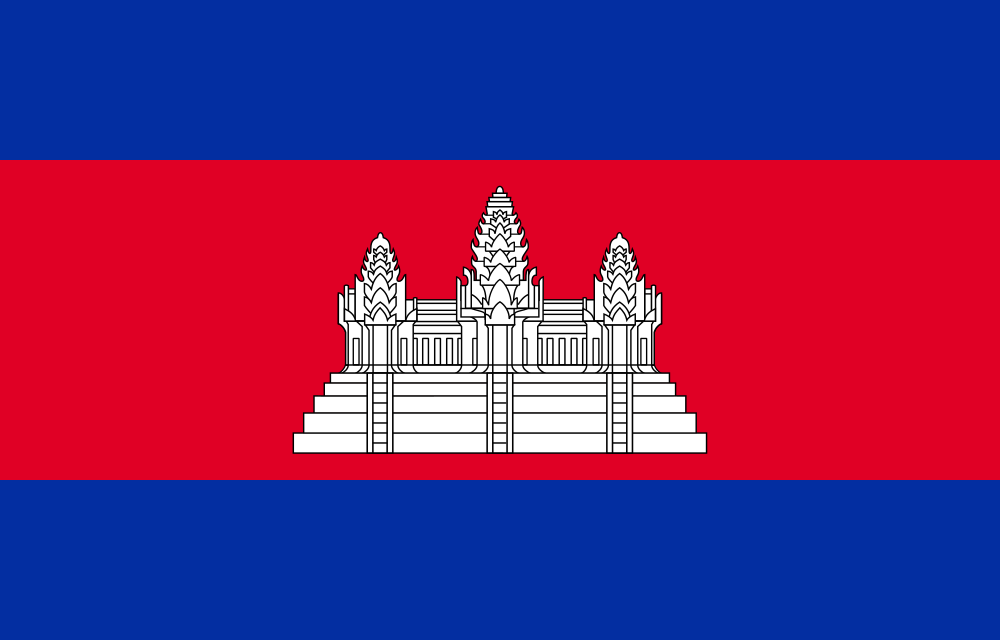
Also known as Kingdom of Cambodia, kh, Kampuchea, Camboya, Campuchia, Kamboja, Kambodzha, KHM
pays d'Asie du Sud-Est
Cambodia is a Southeast Asian country bordered by Thailand, Laos, and Vietnam, characterized by low-lying plains, the Mekong River, and Southeast Asia's largest lake, with a tropical climate and a population of about 17 million people who are predominantly Khmer. Its capital and largest city is Phnom Penh, with other major cities including Siem Reap and Battambang.
AI-generated from the Wikipedia summary — may contain errors.
via Open-Meteo
Cambodia has had a pretty bad run of luck for the last half-millennium or so. Ever since the fall of Angkor in 1431, the once mighty Khmer Empire was plundered by all its neighbours. Cambodia was colonised by the French in the 19th century, and during the 1970s suffered heavy carpet bombing by the USA. After a false dawn of independence in 1953, Cambodia promptly plunged back into the horrors of civil war in 1970 to suffer the Khmer Rouge's incredibly brutal reign of terror followed by occupation by Vietnamese forces, and only after UN-sponsored elections in 1993 did the country begin to struggle back onto its feet.
In 2011, 10% of the population lived on less than US$1.25 per day, down from 31% in 2007. However, 41% of the population still lived on less than US$2 per day, and 72% lived on less than US$3 per day. The provision of even basic services remains spotty. Short power outages are not uncommon—stay calm, the power will probably come back on in a few minutes. Political intrigue remains as complex and opaque as ever; but the security situation has improved immeasurably, and increasing numbers of visitors are rediscovering Cambodia's temples and beaches. Siem Reap, the gateway to Angkor, now sports luxury hotels, chic nightspots, ATMs, and an airport fielding flights from all over the region, while several beach destinations are increasingly well-trafficked. However, travel beyond the most popular tourist destinations is still an adventure.
thumb|375px|A map showing the visa requirements of Cambodia, with countries in green and light green having visa-free access; and countries in gold and striped yellow green having visa on arrival
thumb|A small part of Angkor Wat Cambodia's main sight is so famous and grand, it's also one of the prime destinations in all of Asia. The magnificent and awe-inspiring temples of the Angkor Archaeological Park draw huge and diverse crowds, who come to admire their enormous symbolism and sheer magnitude. It's a place not to be missed on any trip to the region, worth every bit of the often sweltering heat. Finding a somewhat private spot for sundown over the temples can be a challenge, but the colours are wonderful. Start early to beat the crowds at the mysterious Ta Prohm complex. Made extra famous as a filming location for Tomb Raider, the ruins overgrown by huge jungle trees make for one of the most atmospheric sites at Angkor.
Cambodia has a total of three world heritage-listed memorial sites. Close to the capital city of Phnom Penh, the Choeung Ek Memorial, better known as the Killing fields — while shocking and sad — leaves a long-lasting impression. Excellent tours are available, providing an insight into the outrageous atrocities committed by the Khmer Rouge. For further insights, the Tuol Sleng Genocide Museum is the main place to visit.
Le Cambodge, en forme longue le royaume du Cambodge, en khmer Kâmpŭchéa et ព្រះរាជាណាចក្រកម្ពុជា, Preăhréachéanachâkr Kâmpŭchéa, aussi appelé Srok Khmer, ស្រុកខ្មែរ, littéralement « le pays khmer », est un pays d'Asie du Sud-Est, peuplé d’environ 17 millions d'habitants. Sa capitale est Phnom Penh. Le Cambodge est une monarchie constitutionnelle, héritière de l’ancien empire khmer hindouiste et bouddhiste qui régna sur la péninsule d’Indochine entre le XIe et le XIVe siècles. Le Cambodge a des frontières communes avec la Thaïlande à l'ouest-nord-ouest, le Laos au nord-est, et le Viêt Nam à l'est et au sud-est. Les habitants du pays portent le nom de Khmers ou Cambodgiens. La majorité des Cambodgiens sont de religion bouddhiste theravāda (96 % de la population, religion d'État). Entre le Ier siècle et le VIIe siècle, le territoire du pays fait partie du royaume (ou royaumes) du Fou-nan, avant d'être absorbé par le royaume Chenla. Les principautés Chenla sont unifiées en 802 pour former l'empire khmer. La chute de l'empire en 1431 précède un Âge sombre qui dure quatre siècles. En 1863, le Cambodge devient un protectorat français comme partie de l'Indochine française. Après la guerre d'Indochine, le pays obtient son indépendance en 1953 en tant que monarchie constitutionelle. Dans le contexte de la guerre froide et de la guerre du Viêt Nam, une guerre civile éclate en 1967 entre le gouvernement et les rebelles communistes des Khmers rouges. Au cours de la guerre, la monarchie est renversée en 1970 par un coup d'État et la République khmère est proclamée. Cependant, les Khmers rouges parviennent à remporter la guerre en 1975 et rebaptisent le pays le Kampuchéa démocratique. Au cours des quatre années suivantes, les Khmers rouges commettent un génocide, durant lequel près d'un quart de la population est tué. En 1979, les Khmers rouges sont renversés par une guerre contre le Viêt Nam, qui instaure un gouvernement pro-vietnamien largement non reconnu par la communauté internationale. De différentes factions anti-vietnamiennes continuent un conflit de guérilla contre l'occupation vietnamienne au cours des années 1980. À l'issue des accords de paix de 1991, le pays tombe sous la tutelle des Nations unies jusqu'à 1993. Par la suite, le Cambodge est rétabli en tant que monarchie constitutionnelle. Depuis un coup d'État en 1997, le pays est fermement sous la gouvernance du Parti du peuple cambodgien et le premier ministre Hun Sen. L'agriculture reste le secteur économique dominant (57,6 % de la population active et 33,4 % du PIB). Les industries principales du Cambodge sont la confection et le tourisme. Du pétrole et du gaz ont été découverts dans les eaux territoriales du pays en 2005. Bien qu'une partie de la population vive dans l'extrême pauvreté (31 % en dessous du seuil de pauvreté), le Cambodge connaît depuis la fin des années 1990 un fort développement économique et bénéficie de l'afflux d'investissements internationaux. Entre 2004 et 2007, le PIB du royaume connaît une croissance moyenne de 10 % par an. Le PIB par habitant du Cambodge, avec 773 dollars par an et par habitant, reste cependant bien en dessous de la moyenne régionale et au même niveau que nombre de pays d'Afrique sub-saharienne. En 2022, le Cambodge est classé en 97e position pour l'indice mondial de l'innovation. Le Cambodge a un climat tropical.
6 mapped locations
Discovered by embedding cosine similarity (sentence-transformers MiniLM, 384-dim).
via REST Countries
via World Bank Open Data · CC BY 4.0
via OpenStreetMap · GeoNames
via Wikimedia Pageviews API
via Wikipedia infobox
via PubMed
via Wikidata · CC0
Go on a boat party in Phnom Penh Go hiking in Bokor National Park See endangered river dolphins in Kratie Boat through to the floating village and have lunch aboard the floating restaurant near Siem Reap
Beaches – Abundant in the southwest of Cambodia and on the various islands. Also Sihanoukville is considered a beach city. Meditation – Cambodia is predominantly Buddhist and there are at least three of the famous Dhamma Vipassana centers around the country. Courses start at 10 days and are not as overrun as in Thailand or India but equally trust worthy. Motorbike – A convenient and recommended way to explore the towns surrounding an area is by motorbike. They can be rented from as little as US$5. Shooting ranges – Due to its military history and violent past, but also due to rich elites in the country, there exist several shooting ranges in Cambodia where regular people can shot guns and rifles like an AK-47 or the M16 without further certification. At least three ranges exist around Phnom Penh, one in Sihanoukville and one in Siem Reap, even though the reputation and prices of the latter one are debatable. A regular rifle with 30 rounds goes for around US$60, but there are also sniper rifles, UZIs, rocket launcher, grenades, and hand guns available for up to US$200.
thumb|Fried noodles, sour soup and a Khmer-style curry While not the strongest link in Southeast Asia's chain of delightful cuisines, Khmer food is tasty and cheap. Rice and occasionally noodles are the staples. Unlike in Thailand or Laos, spicy hot food is not the mainstay; black pepper is preferred over chilli peppers, though chillis are usually served on the side. Similarities with Thai and Vietnamese cuisines can be noted in Khmer food, although Cambodians love strong sour tastes in their dishes. Prahok, a fermented fish paste, is common in Khmer cooking, but may not always please Western palates. Indian and Chinese restaurants have a healthy representation in Phnom Penh and the larger towns. Western food can be readily found in most restaurants in any of the tourist areas of Cambodia and Cambodia offers some of the best budget western meals in Southeast Asia. However, while still inexpensive, a western meal will often be double the price of a Khmer meal.
Typical Khmer dishes include:
Amok - a Khmer steamed curry served in banana leaves or a hollowed-out coconut and often considered one of the national dishes of Cambodia. Although traditionally made with certain kinds of fish, modern renditions may also include chicken, beef or even tofu. A proper amok's texture should resemble that of a mousse or a souffle. Kuytheav - A noodle soup generally served for breakfast. Can be made with pork, beef or seafood. Flavourings are added to the customers taste in the form of lime ju…
thumb|Sugarcane juice The tap water supply in Phnom Penh has undergone some serious changes at the hands of a "water revolutionary" in the government, Ek Sonn Chan. So, in Phnom Penh you can drink the tap water without problem, although it's highly chlorinated and you may not like the taste. Additionally, there are some concerns about the bottle water vendors. The US Embassy website says that "In 2008, Cambodia's Ministry of Industry, Mines and Energy reported that more than 100 bottled water companies in Cambodia were being considered for closure for failing to meet minimum production quality standards. Only 24 of the 130 bottled water companies are compliant with the ministry's Department of Industrial Standards." That page seems to be down on bottled water generally, so take it with a grain of salt.
Outside of Phnom Penh (and perhaps Siem Reap) you should assume that tap water is not potable. Khmer brand water in blue plastic bottles sell for 1,000 riel or less (although prices are often marked up for tourists, to 50 cents or a US dollar).
Western-style accommodation is available in most major towns the country over; even less-visited places such as Kampong Chhnang have a number of affordable guesthouses or hotels. Basic guesthouses can go as low as US$5 a night in the countryside but prices in the cities are usually around the US$5-10. At the budget end, expect to provide your own towels etc. If you want air-con and hot water and cable TV the price creeps up to close to US$10-20, you can have a dorm bed in a backpacker's hotel in most places from US$2 up to US$5. Some budget places don't have hot showers, especially outside big cities, so check before booking if you can't stand a cold shower.
thumb|300px|Ice in Cambodia may be made in factories with treated water but cannot be regarded as safe, since it may have been transported in contaminated bags. Ice cubes are safer than ice that appears to have been chipped from a block.
Cambodia lacks reliable medical facilities, doctors, clinics, hospitals and medication, especially in rural areas. The only hospitals run to Western standards in Cambodia are the Royal Phnom Penh Hospital in Phnom Penh, and the Royal Angkor International Hospital in Siem Reap, but because they are both private hospitals, you will be paying a steep premium for their services. Any serious problem should be dealt with in Bangkok, Ho Chi Minh City or Singapore, which boast first rate services (at least to those who can afford them). Repatriation is also more easily arranged from either of those cities. Make sure your insurance covers medical evacuation. The private and pricey Royal Rattanak Hospital in Phnom Penh can be trusted for emergency medical care and can treat most diseases and injuries common to the region. Naga Clinic has branches in Siem Reap and Phnom Penh. It is also clean, safe and useful for minor conditions.
Local hospitals and clinics vary from mediocre to frightening. Expect dirt, poor equipment, expired medicines and placebos of flour and sugar.
In local clinics don't let them put anything in your blood: treat dehydration orally and not with a drip, as there is a risk of septicaemia (i.e. bacterial blood poisoning). The same…
Cambodia is a country at a crossroads. While the more heavily touristed places like Phnom Penh and Siem Reap are well adjusted to tourist behaviour, people in places such as Stung Treng or Banlung are less so. Always ask permission before you take somebody's picture, as many in the more remote areas do not like to be photographed, and some in the urban areas will ask for payment.
Dress for women is quite conservative in Cambodia. While shorts are now acceptable in Phnom Penh and Siem Reap, it is more respectful to wear knee length shorts or trousers when outside of these areas. While Cambodian women may prefer to dress conservatively in the daytime, covering much skin to prevent tanning, which they find unattractive, at night the dress code is more revealing. Do not mistake such local women in nightclubs for prostitutes; they are out for a night on the town like anyone else. Beachwear is pretty conservative: speedos and bikinis are not common except among foreigners.
Groups of young children can be found everywhere in Cambodia and many travellers feel 'pestered' by them to purchase their friendship bracelets and other wares. However, it's often the case that children enjoy the chance to practice their English on you- and by asking them their names and ages a conversation is likely to develop where the 'hard sell' is forgotten. Children and adults alike enjoy looking at photographs of your family and home country, so it might be a good idea to have some ready.
thumb|Mass gr…
Laos The beaches and islands of Eastern Thailand, like Ko Chang, Ko Samet and Pattaya, can easily be reached from Cambodia. Vietnam See Bangkok to Ho Chi Minh City overland for a popular route that passes through Cambodia between Thailand and Vietnam.
Travel guide from Wikivoyage (CC BY-SA 4.0)
Abstract from DBpedia / Wikipedia · CC BY-SA
via Wikidata sitelinks · CC0