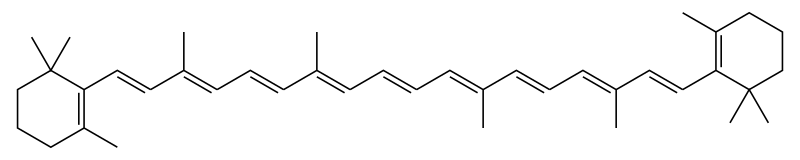
File:Beta-Carotin.svg · Wikimedia Commons · See Wikimedia Commons
β-carotene
Sign in to saveAlso known as 1,1'-[(1E,3E,5E,7E,9E,11E,13E,15E,17E)-3,7,12,16-tetramethyloctadeca-1,3,5,7,9,11,13,15,17-nonaene-1,18-diyl]bis(2,6,6-trimethylcyclohexene), beta-Karotin, all-trans-beta-carotene, 1,3,3-trimethyl-2-[(1E,3E,5E,7E,9E,11E,13E,15E,17E)-3,7,12,16-tetramethyl-18-(2,6,6-trimethyl-1-cyclohexenyl)octadeca-1,3,5,7,9,11,13,15,17-nonaenyl]cyclohexene, 1,3,3-trimethyl-2-[(1E,3E,5E,7E,9E,11E,13E,15E,17E)-3,7,12,16-tetramethyl-18-(2,6,6-trimethylcyclohexen-1-yl)octadeca-1,3,5,7,9,11,13,15,17-nonaenyl]cyclohexene, Solatene, Provatene, Provatenol
β-Carotene (beta-carotene) is an organic, strongly colored red-orange pigment abundant in fungi, plants, and fruits. It is a member of the carotenes, which are terpenoids (isoprenoids), synthesized biochemically from eight isoprene units and thus having 40 carbons.
OverviewAI-generated
β-carotene is a chemical compound with the formula C₄₀H₅₆. It has a mass of 536.438 and a melting point of 180. The substance is characterized by a charge of 0 and a topological polar surface area of 0. It possesses no hydrogen bond donors or acceptors. The xlogp value for β-carotene is 13.5.
The compound is associated with 19,971 entries in the PubMed database. It is referenced by 622 other encyclopedia articles. The chemical structure is defined by specific SMILES notations, including a canonical form and an isomeric form that details its stereochemistry.
Synthesized by Vinony from 19 facts across 4 sources: Wikidata, PubMed, PubChem, Vinony graph. Generated from structured data (not the Wikipedia text) and checked against those facts — may still contain errors.
Chemical data
- Formula
- C40H56
- Molecular weight
- 536.9 g/mol
- IUPAC name
- 1,3,3-trimethyl-2-[(1E,3E,5E,7E,9E,11E,13E,15E,17E)-3,7,12,16-tetramethyl-18-(2,6,6-trimethylcyclohexen-1-yl)octadeca-1,3,5,7,9,11,13,15,17-nonaenyl]cyclohexene
- SMILES
- CC1=C(C(CCC1)(C)C)/C=C/C(=C/C=C/C(=C/C=C/C=C(/C=C/C=C(/C=C/C2=C(CCCC2(C)C)C)\C)\C)/C)/C
- InChIKey
- OENHQHLEOONYIE-JLTXGRSLSA-N
- XLogP
- 13.5
- Polar surface area
- 0 Ų
- H-bond donors
- 0
- H-bond acceptors
- 0
- Formal charge
- 0
via PubChem
Drug data · ChEMBL
- Max clinical phase
- Approved
- Molecule type
- Small molecule
- First approval
- 1982
- Admin. routes
- oral
- Indications
- Crohn's disease, myocardial infarction, macular degeneration, Myocardial Ischemia
via ChEMBL · EBI
Research
19,971 papers- [Beta-carotene].Nihon rinsho. Japanese journal of clinical medicine · 2004
- beta-carotene: friend or foe?Fundamental and applied toxicology : official journal of the Society of Toxicology · 1997
- Beta-carotene in dermatology: Does it help?Acta dermatovenerologica Alpina, Pannonica, et Adriatica · 2008
- The effects of β-carotene on osteoporosis: a systematic review and meta-analysis of observational studies.Osteoporosis international : a journal established as result of cooperation between the European Foundation for Osteoporosis and the National Osteoporosis Foundation of the USA · 2023
- Dunaliella β-Carotene Productivity Comparison Under In Vitro Conditions.Current microbiology · 2024
via PubMed
Wikidata facts
- Subclass of
- carotene
- Has part
- hydrogen
- Mass
- 536.438
- Has use
- food additive
Show 10 more facts
- chemical formula
- C₄₀H₅₆
- found in taxon
- Liliaceae
- canonical SMILES
- CC1=C(C(CCC1)(C)C)C=CC(=CC=CC(=CC=CC=C(C)C=CC=C(C)C=CC2=C(CCCC2(C)C)C)C)C
- isomeric SMILES
- CC1=C(C(CCC1)(C)C)/C=C/C(=C/C=C/C(=C/C=C/C=C(/C=C/C=C(/C=C/C2=C(CCCC2(C)C)C)\C)\C)/C)/C
- subject has role
- biological pigment
- melting point
- 180
- has characteristic
- bitterness
- Commons category
- Β-Carotene
- World Health Organisation international non-proprietary name
- 倍他胡萝卜素
- characteristic of
- vitamin A
Sources (7)
via Wikidata · CC0
~14 min read
Encyclopedic overview
21 sectionsContents
- Provitamin A activity
- Absorption, metabolism and excretion
- Conversion factors
- Retinol activity equivalents (RAEs)
- International Units
- Dietary sources
- No dietary requirement
- Side effects
- Carotenosis
- No risk for hypervitaminosis A
- Drug interactions
- β-Carotene and lung cancer in smokers
- Industrial sources
- Research
- Macular degeneration
- Cancer
- Cataract
- Erythropoietic protoporphyria
- Food drying
- See also
- References
β-Carotene (beta-carotene) is an organic, strongly colored red-orange pigment abundant in fungi, plants, and fruits. It is a member of the carotenes, which are terpenoids (isoprenoids), synthesized biochemically from eight isoprene units and thus having 40 carbons.
Dietary β-carotene is a provitamin compound, converting in the body to retinol (vitamin A). In foods, it has rich content in carrots, pumpkin, spinach, and sweet potato. It is used as a dietary supplement and may be prescribed to treat erythropoietic protoporphyria, an inherited condition of sunlight sensitivity.
Excerpted from Wikipedia’s “β-carotene” article, available under the CC BY-SA 4.0 licence.