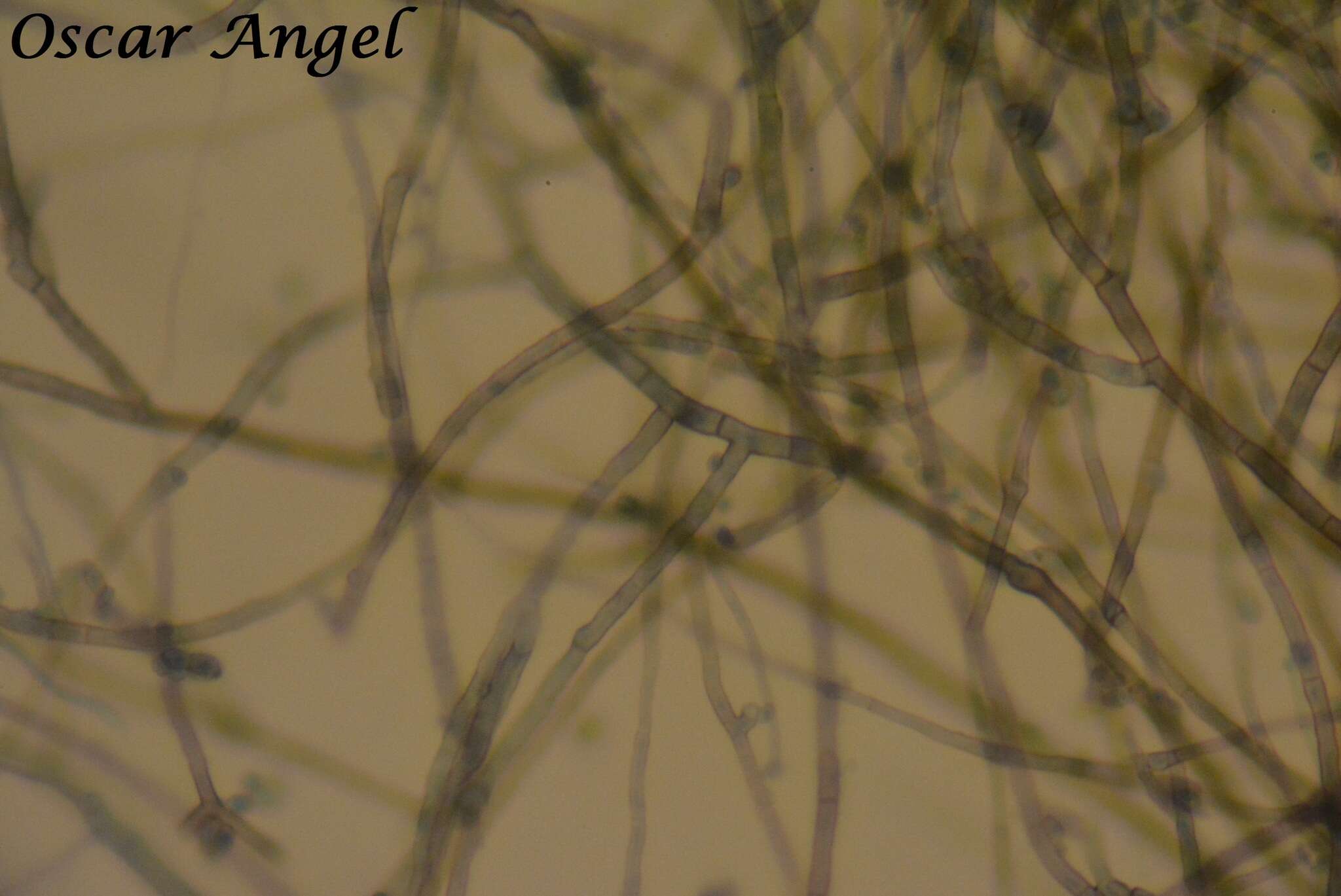
Encyclopedia of Life · EOL (see source)
Ceratobasidiaceae
Sign in to saveThe Ceratobasidiaceae are a family of fungi in the order Cantharellales. All species within the family have basidiocarps (fruit bodies) that are thin and effused. They have sometimes been included within the corticioid fungi or alternatively within the "heterobasidiomycetes". Species are saprotrophic, but some are also facultative plant pathogens or are associated with orchid mycorrhiza. Genera of economic importance include Ceratobasidium and Rhizoctonia, both of which contain plant pathogenic species causing diseases of commercial crops and turf grass.
Species
FAMILY
- KingdomFungi
- PhylumBasidiomycota
- ClassAgaricomycetes
- OrderCantharellales
- FamilyCeratobasidiaceae
Ceratobasidiaceae é uma família de fungos pertencente à família Ceratobasidiaceae.[1][2] Espécies Cantharellales Hydnaceae Clavulinaceae Botryobasidiaceae Aphelariaceae Ceratobasidiaceae Rhizoctonia Ceratorhiza Scotomyces Ceratobasidium Thanatephorus Moniliopsis Ceratoporia Cejpomyces Cantharellaceae Tulasnellaceae Minimedusa Burgella Radulochaete Odontiochaete Stilbotulasnella Referências ↑ «Species 2000 & ITIS Catalogue of Life: 2011 Annual Checklist.». Bisby F.A., Roskov Y.R., Orrell T.M., Nicolson D., Paglinawan L.E., Bailly N., Kirk P.M., Bourgoin T., Baillargeon G., Ouvrard D. (red.). Species 2000: Reading, UK. 2011. Consultado em 24 de setembro de 2012 ↑ Species Fungorum. Kirk P.M., 2010-11-23 Este artigo foi inicialmente traduzido, total ou parcialmente, do artigo da Wikipédia em sueco, cujo título é «Ceratobasidiaceae».
via GBIF
Museum specimens
- Specimen records
- 10
- With media
- 4
- Family
- Ceratobasidiaceae
- Collections
- MICH, ILL, UFPE
- Recorded in
- United States, Germany, Austria, Slovenia, SuéCia
Wikidata facts
- Instance of
- taxon
- Parent taxon
- Cantharellales
- Image
- Thanatephorus cucumeris infected peanuts.jpg
Show 5 more facts
- Commons category
- Ceratobasidiaceae
- taxon name
- Ceratobasidiaceae
- taxon rank
- family
- topic's main category
- Category:Ceratobasidiaceae
- taxonomic type
- Ceratobasidium
Sources (1)
via Wikidata · CC0
~3 min read
Encyclopedic overview
5 sectionsContents
- Taxonomy
- Current status
- Habitat and distribution
- Economic importance
- References
The Ceratobasidiaceae are a family of fungi in the order Cantharellales. All species within the family have basidiocarps (fruit bodies) that are thin and effused. They have sometimes been included within the corticioid fungi or alternatively within the "heterobasidiomycetes". Species are saprotrophic, but some are also facultative plant pathogens or are associated with orchid mycorrhiza. Genera of economic importance include Ceratobasidium and Rhizoctonia, both of which contain plant pathogenic species causing diseases of commercial crops and turf grass.
==Taxonomy== The family was created in 1948 by American mycologist G.W. Martin to accommodate species of corticioid fungi with heterobasidiomycete features (elongated sterigmata and basidiospores that give rise to secondary spores). He restricted the Ceratobasidiaceae to the genus Ceratobasidium, though including within the genus species later placed in Thanatephorus and Oliveonia. In 1981, Jülich created the order Ceratobasidiales to accommodate the family. By 1995, the order and the family contained 18 genera, including Ceratobasidium, Heteroacanthella, Oliveonia, Scotomyces, Thanatephorus, and their various synonyms and anamorphs.
Excerpted from Wikipedia’s “Ceratobasidiaceae” article, available under the CC BY-SA 4.0 licence.