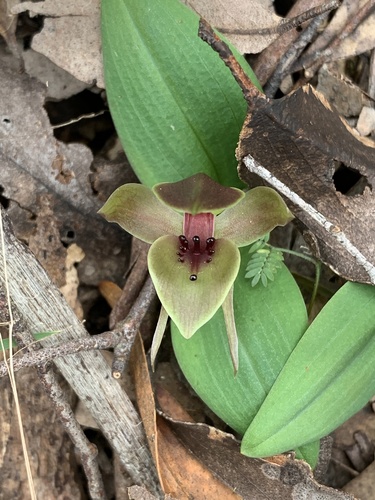
(c) Indra Bone, some rights reserved (CC BY-NC), uploaded by Indra Bone · cc-by-nc
Chiloglottis
Sign in to saveChiloglottis, commonly known as wasp orchids, ant orchids or bird orchids, is a genus of about 25 species of flowering plants in the orchid family, Orchidaceae and is found in eastern Australia and New Zealand. Wasp orchids are terrestrial herbs which grow in colonies of genetically identical plants. They usually have two leaves at the base of the plant and a single resupinate ("upside-down") flower. The labellum is more or less diamond-shaped and has calli resembling the body of a wingless female wasp.thumb|right|225px|Labelled image of Chiloglottis formicifera
Species
large bird-orchid
GENUS
- KingdomPlantae
- PhylumTracheophyta
- ClassLiliopsida
- OrderAsparagales
- FamilyOrchidaceae
via GBIF · Kew POWO
Museum specimens
- Specimen records
- 14
- With media
- 4
- Family
- Orchidaceae
- Collections
- MEL, CINC, NHMUK, GH, NCU, VT
- Recorded in
- Australia, New Zealand
Wikidata facts
- Instance of
- taxon
- Parent taxon
- Drakaeinae
- Image
- Chiloglottis diphylla (Illustrationes Florae Novae Hollandiae plate 8).jpg
Show 6 more facts
- Commons gallery
- Chiloglottis
- taxon name
- Chiloglottis
- taxon rank
- genus
- topic's main category
- Category:Chiloglottis
- Commons category
- Chiloglottis
Sources (1)
via Wikidata · CC0
~4 min read
Encyclopedic overview
6 sectionsContents
- Taxonomy and naming
- Distribution
- Ecology
- List of species
- References
- External links
Chiloglottis, commonly known as wasp orchids, ant orchids or bird orchids, is a genus of about 25 species of flowering plants in the orchid family, Orchidaceae and is found in eastern Australia and New Zealand. Wasp orchids are terrestrial herbs which grow in colonies of genetically identical plants. They usually have two leaves at the base of the plant and a single resupinate ("upside-down") flower. The labellum is more or less diamond-shaped and has calli resembling the body of a wingless female wasp.thumb|right|225px|Labelled image of Chiloglottis formicifera
==Taxonomy and naming== The genus Chiloglottis was first formally described in 1810 by Robert Brown. Brown described Chiloglottis diphylla at the same time, making it the type species.
Excerpted from Wikipedia’s “Chiloglottis” article, available under the CC BY-SA 4.0 licence.
Gallery (4)
Available in 16 languages
- Español
- Português
- Cebuano
- Egyptian Arabic
- Komi
- Komi-Permyak
- Moksha
- Nederlands
- Polski
- Svenska
- Tiếng Việt
- Udmurt
- Waray
- Western Mari
- فارسی
via Wikidata sitelinks · CC0