Chrysobalanaceae · Kew POWO · Kew Plants of the World Online
Chrysobalanaceae
Sign in to saveChrysobalanaceae is a family of flowering plants, consisting of trees and shrubs in 27 genera and about 700 species of pantropical distribution with a centre of diversity in the Amazon. Some of the species contain silica in their bodies for rigidity and so the mesophyll often has sclerenchymatous idioblasts. The widespread species Chrysobalanus icaco produces a plum-like fruit and the plant is commonly known as the coco plum.
OverviewAI-generated
Chrysobalanaceae is a family of plants within the kingdom Plantae. It belongs to the phylum Tracheophyta, class Magnoliopsida, and order Malpighiales. The taxon is currently accepted at the family rank.
Records for this family are held by several institutions, including MEL, IBUNAM, BRIT, and NY. These records document occurrences in countries such as Madagascar, Guyana, French Guiana, Belize, and Belice. The family has 212,546 recorded occurrences and 1,178 associated records, with 237 media items available.
Synthesized by Vinony from 29 facts across 8 sources: Wikidata, GBIF, PubMed, Gbif Occ, Plants of the World, WoRMS, iDigBio, Vinony graph. Generated from structured data (not the Wikipedia text) and checked against those facts — may still contain errors.
In the Vinony graph
Within Vinony's link graph, Chrysobalanaceae is referenced by 576 other articles, and connects out to Asterids, Vitaceae and Myrtales.
Vinony files it under Chrysobalanaceae, Malpighiales families and Pantropical flora.
Its subject is documented across 35 Wikipedia language editions.
Species
FAMILY
- KingdomPlantae
- PhylumTracheophyta
- ClassMagnoliopsida
- OrderMalpighiales
- FamilyChrysobalanaceae
General: to the Trigoniaceae, Euphroniaceae and Dichapetalaceae. The Chrysobalanaceae
via GBIF · Kew POWO
Museum specimens
- Specimen records
- 1,178
- With media
- 237
- Family
- Chrysobalanaceae
- Collections
- MEL, IBUNAM, BRIT, NY
- Recorded in
- Madagascar, Guyana, French Guiana, Belize, Belice, Bolivia (Plurinational State Of), Peru, Cameroon
Research
115 papers- Unraveling the biogeographical history of Chrysobalanaceae from plastid genomes.American journal of botany · 2016
- Isolation and Antimicrobial Activities of Phytochemicals from Parinari curatellifolia (Chrysobalanaceae).Advances in pharmacological and pharmaceutical sciences · 2021
- Fruits and wood of Parinari from the early Miocene of Panama and the fossil record of Chrysobalanaceae.American journal of botany · 2016
- Phenolic Composition, Toxicity Potential, and Antimicrobial Activity of Licania rigida Benth (Chrysobalanaceae) Leaf Extracts.Journal of medicinal food · 2022
- Chromones from Licania arianeae (Chrysobalanaceae).Natural product research · 2005
via PubMed
Wikidata facts
- Instance of
- taxon
- Parent taxon
- Euphorbiales
- Image
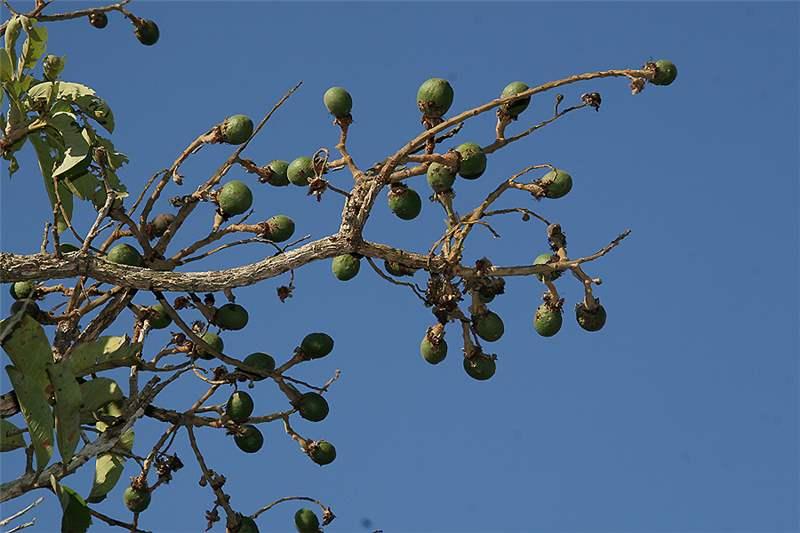
- Maranthes polyandra MS3969.jpg
Show 7 more facts
- Commons category
- Chrysobalanaceae
- taxon rank
- family
- taxon name
- Chrysobalanaceae
- topic's main category
- Category:Chrysobalanaceae
- taxonomic type
- Chrysobalanus
- taxon common name
- 可可李科
Sources (1)
via Wikidata · CC0
~2 min read
Encyclopedic overview
2 sectionsContents
- Genera
- References
Chrysobalanaceae is a family of flowering plants, consisting of trees and shrubs in 27 genera and about 700 species of pantropical distribution with a centre of diversity in the Amazon. Some of the species contain silica in their bodies for rigidity and so the mesophyll often has sclerenchymatous idioblasts. The widespread species Chrysobalanus icaco produces a plum-like fruit and the plant is commonly known as the coco plum.
The family was traditionally placed as subfamily Chrysobalanoideae in the rose family (Rosaceae) or as a family in the rose order and exceptionally as an order in Myrtiflorae by Dahlgren. In the phenotypic cladistic analysis of Nandi et al., it branched with Elaeagnaceae as sister group of Polygalaceae, in their molecular cladistic analysis it was in Malpighiales and also in their combined analysis.
Excerpted from Wikipedia’s “Chrysobalanaceae” article, available under the CC BY-SA 4.0 licence.