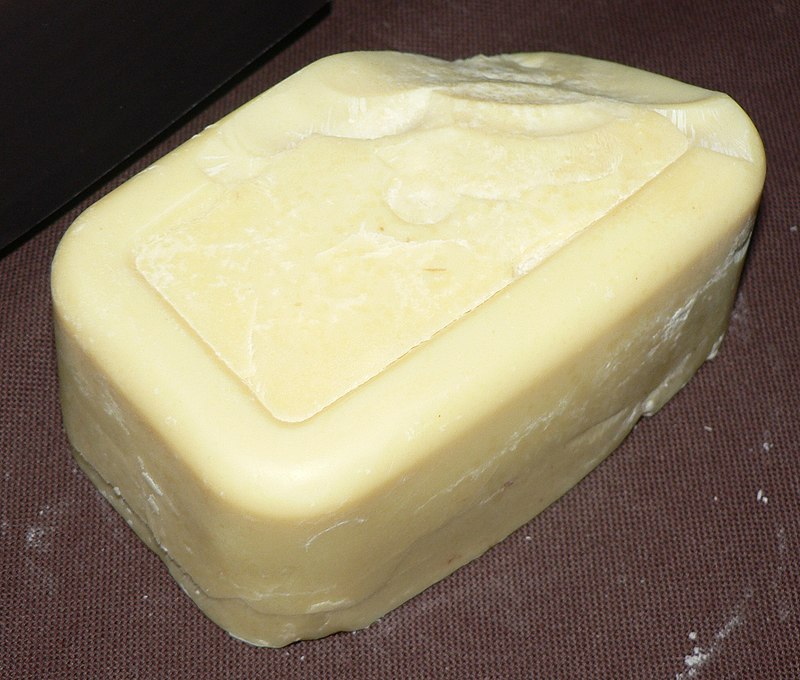
File:Cocoa_butter_p1410148.JPG · Wikimedia Commons · See Wikimedia Commons
cocoa butter
Sign in to saveAlso known as cocoa-butter, theobroma oil
pale-yellow, edible vegetable fat extracted from the cocoa bean
Key facts
- Total saturated
- 57–64%:, stearic acid (24–37%), palmitic acid (24–30%), myristic acid , (0–4%), arachidic acid (1%), lauric acid (0–1%)
- Total unsaturated
- 36–43%
- Monounsaturated
- 29–43%:, oleic acid (29–38%), palmitoleic acid (0–2%)
- Polyunsaturated
- 0–5%:, linoleic acid (0–4%), α-Linolenic acid (0–1%)
- Food energy per 100 g 3 5 oz
- 3,699 kilojoules (884 kcal)
- Melting point
- 34.1 °C (93.4 °F), 35–36.5 °C (95.0–97.7 °F)
- Solidity at 20 c 68 f
- solid
- Refractive index
- 1.44556–1.44573
- Iodine value
- 32.11–35.12, 35.575
- Saponification value
- 191.214, 192.88–196.29
via Wikipedia infobox
Wikidata facts
- Subclass of
- chemical substance
- Material used
- chocolate liquor
- Image
- Cocoa butter p1410148.JPG
Show 2 more facts
- Commons category
- Cocoa butter
- water footprint
- 33938
Sources (2)
via Wikidata · CC0
~6 min read
Encyclopedic overview
Cocoa butter, also called theobroma oil, is a pale-yellow, edible fat extracted from the cocoa bean (Theobroma cacao). It is used to make chocolate, as well as some ointments, toiletries, and pharmaceuticals. Cocoa butter has a cocoa flavor and aroma. Its melting point is slightly below human body temperature. It is an essential ingredient of chocolate and related confectionary products. Cocoa butter does not contain butter or other animal products; it is vegan.
Extraction and composition
Excerpted from Wikipedia’s “cocoa butter” article, available under the CC BY-SA 4.0 licence.