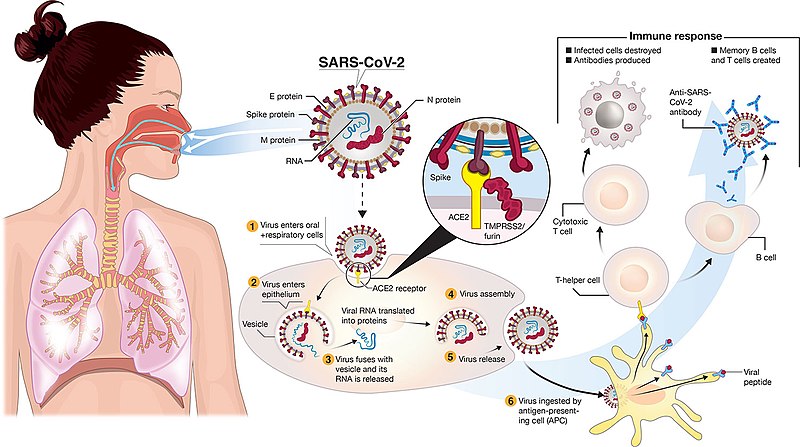
File:Fphar-11-00937-g001.jpg · Wikimedia Commons · See Wikimedia Commons
COVID-19
Sign in to saveAlso known as coronavirus disease 2019, nCOVD-19, 2019-nCoV acute respiratory disease, Novel Coronavirus Pneumonia, Severe Acute Respiratory Syndrome Coronavirus 2, Wuhan respiratory syndrome, severe acute respiratory syndrome type 2
Coronavirus disease 2019 (COVID-19) is a contagious disease caused by the coronavirus SARS-CoV-2. Starting in January 2020, the disease spread worldwide, resulting in the COVID-19 pandemic. In March 2020, the World Health Organization declared COVID-19 a global health emergency; they declared the end of the emergency in May 2023.
OverviewAI-generated
COVID-19, officially named coronavirus disease 2019, is an emerging communicable disease and atypical pneumonia caused by SARS-CoV-2. It was discovered in Wuhan in 2019. The illness is a zoonosis and viral pneumonia that can lead to acute respiratory distress syndrome and thrombosis. Transmission occurs through airborne transmission and droplet infection.
Symptoms include cough, fever, respiratory failure, and headache. The incubation period in humans ranges from a minimal two days to a maximal twenty-seven days. Medical examination may involve reverse transcription polymerase chain reaction, ELISA, computed tomography, or polymerase chain reaction. Possible treatments include symptomatic treatment, antiviral drugs, oxygen therapy, and immunotherapy. The case fatality rate is 0.023. Significant persons associated with the disease include Zhang Jixian and Zhong Nanshan.
Synthesized by Vinony from 30 facts across 4 sources: Wikidata, Firecrawl, PubMed, Vinony graph. Generated from structured data (not the Wikipedia text) and checked against those facts — may still contain errors.
Key facts
- Medical condition.name
- Coronavirus disease 2019(COVID-19)
- Medical condition.synonyms
- COVID, (the) coronavirus
- Medical condition.image
- Fphar-11-00937-g001.jpg
- Medical condition.image_size
- 310px
- Medical condition.specialty
- Infectious disease
- Medical condition.symptoms
- Fever, cough, fatigue, shortness of breath, vomiting, loss of taste or smell; some cases asymptomatic
- Medical condition.complications
- Pneumonia, sepsis, ARDS, kidney failure, respiratory failure, pulmonary fibrosis, CKS, MIS-C, long COVID, brain damage
- Medical condition.onset
- 2–14 days (typically 5)after infection
- Medical condition.duration
- 5 days to chronic
- Medical condition.cause
- SARS-CoV-2
- Medical condition.diagnosis
- RTPCR testing, CT scan, rapid antigen test
- Medical condition.prevention
- Vaccination, face coverings, quarantine, social distancing, ventilation, hand washing
- Medical condition.treatment
- Symptomatic and supportive
- Medical condition.frequency
- confirmed cases (true case count is expected to be much higher)
via Wikipedia infobox
Research
513,119 papers- Recent Developments on Therapeutic and Diagnostic Approaches for COVID-19.ReviewThe AAPS journal · 2021Majumder J, Minko TDOI: 10.1208/s12248-020-00532-2
- COVID-19 diagnosis -A review of current methods.ReviewBiosensors & bioelectronics · 2021Yüce M, Filiztekin E, Özkaya KGDOI: 10.1016/j.bios.2020.112752
- COVID-19 pandemic: from origins to outcomes. A comprehensive review of viral pathogenesis, clinical manifestations, diagnostic evaluation, and management.ReviewLe infezioni in medicina · 2021Ochani R, Asad A, Yasmin F et al.
- Resolution of coronavirus disease 2019 (COVID-19).ReviewExpert review of anti-infective therapy · 2020Habas K, Nganwuchu C, Shahzad F et al.DOI: 10.1080/14787210.2020.1797487
- COVID-19: A Review on the Novel Coronavirus Disease Evolution, Transmission, Detection, Control and Prevention.ReviewViruses · 2021Sharma A, Ahmad Farouk I, Lal SKDOI: 10.3390/v13020202
- Origin, transmission, diagnosis and management of coronavirus disease 2019 (COVID-19).ReviewPostgraduate medical journal · 2020Umakanthan S, Sahu P, Ranade AV et al.DOI: 10.1136/postgradmedj-2020-138234
- Tools and Techniques for Severe Acute Respiratory Syndrome Coronavirus 2 (SARS-CoV-2)/COVID-19 Detection.ReviewClinical microbiology reviews · 2021Safiabadi Tali SH, LeBlanc JJ, Sadiq Z et al.DOI: 10.1128/CMR.00228-20
- COVID-19: Progress in diagnostics, therapy and vaccination.ReviewTheranostics · 2020Liu X, Liu C, Liu G et al.DOI: 10.7150/thno.47987
via PubMed
Described at

Coronavirus disease (COVID-19)
Information on COVID-19, the infectious disease caused by the most recently discovered coronavirus.
who.int →Digital solutions & channels to help keep communities everywhere safe and informed during the COVID-19 pandemic and beyond.
Excerpt from a page describing this subject · 8,347 chars · not written by Vinony
Wikidata facts
- Subclass of
- disease
- Official name
- مرض فيروس كورونا
- Image
- Fphar-11-00937-g001.jpg
- Number of deaths
- 6250843
- Significant event
- COVID-19 pandemic
Show 34 more facts
- has cause
- SARS-CoV-2
- has effect
- long covid
- symptoms and signs
- erectile dysfunction
- health specialty
- epidemiology
- maximal incubation period in humans
- 27
- described at URL
- koronavirus.gov.hu
- minimal incubation period in humans
- 2
- time of discovery or invention
- 2019-12-00
- location of discovery
- Wuhan
- hashtag
- coronavirus
- medical examination
- COVID-19 rapid antigen test
- Commons category
- COVID-19
- short name
- کووِڈ-19
- possible treatment
- antiserum
- case fatality rate
- 0.023
- significant person
- Zhong Nanshan
- history of topic
- timeline of the COVID-19 pandemic
- number of cases
- 517116168
- maintained by WikiProject
- WikiProject COVID-19
- topic's main category
- Category:COVID-19
- topic's main Wikimedia portal
- Portal:COVID-19
- on focus list of Wikimedia project
- Wikipedia:Vital articles/Level/4
- risk factor
- asthma
- basic reproduction number
- 5.7
- NCI Thesaurus ID
- C171133
- number of recoveries
- 471603183
- subject has role
- acute respiratory distress syndrome
- has natural reservoir
- mink
- exact match
- identifiers.org/doid/DOID:0080600
- manifestation of
- disease X
- handled, mitigated, or managed by
- treatment of COVID-19
- social media followers
- 357740
- P8168
- Q1089827
- Stack Exchange tag
- sports.stackexchange.com/tags/covid-19
Sources (15)
via Wikidata · CC0
~76 min read
Encyclopedic overview
65 sectionsContents
- Nomenclature
- Signs and symptoms
- Complications
- Cause
- Transmission
- Virology
- SARS-CoV-2 variants
- Pathophysiology
- Respiratory tract
- Nervous system
- Gastrointestinal tract
- Cardiovascular system
- Kidneys
- Immunopathology
- Viral and host factors
- Virus proteins
- Host factors
- Host cytokine response
- Pregnancy response
- Diagnosis
- Viral testing
- Imaging
- Coding
- Pathology
- Prevention
- Vaccine
- Face masks and respiratory hygiene
- Indoor ventilation and avoiding crowded indoor spaces
- Hand-washing and hygiene
- Social distancing
- Surface cleaning
- Self-isolation
- International travel-related control measures
- Treatment
- Prognosis and risk factors
- Genetic risk factors
- Blood group
- Children
- Long-term effects
- Immunity
- Mortality
- Case fatality rate
- Infection fatality rate
- Estimates
- Earlier estimates of IFR
- Sex differences
- Ethnic differences
- Comorbidities
- History
- Misinformation
- Other species
- Research
- Transmission and prevention research
- Treatment-related research
- Cytokine storm
- Passive antibodies
- Bioethics
- See also
- References
- Further reading
- External links
- Health agencies
- Directories
- Medical journals
- Treatment guidelines
Coronavirus disease 2019 (COVID-19) is a contagious disease caused by the coronavirus SARS-CoV-2. Starting in January 2020, the disease spread worldwide, resulting in the COVID-19 pandemic. In March 2020, the World Health Organization declared COVID-19 a global health emergency; they declared the end of the emergency in May 2023.
The symptoms of COVID‑19 can vary but often include fever, fatigue, cough, breathing difficulties, loss of smell, and loss of taste. Symptoms may begin one to 14 days after exposure to the virus. At least a third of people who are infected do not develop noticeable symptoms. Of those who develop symptoms noticeable enough to be classified as patients, most (81%) develop mild to moderate symptoms (up to mild pneumonia), while 14% develop severe symptoms (dyspnea, hypoxia, or more than 50% lung involvement on imaging), and 5% develop critical symptoms (respiratory failure, shock, or multiorgan dysfunction). Older people have a higher risk of developing severe symptoms and dying. Some people experience persistent symptoms (long COVID), for months or years after infection, including fatigue, cognitive issues and shortness of breath. Damage to organs has been observed in a subset.
Excerpted from Wikipedia’s “COVID-19” article, available under the CC BY-SA 4.0 licence.
Gallery (32)
Available in 205 languages
- Español
- Français
- Deutsch
- 中文
- 日本語
- Русский
- Português
- Italiano
- العربية
- हिन्दी
- Afrikaans
- Akan
- Albanian
- Amharic
- ami
- Angika
- Aragonese
- Armenian
Show 186 more
- Arpitan
- Assamese
- Asturian
- Atikamekw
- Avaric
- Awadhi
- azb
- Azerbaijani
- Bahasa Indonesia
- Bangla
- Banjar
- Basque
- be_x_old
- Belarusian
- Bhojpuri
- Bikol
- blk
- Bosnian
- Breton
- btm
- Buginese
- Bulgarian
- Buriat
- Burmese
- Catalan
- cdo
- Central Kurdish
- Cherokee
- Church Slavic
- Chuvash
- Crimean Tatar
- Croatian
- Czech
- dag
- Danish
- Dinka
- Divehi
- Dzongkha
- Egyptian Arabic
- eml
- Esperanto
- Estonian
- Fiji Hindi
- Filipino
- Finnish
- Fon
- Fula
- Galician
- Gan Chinese
- Georgian
- Gorontalo
- gpe
- Greek
- Guarani
- Gujarati
- guw
- Haitian Creole
- Hakka Chinese
- Hausa
- Hawaiian
- Hebrew
- Hungarian
- Icelandic
- Ido
- Interlingua
- Inuktitut
- Irish
- Javanese
- Kabyle
- Kannada
- Kanuri
- Kashmiri
- Kazakh
- Khmer
- Kikuyu
- Kinyarwanda
- Kurdish
- Kyrgyz
- Lao
- Latin
- Latvian
- Limburgish
- Lingala
- Lithuanian
- Lombard
- Low German
- Luxembourgish
- Macedonian
- Maithili
- Malay
- Malayalam
- Manipuri
- Manx
- Māori
- Marathi
- Mari
- Mazanderani
- Minangkabau
- Mingrelian
- mnw
- Mongolian
- Moroccan Arabic
- nds_nl
- Nederlands
- Nepali
- Northern Frisian
- Norwegian
- Norwegian Nynorsk
- nrm
- Nyanja
- Occitan
- Odia
- Old English
- Papiamento
- Pashto
- Polski
- ppl
- Punjabi
- pwn
- Quechua
- roa_rup
- Romanian
- Romansh
- Rusyn
- Santali
- Sardinian
- Scots
- Serbian
- Serbian (Latin)
- Shan
- Shona
- Sicilian
- Silesian
- simple
- Sindhi
- Sinhala
- Slovak
- Slovenian
- South Ndebele
- Southern Sotho
- Standard Moroccan Tamazight
- Sundanese
- Svenska
- Swahili
- Swati
- syl
- szy
- Tamil
- Taroko
- Tatar
- tay
- tdd
- Telugu
- Tetum
- Tibetan
- Tiếng Việt
- Toki Pona
- Tongan
- Tsonga
- Tulu
- Tumbuka
- Türkçe
- Turkmen
- Tyap
- Ukrainian
- Urdu
- Uyghur
- Uzbek
- Walloon
- Waray
- Wayuu
- Welsh
- Western Frisian
- Western Panjabi
- Wu Chinese
- Yakut
- Yoruba
- Zaza
- zh_classical
- zh_min_nan
- zh_yue
- Zhuang
- Zulu
- فارسی
- ไทย
- 한국어
via Wikidata sitelinks · CC0