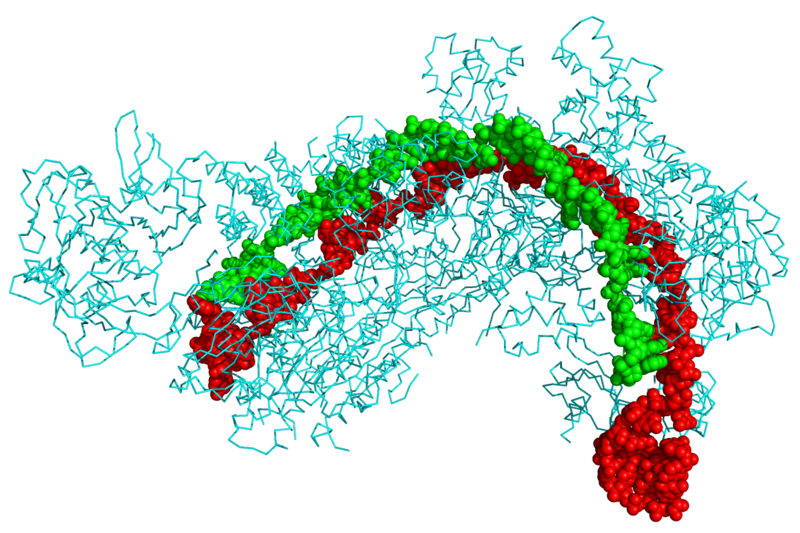
File:4QYZ.png · Wikimedia Commons · See Wikimedia Commons
CRISPR
Sign in to saveAlso known as clustered regularly interspaced short palindromic repeats
Muster im Erbgut von Bakterien
Key facts
- Nonhuman protein.Name
- Cascade (CRISPR-associated complex for antiviral defense)
- Nonhuman protein.image
- 4QYZ.png
- Nonhuman protein.caption
- CRISPR Cascade protein (cyan) bound to CRISPR RNA (green) and phage DNA (red)
- Nonhuman protein.Organism
- Escherichia coli
- Nonhuman protein.TaxID
- 511145
- Nonhuman protein.Symbol
- CRISPR
- Nonhuman protein.EntrezGene
- 947229
- Nonhuman protein.PDB
- 4QYZ
- Nonhuman protein.UniProt
- P38036
- Nonhuman protein.RefSeqProtein
- NP_417241.1
- Protein family.Symbol
- CRISPR_assoc
- Protein family.Name
- CRISPR associated protein CasC/Cse3/Cas6 (Type I effector RNase)
- Protein family.image
- PDB 1wj9 EBI.jpg
- Protein family.caption
- Crystal structure of a crispr-associated protein from Thermus thermophilus
- Protein family.Pfam
- PF08798
- Protein family.InterPro
- IPR010179
- Protein family.CDD
- cd09727
- Protein family.Pfam_clan
- CL0362
via Wikipedia infobox
Research
67,864 papers- Genome modification by CRISPR/Cas9.The FEBS journal · 2014
- CRISPR/Cas9 Immune System as a Tool for Genome Engineering.Archivum immunologiae et therapiae experimentalis · 2017
- CRISPR-Based Gene Therapies: From Preclinical to Clinical Treatments.Cells · 2024
- Advances in therapeutic CRISPR/Cas9 genome editing.Translational research : the journal of laboratory and clinical medicine · 2016
- CRISPR/Cas System: Recent Advances and Future Prospects for Genome Editing.Trends in plant science · 2019
via PubMed
Wikidata facts
- Subclass of
- DNA sequence
- Image
- CAS 4qyz.png
Show 5 more facts
- Commons category
- CRISPR
- derivative work
- CRISPR-Cas method
- location of discovery
- University of Osaka
- discoverer or inventor
- Yoshizumi Ishino
- time of discovery or invention
- 1987-00-00
Sources (2)
via Wikidata · CC0
Article · Deutsch
CRISPR (Clustered Regularly Interspaced Short Palindromic Repeats) sind Abschnitte sich wiederholender DNA (repeats), die im Erbgut vieler Bakterien und Archaeen auftreten. Sie dienen einem Mechanismus, dem CRISPR/Cas-System, der Resistenz gegen das Eindringen fremden Erbguts von Viren oder Plasmiden verschafft, und sind hierdurch ein Teil des Immunsystem-Äquivalents vieler Prokaryoten. Dieses System bildet die Grundlage der gentechnischen CRISPR/Cas-Methode zur Erzeugung gentechnisch veränderter Organismen.
Abstract from DBpedia / Wikipedia · CC BY-SA