File:4QYZ.png · Wikimedia Commons · See Wikimedia Commons
کریسپر
Sign in to saveAlso known as clustered regularly interspaced short palindromic repeats
thumb|262px|Diagram of the CRISPR prokaryotic antiviral defense mechanism CRISPR (; acronym for clustered regularly interspaced short palindromic repeats) is a family of DNA sequences found in the genomes of prokaryotic organisms such as bacteria and archaea. Each sequence within an individual prokaryotic CRISPR is derived from a DNA fragment of a bacteriophage that had previously infected the prokaryote or one of its ancestors. These sequences are used to detect and destroy DNA from similar bacteriophages during subsequent infections. Hence these sequences play a key role in the antiviral (i.
Key facts
- Nonhuman protein.Name
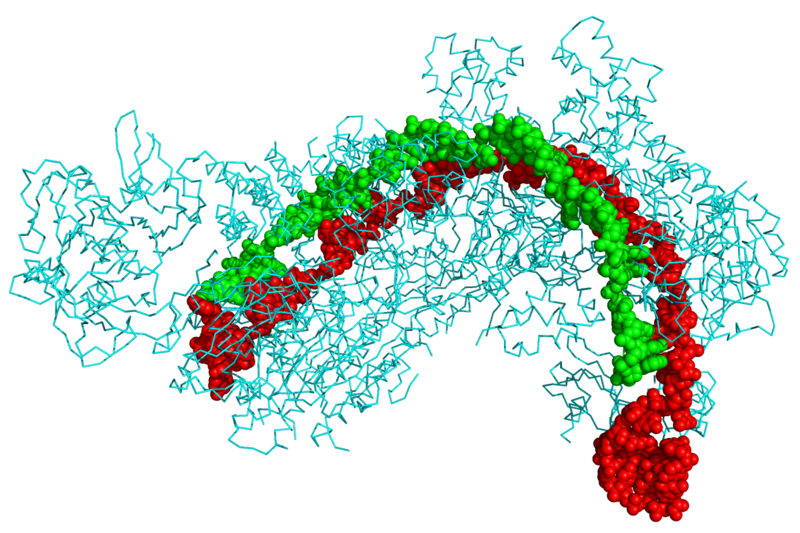
- Cascade (CRISPR-associated complex for antiviral defense)
- Nonhuman protein.image
- 4QYZ.png
- Nonhuman protein.caption
- CRISPR Cascade protein (cyan) bound to CRISPR RNA (green) and phage DNA (red)
- Nonhuman protein.Organism
- Escherichia coli
- Nonhuman protein.TaxID
- 511145
- Nonhuman protein.Symbol
- CRISPR
- Nonhuman protein.EntrezGene
- 947229
- Nonhuman protein.PDB
- 4QYZ
- Nonhuman protein.UniProt
- P38036
- Nonhuman protein.RefSeqProtein
- NP_417241.1
- Protein family.Symbol
- CRISPR_assoc
- Protein family.Name
- CRISPR associated protein CasC/Cse3/Cas6 (Type I effector RNase)
- Protein family.image
- PDB 1wj9 EBI.jpg
- Protein family.caption
- Crystal structure of a crispr-associated protein from Thermus thermophilus
- Protein family.Pfam
- PF08798
- Protein family.InterPro
- IPR010179
- Protein family.CDD
- cd09727
- Protein family.Pfam_clan
- CL0362
via Wikipedia infobox
Research
67,864 papers- Genome modification by CRISPR/Cas9.The FEBS journal · 2014
- CRISPR/Cas9 Immune System as a Tool for Genome Engineering.Archivum immunologiae et therapiae experimentalis · 2017
- CRISPR-Based Gene Therapies: From Preclinical to Clinical Treatments.Cells · 2024
- Advances in therapeutic CRISPR/Cas9 genome editing.Translational research : the journal of laboratory and clinical medicine · 2016
- CRISPR/Cas System: Recent Advances and Future Prospects for Genome Editing.Trends in plant science · 2019
via PubMed
Wikidata facts
- Subclass of
- DNA sequence
- Image
- CAS 4qyz.png
Show 5 more facts
- Commons category
- CRISPR
- derivative work
- CRISPR-Cas method
- location of discovery
- University of Osaka
- discoverer or inventor
- Yoshizumi Ishino
- time of discovery or invention
- 1987-00-00
Sources (2)
via Wikidata · CC0