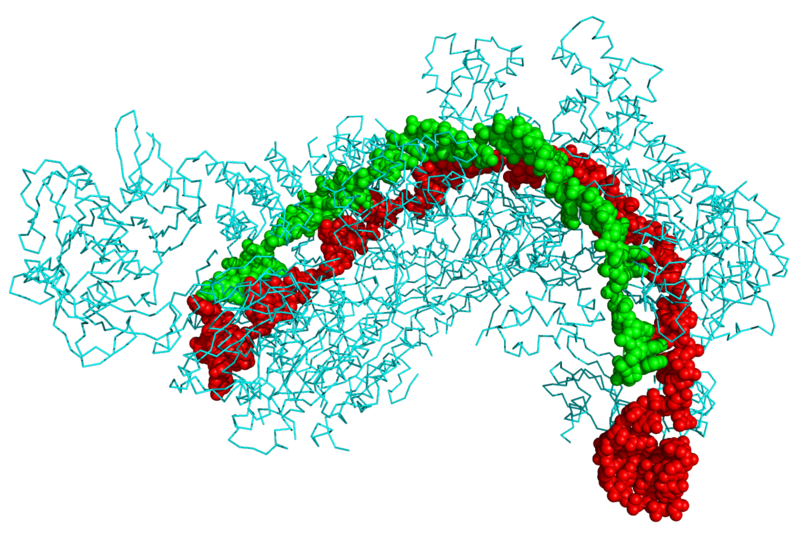
File:4QYZ.png · Wikimedia Commons · See Wikimedia Commons
CRISPR/Cas 系統
Sign in to saveAlso known as clustered regularly interspaced short palindromic repeats
thumb|262px|Diagram of the CRISPR prokaryotic antiviral defense mechanism CRISPR (; acronym for clustered regularly interspaced short palindromic repeats) is a family of DNA sequences found in the genomes of prokaryotic organisms such as bacteria and archaea. Each sequence within an individual prokaryotic CRISPR is derived from a DNA fragment of a bacteriophage that had previously infected the prokaryote or one of its ancestors. These sequences are used to detect and destroy DNA from similar bacteriophages during subsequent infections. Hence these sequences play a key role in the antiviral (i.
Key facts
- Nonhuman protein.Name
- Cascade (CRISPR-associated complex for antiviral defense)
- Nonhuman protein.image
- 4QYZ.png
- Nonhuman protein.caption
- CRISPR Cascade protein (cyan) bound to CRISPR RNA (green) and phage DNA (red)
- Nonhuman protein.Organism
- Escherichia coli
- Nonhuman protein.TaxID
- 511145
- Nonhuman protein.Symbol
- CRISPR
- Nonhuman protein.EntrezGene
- 947229
- Nonhuman protein.PDB
- 4QYZ
- Nonhuman protein.UniProt
- P38036
- Nonhuman protein.RefSeqProtein
- NP_417241.1
- Protein family.Symbol
- CRISPR_assoc
- Protein family.Name
- CRISPR associated protein CasC/Cse3/Cas6 (Type I effector RNase)
- Protein family.image
- PDB 1wj9 EBI.jpg
- Protein family.caption
- Crystal structure of a crispr-associated protein from Thermus thermophilus
- Protein family.Pfam
- PF08798
- Protein family.InterPro
- IPR010179
- Protein family.CDD
- cd09727
- Protein family.Pfam_clan
- CL0362
via Wikipedia infobox
Research
67,864 papers- Genome modification by CRISPR/Cas9.The FEBS journal · 2014
- CRISPR/Cas9 Immune System as a Tool for Genome Engineering.Archivum immunologiae et therapiae experimentalis · 2017
- CRISPR-Based Gene Therapies: From Preclinical to Clinical Treatments.Cells · 2024
- Advances in therapeutic CRISPR/Cas9 genome editing.Translational research : the journal of laboratory and clinical medicine · 2016
- CRISPR/Cas System: Recent Advances and Future Prospects for Genome Editing.Trends in plant science · 2019
via PubMed
Wikidata facts
- Subclass of
- DNA sequence
- Image
- CAS 4qyz.png
Show 5 more facts
- Commons category
- CRISPR
- derivative work
- CRISPR-Cas method
- location of discovery
- University of Osaka
- discoverer or inventor
- Yoshizumi Ishino
- time of discovery or invention
- 1987-00-00
Sources (2)
via Wikidata · CC0
Article · 中文
CRISPR(IPA:/ˈkrɪspər/;DJ:/ˈkrispə/;KK:/ˈkrɪspɚ/)1987年日本科學家在大腸桿菌的基因組發現有特別的規律序列,某一小段DNA會一直重複,重複片段之間又有相等長的間隔,此序列稱為 CRISPR (clustered, regularly interspaced, short palindromic repeats)。它是存在於细菌中的一種基因,該類基因組中含有曾經攻擊過該細菌的病毒的基因片段。細菌透過這些基因片段來偵測並抵抗相同病毒的攻擊,並摧毁其DNA。這類基因組是細菌免疫系统的關鍵組成部分。透過這些基因组,人類可以準確且有效地編輯生命體内的部分基因,也就是CRISPR/Cas9基因編輯技術。 CRISPR/Cas系統,為目前發現存在於多數細菌與絕大多數的古菌中的一種後天免疫系統,以消滅外來的质粒或者噬菌體,並在自身基因組中留下外來基因片段作為“記憶”。臺灣翻譯全名為常間回文重複序列叢集/常間回文重複序列叢集關聯蛋白系統,中國大陸則為规律间隔成簇短回文重复序列/规律间隔成簇短回文重复序列相关蛋白系统(或相关核酸酶系统)(Clustered Regularly Interspaced Short Palindromic Repeats/CRISPR-associated proteins)。 目前已發現三種不同類型的 CRISPR/Cas系統,存在於大約40%和90%已定序的细菌和古菌中。其中第二型的組成較為簡單,以Cas9蛋白以及嚮導RNA(gRNA)為核心的組成。 Cas9是第一個被廣泛應用的CRISPR核酸酶,其次是Cpf1,其在的CRISPR/Cpf1系统中被發現。其它這樣的系統被認為存在。 由於其對DNA干擾(DNAi)的特性(參見RNAi),目前被積極地應用於遺傳工程中,作為基因體剪輯工具,與鋅指核酸酶(ZFN)及類轉錄活化因子核酸酶(TALEN)同樣利用非同源性末端接合(NHEJ)的機制,於基因體中產生DNA的双链断裂以利剪輯。第二型 CRISPR/Cas 經由遺傳工程的改造應用於哺乳類細胞及斑馬魚的基因體剪輯。其設計簡單以及操作容易的特性為最大的優點,目前已逐步應用在各種不同的模式生物當中。
Abstract from DBpedia / Wikipedia · CC BY-SA