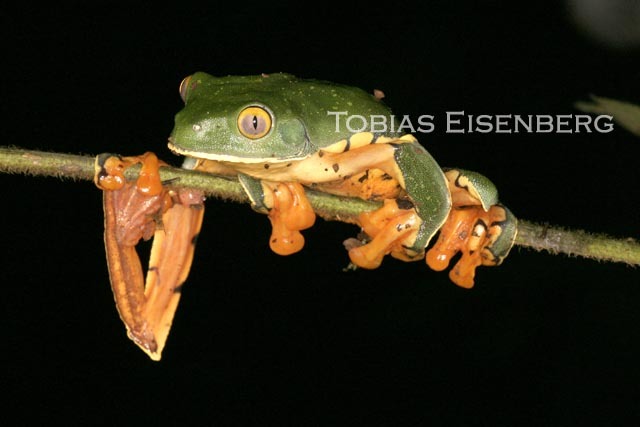
Cruziohyla
Cruziohyla is a genus of frogs in the subfamily Phyllomedusinae. They occur from Honduras in Central America south to the Amazon Basin in South America. This genus was erected in 2005 following a major revision of the Hylidae and fully reviewed in 2018. Species in this genus were previously placed in the genera Agalychnis or Phyllomedusa.
Species
GENUS
- KingdomAnimalia
- PhylumChordata
- ClassAmphibia
- OrderAnura
- FamilyPhyllomedusidae
Cruziohyla is een geslacht van kikkers uit de familie Phyllomedusidae. De groep behoorde lange tijd tot de boomkikkers en werd voor het eerst wetenschappelijk beschreven door Julián Faivovich, Célio Fernando Baptista Haddad, Paulo Christiano de Anchietta Garcia, Darrel Richmond Frost, Jonathan Atwood Campbell en Ward C. Wheeler in 2005. De geslachtsnaam Cruziohyla is een eerbetoon aan de Braziliaanse herpetoloog Carlos Alberto Gonçalves da Cruz (1944). Er zijn drie soorten die voorkomen in delen van Midden- en Zuid-Amerika en leven in de landen Brazilië, Colombia, Costa Rica, Ecuador, Honduras, Nicaragua, Panama en Peru, vermoedelijk ook in Bolivia.
via GBIF
Article
2 sectionsContents
- Species
- References
Cruziohyla is a genus of frogs in the subfamily Phyllomedusinae. They occur from Honduras in Central America south to the Amazon Basin in South America. This genus was erected in 2005 following a major revision of the Hylidae and fully reviewed in 2018. Species in this genus were previously placed in the genera Agalychnis or Phyllomedusa.
These frogs are characterized by extensive hand and foot webbing. Their eye has a bicoloured iris. Tadpoles develop in water-filled depressions on fallen trees. The name Cruziohyla honors Brazilian herpetologist Carlos Alberto Gonçalves da Cruz.