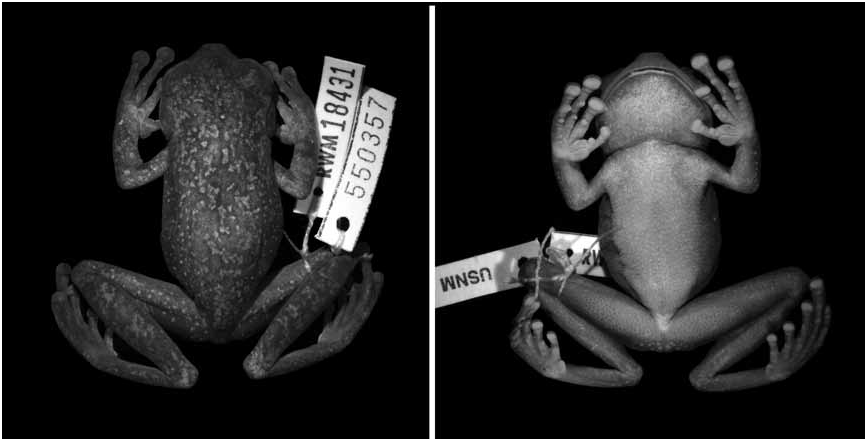
Myersiohyla
Myersiohyla is a genus of frogs in the family Hylidae. It was erected in 2005 following a major revision of the Hylidae and initially included four species that were previously placed in the genus Hyla. The genus is found in the tepui region of Guyana and Venezuela.
Species
GENUS
- KingdomAnimalia
- PhylumChordata
- ClassAmphibia
- OrderAnura
- FamilyHylidae
Herpetologie Myersiohyla is een geslacht van kikkers uit de familie boomkikkers (Hylidae).[1] De groep werd voor het eerst wetenschappelijk beschreven door Julián Faivovich, Célio Fernando Baptista Haddad, Paulo Christiano de Anchietta Garcia, Darrel Richmond Frost, Jonathan Atwood Campbell en Ward C. Wheeler in 2005. Er zijn zes soorten, inclusief twee soorten die pas in 2013 zijn beschreven. Alle soorten komen voor in delen van Zuid-Amerika en leven in de landen Guyana en Venezuela.[2] Soorten Geslacht Myersiohyla Soort Myersiohyla aromatica Soort Myersiohyla chamaeleo Soort Myersiohyla inparquesi Soort Myersiohyla kanaima Soort Myersiohyla loveridgei Soort Myersiohyla neblinaria Referenties ↑ Darrel R. Frost - Amphibian Species of the World: an online reference - Version 6.0 - American Museum of Natural History, Myersiohyla. ↑ University of California - AmphibiaWeb, Myersiohyla. Bronnen (en) - Darrel R. Frost - Amphibian Species of the World: an online reference - Version 6.0 - American Museum of Natural History - Myersiohyla - Website Geconsulteerd 1 december 2016 (en) - University of California - AmphibiaWeb - Myersiohyla - Website
via GBIF
Article
3 sectionsContents
- Species
- References
- Further reading
Myersiohyla is a genus of frogs in the family Hylidae. It was erected in 2005 following a major revision of the Hylidae and initially included four species that were previously placed in the genus Hyla. The genus is found in the tepui region of Guyana and Venezuela.
==Species== There are six species in this genus: Myersiohyla aromatica (Ayarzagüena and Señaris, 1994) Myersiohyla chamaeleo (Faivovich, McDiarmid, and Myers, 2013) Myersiohyla inparquesi (Ayarzagüena and Señaris, 1994) Myersiohyla liliae (Kok, 2006) Myersiohyla loveridgei (Rivero, 1961) Myersiohyla neblinaria (Faivovich, McDiarmid, and Myers, 2013)