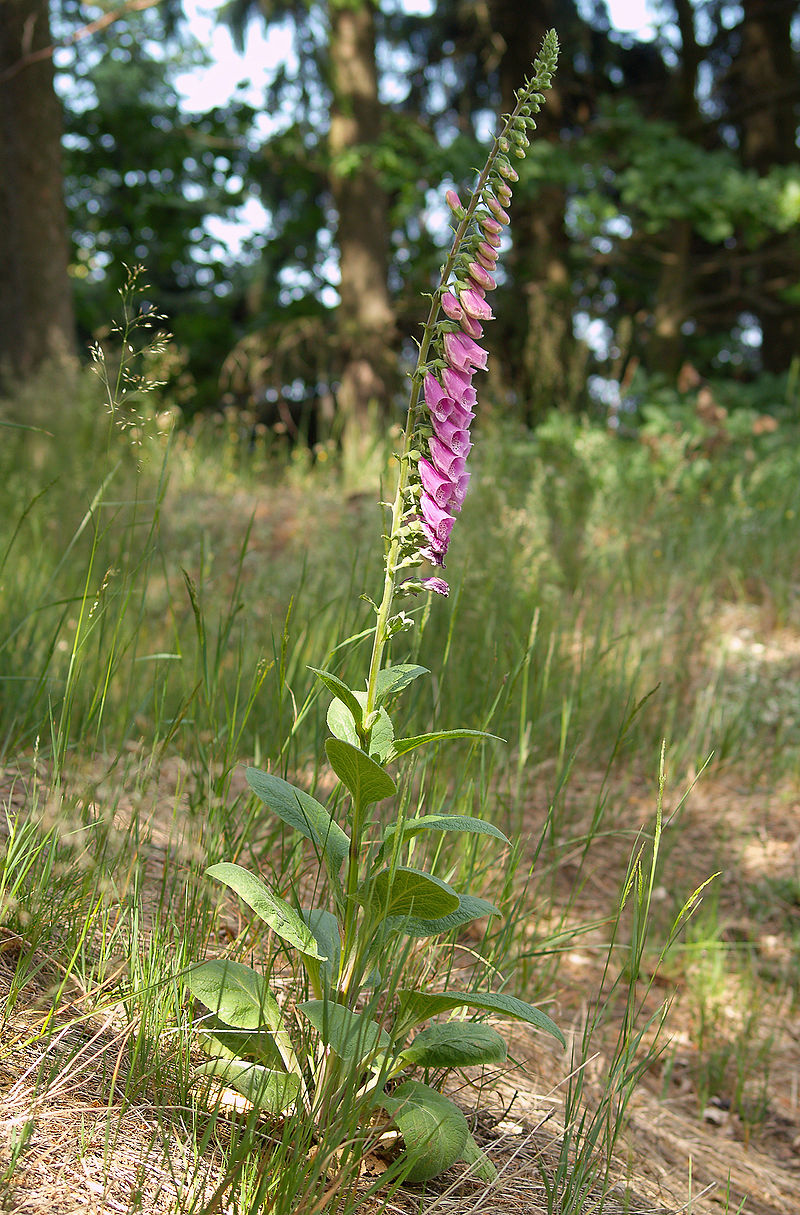
File:Digitalis_purpurea_LC0101.jpg · Wikimedia Commons · See Wikimedia Commons
Digitalis purpurea
Sign in to saveAlso known as Foxglove, Fairy bells
toxic flowering plant in the family Plantaginaceae
OverviewAI-generated
Digitalis purpurea, commonly known as Foxglove, is a species of herbaceous, biennial, and poisonous plant within the family Plantaginaceae. It belongs to the genus Digitalis and is classified under the order Lamiales and class Magnoliopsida. The species produces a capsule as its fruit type and is utilized as a medicinal plant, specifically for the production of the heart drug digitalis.
The plant is native to regions including Belgium, Corse, Czechia-Slovakia, France, Germany, Great Britain, Ireland, Morocco, Portugal, Sardegna, Spain, and Sweden. Its taxon range also includes Beijing, China, Fujian, and Guangdong. Records from iDigBio indicate the presence of the species in Mexico, with collections held by institutions such as UACH, ENCB-IPN, INECOL, IIB-UV, and IBUNAM. The IUCN Red List assessed the species as Least Concern in 2014.
Synthesized by Vinony from 38 facts across 7 sources: Wikidata, GBIF, IUCN Red List, Gbif Occ, Plants of the World, iDigBio, Vinony graph. Generated from structured data (not the Wikipedia text) and checked against those facts — may still contain errors.
Species
Least ConcernDigitalis purpurea
SPECIES
- KingdomPlantae
- PhylumTracheophyta
- ClassMagnoliopsida
- OrderLamiales
- FamilyPlantaginaceae
毛地黄(学名:Digitalis purpurea;foxglove、common foxglove、purple foxglove、lady's glove)为玄參科毛地黄属下的一个种,廣泛分佈於溫帶歐洲。也見於北美和其他溫帶部分地區。此植物是提煉心臟科藥物地高辛的來源。 本物種為著名的藥用有毒植物,全株皆有毒。與同作藥用的有毒植物如馬醉木等是少數可作為觀賞用之有毒卻有藥用的有毒植物。(至於大花曼陀羅、海檬果、夾竹桃等則是未被作為藥用,純為觀賞用。)
via GBIF · IUCN · Kew POWO
Museum specimens
- Specimen records
- 3,960
- With media
- 2,833
- Family
- Plantaginaceae
- Collections
- UACH, ENCB-IPN, INECOL, IIB-UV, IBUNAM, FC-UNAM
- Recorded in
- Mexico
Wikidata facts
- Instance of
- taxon
- Subclass of
- poisonous plant
- Parent taxon
- Digitalis
- Image
- Digitalis-stora hultrum.sweden-24.jpg
- Has use
- medicinal plant
Show 11 more facts
- taxon name
- Digitalis purpurea
- taxon rank
- species
- Commons category
- Digitalis purpurea
- Commons gallery
- Digitalis purpurea
- has fruit type
- capsule
- taxon range
- Myanmar
- short name
- D. purpurea
- taxon author citation
- L.
- taxon common name
- sanxuaniegu
- external data available at URL
- www.gbif.org/dataset/93725bf2-6ada-47f9-bd5e-0e679e3d245e
Sources (9)
via Wikidata · CC0
~11 min read
Encyclopedic overview
Digitalis purpurea, the foxglove or common foxglove, is a toxic species of flowering plant in the plantain family Plantaginaceae, native to and widespread throughout most of temperate Europe. It has also naturalized in parts of North America, as well as some other temperate regions. The plant is a popular garden subject, with many cultivars available. It is the original source of the heart medicine digoxin (also called digitalis or digitalin). This biennial plant grows as a rosette of leaves in the first year after sowing, before flowering and then dying in the second year (i.e., it is monocarpic). It generally produces enough seeds so that new plants will continue to grow in a garden setting.
Description
Excerpted from Wikipedia’s “Digitalis purpurea” article, available under the CC BY-SA 4.0 licence.
Gallery (17)
Available in 60 languages
- Español
- Français
- Deutsch
- 中文
- 日本語
- Русский
- Português
- Italiano
- العربية
- Albanian
- Aragonese
- Armenian
- Asturian
- Azerbaijani
- Bahasa Indonesia
- Basque
- Belarusian
- Breton
Show 41 more
- Catalan
- Cebuano
- Corsican
- Croatian
- Czech
- Danish
- Egyptian Arabic
- Esperanto
- Estonian
- Finnish
- Galician
- Hebrew
- Hungarian
- Irish
- Kazakh
- Latvian
- Lithuanian
- Malayalam
- nds_nl
- Nederlands
- Northern Frisian
- Norwegian
- Norwegian Nynorsk
- nrm
- Ossetic
- Pashto
- Polski
- Romanian
- Scots
- Slovak
- Svenska
- Tiếng Việt
- Türkçe
- Ukrainian
- Upper Sorbian
- Uzbek
- Waray
- Welsh
- zh_classical
- فارسی
- 한국어
via Wikidata sitelinks · CC0