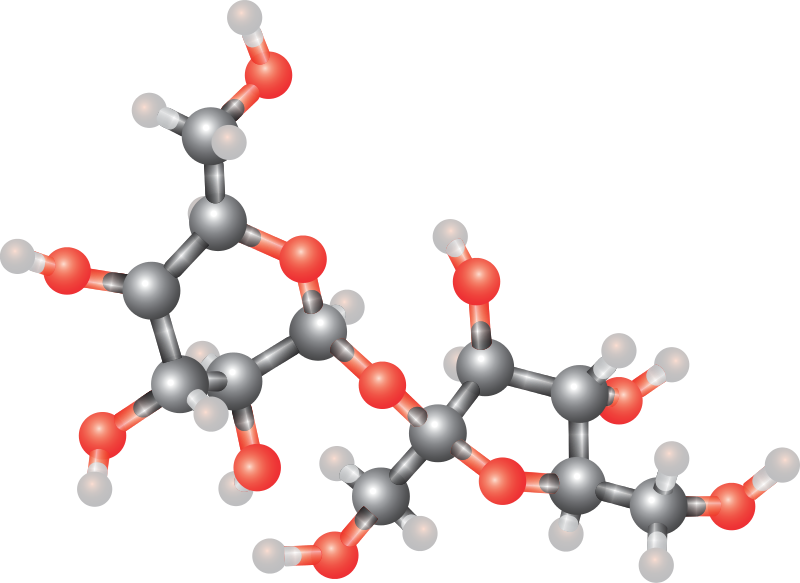
File:Sucrose_molecule.svg · Wikimedia Commons · See Wikimedia Commons
disaccharide
Sign in to saveAlso known as double sugar, biose, disaccharides
thumb|287x287px|Sucrose, a disaccharide formed from condensation of a molecule of glucose and a molecule of fructose A disaccharide (also called a double sugar or biose) is the sugar formed when two monosaccharides are joined by glycosidic linkage. Like monosaccharides, disaccharides are simple sugars soluble in water. Three common examples are sucrose, lactose, and maltose.
A disaccharide is a type of sugar made up of two smaller sugar molecules linked together, with sucrose (table sugar), lactose (milk sugar), and maltose (malt sugar) being common examples. Like simpler sugars, disaccharides dissolve in water and serve as important sources of energy and sweetness in foods and beverages.
AI-generated from the Wikipedia summary — may contain errors.
Research
77,580 papers- Disaccharide intolerance.ReviewPediatric clinics of North America · 1967Davidson MDOI: 10.1016/s0031-3955(16)31945-9
- Disaccharide digestion and maldigestion.ReviewScandinavian journal of gastroenterology. Supplement · 1996Gudmand-Høyer E, Skovbjerg HDOI: 10.3109/00365529609094566
- [Disaccharide intolerance].ReviewCeskoslovenska pediatrie · 1965Brunecký Z
- Synthesis of the Disaccharide Core of Ezomycin Nucleosides.Organic letters · 2023Fan S, Jiang T, Lv T et al.DOI: 10.1021/acs.orglett.3c01494
- Immunochemical Detection and Glycosaminoglycan Disaccharide-Based Characterization of Chondroitin Sulfate Proteoglycans.Methods in molecular biology (Clifton, N.J.) · 2023Mikami T, Kitagawa HDOI: 10.1007/978-1-0716-2946-8_2
- Antiviral Disaccharide Lead Compounds against SARS-CoV-2 through Computer-Aided High-Throughput Screen.Chembiochem : a European journal of chemical biology · 2022Li B, Zhang T, Li JP et al.DOI: 10.1002/cbic.202200461
- [Disaccharide intolerance].Srpski arhiv za celokupno lekarstvo · 2010Radlović NDOI: 10.2298/sarh1012777r
- Disaccharide intolerance in infancy.ReviewThe New Zealand medical journal · 1966Arthur AB
via PubMed
Wikidata facts
- Subclass of
- carbohydrate
- Has part
- glycosidic bond
- Followed by
- trisaccharide
- Follows
- monosaccharide
Show 2 more facts
- Commons category
- Disaccharides
- topic's main category
- Category:Disaccharides
Sources (6)
via Wikidata · CC0
~6 min read
Encyclopedic overview
7 sectionsContents
- Classification
- Formation
- Characteristic reactions
- Assimilation
- Common disaccharides
- References
- External links
thumb|287x287px|Sucrose, a disaccharide formed from condensation of a molecule of glucose and a molecule of fructose A disaccharide (also called a double sugar or biose) is the sugar formed when two monosaccharides are joined by glycosidic linkage. Like monosaccharides, disaccharides are simple sugars soluble in water. Three common examples are sucrose, lactose, and maltose.
Disaccharides are one of the four chemical groupings of carbohydrates (monosaccharides, disaccharides, oligosaccharides, and polysaccharides). The most common types of disaccharides—sucrose, lactose, and maltose—have 12 carbon atoms, with the general formula C12H22O11. The differences in these disaccharides are due to atomic arrangements within the molecule.
Excerpted from Wikipedia’s “disaccharide” article, available under the CC BY-SA 4.0 licence.
Gallery (6)
Available in 66 languages
- Español
- Français
- Deutsch
- 中文
- 日本語
- Русский
- Português
- Italiano
- العربية
- Albanian
- Armenian
- Azerbaijani
- Bahasa Indonesia
- Bangla
- Basque
- be_x_old
- Belarusian
- Bosnian
Show 47 more
- Bulgarian
- Catalan
- Central Kurdish
- Chuvash
- Croatian
- Czech
- Danish
- Esperanto
- Estonian
- Finnish
- Galician
- Greek
- Hebrew
- Hungarian
- Icelandic
- Irish
- Kazakh
- Kurdish
- Kyrgyz
- Latin
- Lithuanian
- Macedonian
- Malay
- Nederlands
- Norwegian
- Occitan
- Polski
- Romanian
- Serbian
- Serbian (Latin)
- simple
- Sinhala
- Slovak
- Slovenian
- Svenska
- Tamil
- Tiếng Việt
- Ukrainian
- Uzbek
- Western Frisian
- Wu Chinese
- zh_min_nan
- zh_yue
- Zulu
- فارسی
- ไทย
- 한국어
via Wikidata sitelinks · CC0