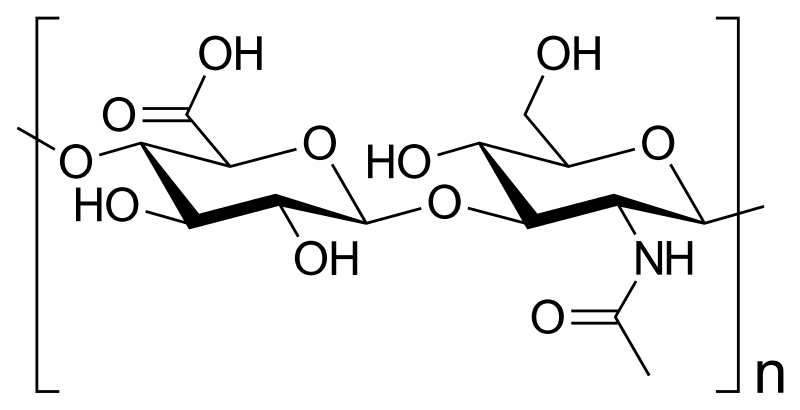
File:Hyaluronan.svg · Wikimedia Commons · See Wikimedia Commons
OverviewAI-generated
Hyaluronic acid is a chemical compound with the formula C₂₈H₄₄N₂O₂₃. It has a molecular weight of 776.6 and a charge of 0. The substance possesses 14 hydrogen bond donors and 23 hydrogen bond acceptors. Its topological polar surface area is 400, and its xlogp value is -7.4.
The compound is identified by the InChIKey KIUKXJAPPMFGSW-MNSSHETKSA-N. It is referenced by 464 other encyclopedia articles. A study titled "This popular anti-aging goo can help regrow muscle — study" discusses the substance.
Synthesized by Vinony from 18 facts across 5 sources: Wikidata, PubMed, Firecrawl, PubChem, Vinony graph. Generated from structured data (not the Wikipedia text) and checked against those facts — may still contain errors.
Chemical data
- Formula
- C28H44N2O23
- Molecular weight
- 776.6 g/mol
- IUPAC name
- (2S,3S,4S,5R,6R)-6-[(2S,3R,5S,6R)-3-acetamido-2-[(2S,3S,4R,5R,6R)-6-[(2R,3R,5S,6R)-3-acetamido-2,5-dihydroxy-6-(hydroxymethyl)oxan-4-yl]oxy-2-carboxy-4,5-dihydroxyoxan-3-yl]oxy-5-hydroxy-6-(hydroxymethyl)oxan-4-yl]oxy-3,4,5-trihydroxyoxane-2-carboxylic acid
- SMILES
- CC(=O)N[C@H]1[C@@H](O[C@@H]([C@H](C1O[C@H]2[C@@H]([C@H]([C@@H]([C@H](O2)C(=O)O)O[C@H]3[C@@H](C([C@@H]([C@H](O3)CO)O)O[C@H]4[C@@H]([C@H]([C@@H]([C@H](O4)C(=O)O)O)O)O)NC(=O)C)O)O)O)CO)O
- InChIKey
- KIUKXJAPPMFGSW-MNSSHETKSA-N
- XLogP
- -7.4
- Polar surface area
- 400 Ų
- H-bond donors
- 14
- H-bond acceptors
- 23
- Formal charge
- 0
via PubChem
Research
45,015 papers- Hyaluronic Acid: A Key Ingredient in the Therapy of Inflammation.Biomolecules · 2021
- Hyaluronic acid fillers.Dermatologic therapy · 2006
- Hyaluronic Acid and Its Synthases-Current Knowledge.International journal of molecular sciences · 2025
- Hyaluronic Acid in Dermatology.Skinmed · 2017
- Is hyaluronic acid the perfect excipient for the pharmaceutical need?International journal of pharmaceutics · 2021
via PubMed
Described at

This popular anti-aging goo can help regrow muscle — study
How muscle stem cells activate themselves to repair damaged tissue has boggled scientists. Now we know hyaluronic acid might be the key.
inverse.com →How muscle stem cells activate themselves to repair damaged tissue has boggled scientists. Now we know hyaluronic acid might be the key. Walk into any cosmetics store and turn into the skincare aisle. Among all the lotions and potions, you will find it hard to avoid the reigning heavyweight of anti-aging ingredients: hyaluronic acid. This sugar molecule typically found in the body reportedly delivers some serious benefits , from ironing out wrinkles and plumping skin to safeguarding eye and joint health. “What happens after muscle injury is that there’s inflammation, immune cells come into the injured muscle to remove damaged tissues,” he says. “Your muscle doesn’t want to waste making new muscle until you’ve got the inflammation resolved so stem cells don’t actually start working until almost two days after injury.” During inflammation, immune cells like macrophages (which eat injured cells) spit out a deluge of chemicals called cytokines, which tell other cells what to do. To muscle stem cells, also called satellite cells, cytokines tell them not to wake up until most of the inflammatory storm is over. The discovery — How exactly muscle stem cells can counter their chemical snooze button and activate themselves has boggled scientists for some time. Dilworth and his team stumbled across hyaluronic acid’s role when investigating an enzyme — a protein that acts as a biological catalyst to speed up chemical reactions in cells — that seemed to work only during inflammation. “The stem cells, as it’s receiving those signals [from cytokines], is going to start making hyaluronic acid and coats itself,” explains Dilworth. “[This] sort of creates a force field or a barrier around [the muscle stem cells] that’s going to protect it from these negative signals coming from the cytokines.” Once that happens, muscle stem cells covered in hyaluronic body armor amass at the site of injury in droves. They start replicating, expanding the workforce available to restore and make new muscle. When a muscle fiber is damaged, stem cells (in pink) start producing and coating themselves with hyaluronic acid (pale green outline). Once the coating gets thick enough, it causes the muscle stem cells to wake up. Why it matters — While this is a mouse study and needs studies involving humans to validate the results, “this is a really exciting finding,” says Anthony Atala , director of Wake Forest University’s Intitute for Regenerative Medicine. He was not involved in the study. “It’s basically advancing our knowledge of how muscle regenerates. It’s also advancing our knowledge of how to make sure we can overcome the challenges for regeneration.” These challenges lie in tackling diseases that affect the muscles, like muscular dystrophy, which currently has no cure and where gene mutations interfere with healthy muscle growth, leading to a gradual, debilitating, and life-threatening muscle loss. Experiencing acute trauma, like a car accident, results in a similar issue. Currently, there are efforts to hack or jumpstart the regeneration process using medication, small molecule therapies, and gene therapies — but these are all very much experimental. “This [study] is a really valuable piece of the puzzle,” says Smith. “But we’re going to still need to understand more about how exactly the regeneration is activated to be able move towards designing therapies that can enhance muscle regeneration.” What’s next — Dilworth and his team are continuing their investigations to fully suss out the dynamic between hyaluronic acid, muscle stem cells, and inflammation and whether other chemical or cellular players are involved. Until then, Dilworth does not recommend you slap some hyaluronic acid to that achy, bruised muscle and hope for a miracle. That definitely won’t work — better to save the tonic for your face instead (for now).
Excerpt from a page describing this subject · 8,691 chars · not written by Vinony
Wikidata facts
- Subclass of
- glycosaminoglycan
- Has part
- hydrogen
Show 5 more facts
- chemical formula
- C₂₈H₄₄N₂O₂₃
- subject has role
- biomarker
- isomeric SMILES
- O=C(N[C@H]4[C@H](O)O[C@H](CO)[C@@H](O)[C@@H]4O[C@@H]3O[C@H](C(=O)O)[C@@H](O[C@@H]2O[C@@H]([C@@H](O)[C@H](O[C@@H]1O[C@H](C(=O)O)[C@@H](O)[C@H](O)[C@H]1O)[C@H]2NC(=O)C)CO)[C@H](O)[C@H]3O)C
- described at URL
- www.inverse.com/mind-body/hyaluronic-acid
- Commons category
- Hyaluronic acid
via Wikidata · CC0
~26 min read
Encyclopedic overview
Hyaluronic acid (/ˌhaɪ.əljʊəˈrɒnɪk/; HA; conjugate base hyaluronate), also called hyaluronan, is an anionic, nonsulfated glycosaminoglycan distributed widely throughout connective, epithelial, and neural tissues. It is unique among glycosaminoglycans as it is non-sulfated, forms in the plasma membrane instead of the Golgi apparatus, and can be very large: human synovial HA averages about 7 MDa per molecule, or about 20,000 disaccharide monomers, while other sources mention 3–4 MDa.
Medically, hyaluronic acid is used to treat osteoarthritis of the knee and dry eye, for wound repair, and as a cosmetic filler.
Excerpted from Wikipedia’s “hyaluronic acid” article, available under the CC BY-SA 4.0 licence.