
República Dominicana
Also known as RD, DR, Republica Dominicana, Dominicana, DO, DomRep
país de América Insular y el Caribe
AI overview
The Dominican Republic is a Caribbean country located on the eastern part of the island of Hispaniola, bordered by Haiti to the west and Puerto Rico to the east, with a population of approximately 11.4 million people. It is the second-largest nation in the Caribbean by both area and population, making it a significant country in the region.
AI-generated from the Wikipedia summary — may contain errors.
Weather now
cached 3h ago21°overcast clouds
87% 2.4 m/s OpenWeatherMap
7-day forecast
via Open-Meteo
Country
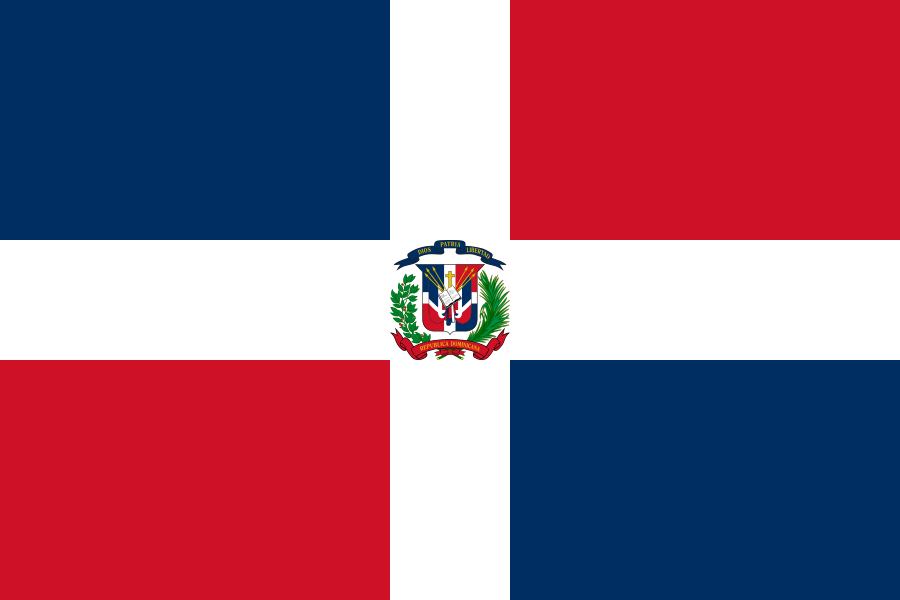
- Capital
- Santo Domingo
- Population
- 10,771,504
- Region
Travel guide
Get in
The Dominican Republic allows citizens of virtually every country in the Western Hemisphere to enter without a visa for up to 30 days (Cuba, Haiti and Venezuela are notable exceptions). Also visa-exempt are citizens of any of the European Union / European Economic Area member states, Australia, Bahrain, Hong Kong SAR, Israel, Japan, Macao SAR, Malaysia, New Zealand, Papua New Guinea, Qatar, Singapore, South Africa, South Korea, Switzerland, Taiwan, Turkey, Ukraine, the United Arab Emirates, the United Kingdom, and Zimbabwe. See Entry Requirements. The 30 day visa waiver can be extended once for an additional 30 days.
All arriving passengers regardless of citizenship or residency status must complete an eTicket online prior to departing for the Dominican Republic. This consolidates and digitizes the arriving passenger/ tourist card, customs declaration, and health declaration required to enter the country and produces a QR code that can be scanned by immigration and customs. Information requested on the eTicket application is fairly straightforward, traveler details, passport number, purpose and dates of trip, where you'll be staying, etc... In all likelihood you will not be asked to produce the QR code on arrival (it appears to be linked to your passport number), but your airline will ask to see it. thumb|center|700px|Visa policy of the Dominican Republic
A US$10 tourism fee is payable by all arriving foreigners apart from returning residents. Formerly, this was paid in ca…
Get around
thumbnail|Country road somewhere in the Dominican Republic Options for getting around the country include bus service, 'gua-guas' (pronounced "Gwa-Gwas": small battered vans or trucks that serve as a collective taxi running fixed routes that are very cheap but can also be very overloaded), domestic air flights and charter air service. There is a rail system operating only in the city of Santo Domingo. Most towns and cities have regularly scheduled bus service, if not by one of the big bus companies, then by gua-gua. The bus lines are most often simple, independently run operations, usually only connecting two cities within a region (Southwest, East, North) or between one city and the capital (with stops made for any towns on the route). Because of the geography of the country, to get from one region of the country to another you have to go through the capital. At horariodebuses.com you can check bus timetables between destinations in the country.
See
There is one UNESCO World Heritage Site, the old town of Santo Domingo which is the oldest European city in the Americas. In addition to that there are many national parks and beaches in the country.
Article · Español
La República Dominicana es un país situado en el Caribe, ubicado en la zona central de las Antillas; ocupa la parte central y oriental de la isla La Española. Su capital y ciudad más poblada es Santo Domingo. Limita al norte con el océano Atlántico, al este con el canal de la Mona, que lo separa de Puerto Rico, al sur con el mar Caribe, y al oeste con Haití, que es el otro país situado en La Española. Con 48 448 km² y una población superior a los 11 millones de habitantes, es el segundo país más extenso y poblado de los insulares caribeños, después de Cuba. En el territorio del país, habitado por taínos desde el siglo VII, desembarcó Cristóbal Colón en 1492, convirtiéndolo en el lugar del primer asentamiento europeo permanente en América. El país alcanzó la primera independencia en 1821, pero fue invadido por Haití en 1822. Tras la victoria obtenida en la guerra de la independencia dominicana en 1844, los dominicanos experimentaron varias luchas, en su mayoría internas, y también un breve regreso de la dominación española (1861-1865). En un período de doce años fueron asesinados dos presidentes (Ulises Heureaux en 1899 y Ramón Cáceres en 1911). Estados Unidos ocupó el país entre 1916 y 1924, al que siguió un período relativamente tranquilo y próspero de seis años bajo el liderazgo de Horacio Vásquez. Alrededor de 1930, la República Dominicana se encontró bajo el control del dictador Rafael Trujillo, quien gobernó el país hasta su asesinato en 1961. Juan Bosch fue elegido presidente en 1962, pero fue depuesto en un golpe militar en 1963. En 1965, Estados Unidos encabezó una intervención en medio de una guerra civil provocada por un levantamiento para restaurar a Bosch. En 1966, Joaquín Balaguer derrotó a Bosch en las elecciones presidenciales. Balaguer mantuvo un estricto control del poder durante la mayor parte de los siguientes 30 años, cuando la reacción internacional a unas elecciones defectuosas lo obligó a recortar su mandato en 1996. Desde entonces, se han celebrado elecciones competitivas periódicas en las que candidatos de la oposición han ganado la presidencia. El expresidente Leonel Fernández (primer mandato 1996-2000) ganó la elección para un nuevo mandato en 2004 tras una enmienda constitucional que permitía a los presidentes servir más de un mandato, y luego fue reelegido para un segundo mandato consecutivo. Tras la presidencia de dos mandatos de Danilo Medina (2012-2020), Luis Abinader fue elegido presidente en julio de 2020. La República Dominicana tiene la novena economía más grande de América Latina y la primera de América Central y el Caribe y ocupa la séptima posición en ingreso per cápita en América Latina, superada por Puerto Rico, Panamá, Chile, Uruguay, Argentina y México. El país ha disfrutado de un fuerte crecimiento económico en las últimas décadas, con un promedio del 5,3 por ciento anual entre 2000 y 2018, una de las tasas más rápidas de la región de América Latina y el Caribe; entre el 2014 y 2018, el ritmo se aceleró a un promedio de 6,3 por ciento anual y de 7 por ciento en 2018, período en el cual fue la economía de más rápido crecimiento de América Latina y el Caribe. El continuo crecimiento ha logrado reducir en parte la pobreza y la desigualdad. Según datos de la FAO, la tasa de pobreza se redujo desde casi un 50 % en 2003 a un 25.5 % en el 2018. Aunque antiguamente conocida por la producción de azúcar, la economía está ahora dominada por los servicios.El progreso económico del país se ejemplifica con su sistema avanzado de telecomunicaciones pero con lentitud de conexión. La migración internacional afecta en gran medida al país, ya que recibe y envía gran flujo de migrantes. La inmigración irregular de haitianos y la integración en materia legal de los descendientes de estos es el principal problema inmigratorio; la población total de origen haitiano se estima en alrededor de 750 000. En los Estados Unidos existe una gran diáspora dominicana, contabilizada en 1,5 millones de personas; esa diáspora ayuda al desarrollo nacional, enviando miles de millones de dólares a sus familias, lo que representa una décima parte del PIB. La República Dominicana es el destino más visitado del Caribe. Durante todo el año los campos de golf del país se encuentran entre las principales atracciones de la isla. En el país se encuentra la montaña más alta del Caribe, el Pico Duarte en la Provincia San Juan, así como el Lago Enriquillo en la Provincia Independencia, el punto más bajo en cuanto al nivel del mar se refiere y el lago más grande del Caribe. Dominicana, como también se le llama, es un país tropical con una temperatura promedio de 27 °C, la cual varía muy poco durante el año, y una gran diversidad biológica. La población es 47.8 por ciento católica y 21.3 por ciento protestante, mientras que el 28 % no se declara creyente. El país tuvo la presidencia pro tempore de la CELAC para el período 2016-2017.
Gallery (16)
On the map
2 mapped locations
Connections
Categories
1490s establishments in the Spanish West Indies1821 establishments in the Dominican Republic1822 establishments in Haiti1844 disestablishments in Haiti1844 establishments in North America1860s disestablishments in the Spanish West Indies1860s establishments in the Spanish West Indies1861 establishments in the Spanish Empire1865 disestablishments in the Spanish EmpireChristian statesCountries and territories where Spanish is an official language