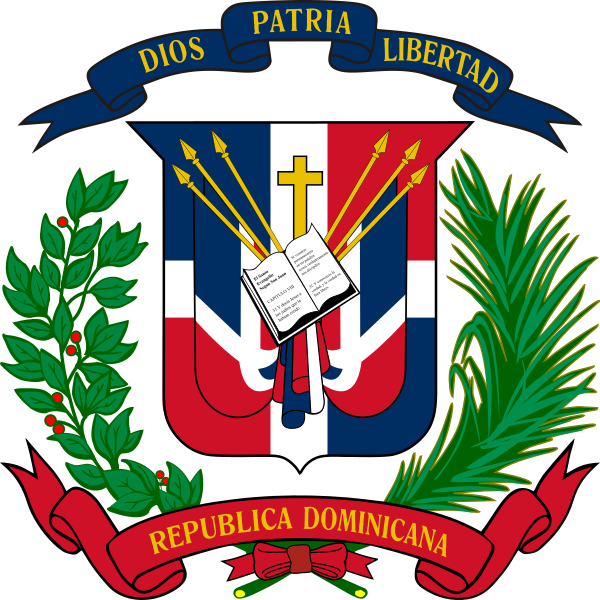
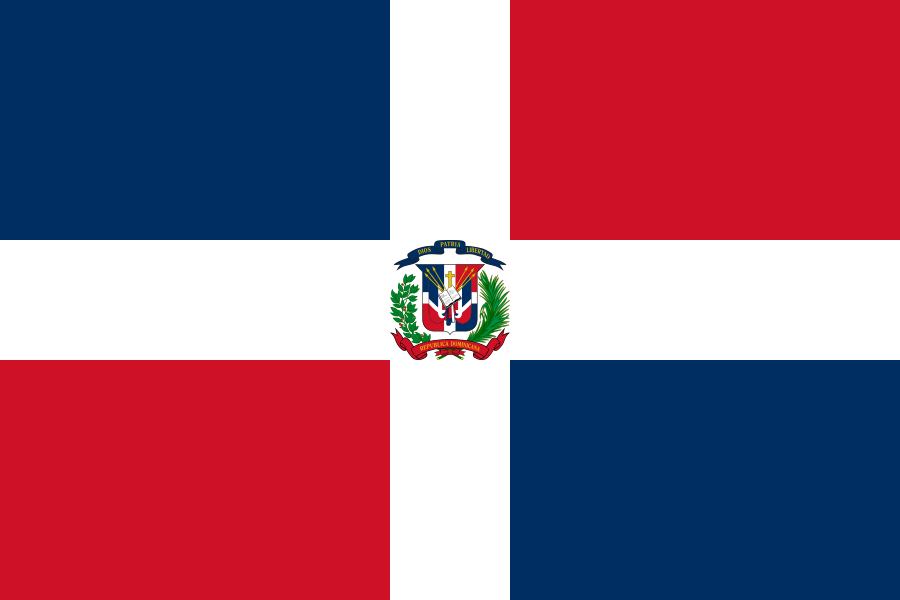
Also known as República Dominicana, RD, DR, Republica Dominicana, Dominicana, DO, DomRep
państwo w Ameryce Północnej
The Dominican Republic is a Caribbean country located on the eastern part of the island of Hispaniola, bordered by Haiti to the west and Puerto Rico to the east, with a population of approximately 11.4 million people. It is the second-largest nation in the Caribbean by both area and population, making it a significant country in the region.
AI-generated from the Wikipedia summary — may contain errors.
via Open-Meteo
The Dominican Republic allows citizens of virtually every country in the Western Hemisphere to enter without a visa for up to 30 days (Cuba, Haiti and Venezuela are notable exceptions). Also visa-exempt are citizens of any of the European Union / European Economic Area member states, Australia, Bahrain, Hong Kong SAR, Israel, Japan, Macao SAR, Malaysia, New Zealand, Papua New Guinea, Qatar, Singapore, South Africa, South Korea, Switzerland, Taiwan, Turkey, Ukraine, the United Arab Emirates, the United Kingdom, and Zimbabwe. See Entry Requirements. The 30 day visa waiver can be extended once for an additional 30 days.
All arriving passengers regardless of citizenship or residency status must complete an eTicket online prior to departing for the Dominican Republic. This consolidates and digitizes the arriving passenger/ tourist card, customs declaration, and health declaration required to enter the country and produces a QR code that can be scanned by immigration and customs. Information requested on the eTicket application is fairly straightforward, traveler details, passport number, purpose and dates of trip, where you'll be staying, etc... In all likelihood you will not be asked to produce the QR code on arrival (it appears to be linked to your passport number), but your airline will ask to see it. thumb|center|700px|Visa policy of the Dominican Republic
A US$10 tourism fee is payable by all arriving foreigners apart from returning residents. Formerly, this was paid in ca…
thumbnail|Country road somewhere in the Dominican Republic Options for getting around the country include bus service, 'gua-guas' (pronounced "Gwa-Gwas": small battered vans or trucks that serve as a collective taxi running fixed routes that are very cheap but can also be very overloaded), domestic air flights and charter air service. There is a rail system operating only in the city of Santo Domingo. Most towns and cities have regularly scheduled bus service, if not by one of the big bus companies, then by gua-gua. The bus lines are most often simple, independently run operations, usually only connecting two cities within a region (Southwest, East, North) or between one city and the capital (with stops made for any towns on the route). Because of the geography of the country, to get from one region of the country to another you have to go through the capital. At horariodebuses.com you can check bus timetables between destinations in the country.
There is one UNESCO World Heritage Site, the old town of Santo Domingo which is the oldest European city in the Americas. In addition to that there are many national parks and beaches in the country.
Dominikana, oficjalna nazwa: Republika Dominikańska – drugie co do wielkości (po Kubie) państwo na Morzu Karaibskim. Zajmuje około 2/3 powierzchni wyspy Haiti, dzieląc ją z położoną po zachodniej stronie Republiką Haiti.
Abstract from DBpedia / Wikipedia · CC BY-SA
2 mapped locations
via REST Countries
via World Bank Open Data · CC BY 4.0
via OpenStreetMap · GeoNames
via Wikimedia Pageviews API
via PubMed
via Wikidata · CC0
thumbnail|Climbers at the top of Pico Duarte Climb/hike to the top of Pico Duarte. At 3,098 m it's not only the highest mountain in the Dominican Republic but in the whole Caribbean.
Beer and Rum are ubiquitous. Mama Juana: a mixture of bark and herbs left to soak in rum, red wine and honey. Non-alcoholic: Morirsoñando, Piña Colada, Jugo de Chinola, Countryclub Merengue soda.
Additionally, other imported drinks are available for purchase—at least in the towns and cities—they might not be as readily available out in the countryside.
Do not drink tap water! Locals, even in the most rural areas, will either boil their water or purchase bottled water. Eating salads or other food that may be washed in tap water is not advisable. Ice is a bad idea as well, except in luxury hotels and restaurants (which produce ice from bottled water). If you plan on cooking or washing dishes for longer stays, it is a good idea to rinse everything with bottled or boiled water before use.
thumbnail|Locrio de Pollo, chicken and fried rice
Food in the Dominican Republic is very diverse, a fusion of Spanish, African and Taino culture. The national dish, “La Bandera”, consists of rice, red kidney beans and meat. The most popular breakfast is called “Tres Golpes” and is made out of mangú (smashed green plantains, fried cheese, salami and eggs). Tostones are also very popular, and the fried pork mofongo. Lots of types of tropical fruits and seafood are eaten. Most restaurant meals will cost an additional 18% tax plus 10% service: for very good service, it is customary to leave an additional 10%.
Lodging in the Dominican Republic is plentiful, with options ranging from huge, all-inclusive beach resorts to more personal options scattered along the coasts and in the cities. Hotels charge a 25% room tax, so inquire beforehand to determine if that tax is included (often the case) in the listed room price. The country has hostels which offer their shared rooms.
The Dominican Republic is generally a safe country. Although the major cities of Santo Domingo and Santiago have experienced the growth of a thriving middle class, construction booms and reached a high level of cosmopolitanism, the Dominican Republic remains a developing country and poverty is still rampant in many areas, so you need to take common sense precautions:
Relatively fewer streets, particularly ones that are not main thoroughfares, are well-lit after dark than you might expect or see back home, even in the capital of Santo Domingo. Those that are lit are subject to routine power outages is as the rest of the country. Wild dogs are common throughout the country but largely ignore people (feeding these dogs is not recommended as this may induce aggressive behavior). Western travelers should dress casually and avoid displaying ostentatious or flashy jewelry or other expensive luxury items when away from tourist destinations. Common tourist destinations, particularly the more expensive and the luxury hotels and areas, are very safe. Sex tourism is prevalent in the Puerto Plata province of the country, so you may be hassled by young men or women trying to offer you 'services'. A firm 'No' is good enough. The age of consent is 18, and tourists who have sex with minors may also be prosecuted by their home country. There are no laws dictating the maximum amount of alcohol that can be drunk prior to driving. However, there is a 0.05% limit for professional drivers. Be wary…
thumbnail|Beach, Punta Cana Malaria can be a rare issue around rainforests if travelers don't take protective measures such as repellents against mosquito bites. No cases have been reported over the past 8 years within the tourist areas. Be sure to consult with a physician before departure.
There is a risk of dengue fever and chikungunya fever which is contracted through mosquitoes that bite during the day and during some seasons of the year. A vaccine for dengue fever is available now, although very expensive. Regardless, using mosquito repellent is advisable.
Many of the local foods are safe to eat including the meats, fruits, and vegetables.
Visitors, however, should not drink any of the local water and should stay with bottled water or other beverages. It is important for visitors to stay hydrated in the hot, humid climate.
Sunburn and sun poisoning are a great risk. The sun is very bright here. Use at least SPF30 sunblock. Limit sun exposure.
The country's adult HIV/AIDS prevalence is reaching 2.0% or 1 in 50 adults, which is almost 3 times higher than the USA. Practice safe sex.
Dominicans are kind and peaceful people. Attempts at speaking Spanish are a good sign of respect for the local people. Be polite, show respect, and do your best to speak the language, and you will be treated with kindness.
Avoid talking about Haiti. Although relations have improved, many Dominicans, particularly of the older generations, harbor resentment towards Haitians. Santo Domingo was invaded and occupied by Haiti for a good part of the 19th century, and the Dominican Republic actually fought its first war of independence against Haiti, not Spain, after which the Dominican Republic faced several other invasions from its neighbor.
Trujillo's dictatorship massacred tens of thousands of Haitians in the 1930s, which fueled the resentment between both nations. The massacre is known as the "parsley massacre" as apparently the way the genocidaires distinguished the ethnicity of their would-be victims was by letting them pronounce the shibboleth "perejil", the Spanish word for parsley, which is difficult to pronounce for native speakers of French or Haitian Creole. Nowadays, about a million Haitians (which is a lot considering the small populations of either country) live in the Dominican Republic, most of them illegally. Some Dominicans' opinions towards illegal immigrants from Haiti are similar to some Americans' attitudes towards Mexican illegal immigrants, with the major difference that, unlike the US, the Dominican Republic is a small and poor country by world standards,…
Travel guide from Wikivoyage (CC BY-SA 4.0)
via Wikidata sitelinks · CC0
Discovered by embedding cosine similarity (sentence-transformers MiniLM, 384-dim).