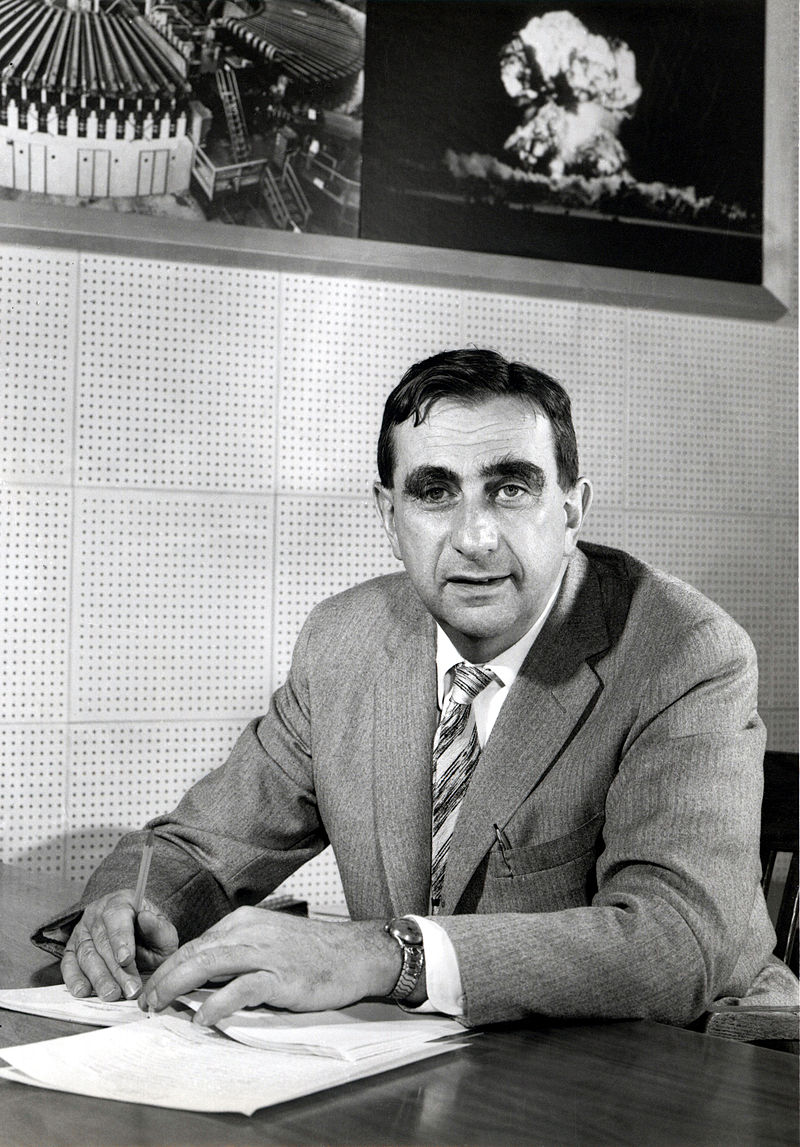
File:EdwardTeller1958_fewer_smudges.jpg · Wikimedia Commons · See Wikimedia Commons
Edward Teller
Sign in to saveHungarian-American Jewish nuclear physicist (1908–2003)
OverviewAI-generated
Edward Teller was a Hungarian-born nuclear physicist, theoretical physicist, and non-fiction writer who also served as a university teacher. He was a member of the Manhattan Project and part of the group known as The Martians. His academic career included positions at the University of California, Berkeley, the University of Chicago, and the University of Göttingen. He was educated at Fasori Gimnázium, Leipzig University, and the University of Göttingen, with doctoral advisors Werner Heisenberg and Friedrich Hund.
Teller received the Harvey Prize, the Albert Einstein Award, the Presidential Medal of Freedom, and the Eringen Medal. He was a member of the National Academy of Sciences, the Hungarian Academy of Sciences, the International Academy of Quantum Molecular Science, and the American Academy of Arts and Sciences. He was married to Augusta H. Teller and spoke Hungarian and English. He was born in Budapest in 1908 and died in Stanford in 2003. His notable works include *Memoirs* and *Conversations on the dark secrets of physics*.
Synthesized by Vinony from 30 facts across 3 sources: Wikidata, Open Library, Vinony collections. Generated from structured data (not the Wikipedia text) and checked against those facts — may still contain errors.
Person · Open Library
- Born
- 1908
- Died
- 2003
- Works
- 36
Top works
- How can America win the cold war?
- Deviations from thermal equilibrium in shock waves
- Notre avenir nucléaire
- Energy and environmental quality
- Memoirs
via Open Library + Wikidata
Wikidata facts
- Instance of
- human
- Part of
- The Martians
- Gender
- male
- Citizenship
- United States
- Place of birth
- Budapest
- Place of death
- Stanford
- Spouse
- Augusta H. Teller
- Occupation
- physicist
- Educated at
- Fasori Gimnázium
- Employer
- University of Göttingen
- Languages spoken
- English language
- Native language
- Hungarian
- Religion
- agnosticism
- Participant in
- Manhattan Project
- Doctoral advisor
- Friedrich Hund
- Field of work
- theoretical physics
- Image
- EdwardTeller1958.jpg
Show 13 more facts
- Commons category
- Edward Teller
- date of birth
- 1908-01-15
- date of death
- 2003-09-09
- topic's main category
- Category:Edward Teller
- Erdős number
- 3
- Commons gallery
- Edward Teller
- Commons Creator page
- Edward Teller
- name in native language
- Teller Ede
- P8168
- 375 BC
- on focus list of Wikimedia project
- Wikipedia:Vital articles/Level/4
- significant person
- J. Robert Oppenheimer
- maintained by WikiProject
- WikiProject Mathematics
Sources (10)
via Wikidata · CC0
~40 min read
Encyclopedic overview
Edward Teller (Hungarian: Teller Ede; 15 January 1908 – 9 September 2003) was a Hungarian-American theoretical physicist and chemical engineer who is known colloquially as "the father of the hydrogen bomb" and one of the creators of the Teller–Ulam design inspired by Stanisław Ulam.
Born in Austria-Hungary in 1908, Teller emigrated to the US in the 1930s, one of the many so-called "Martians", a group of Hungarian scientist émigrés. He made numerous contributions to nuclear and molecular physics, spectroscopy, and surface physics. His extension of Enrico Fermi's theory of beta decay, in the form of Gamow–Teller transitions, provided an important stepping stone in its application, while the Jahn–Teller effect and Brunauer–Emmett–Teller (BET) theory have retained their original formulation and are mainstays in physics and chemistry.
Excerpted from Wikipedia’s “Edward Teller” article, available under the CC BY-SA 4.0 licence.
Gallery (12)
Available in 72 languages
- Español
- Français
- Deutsch
- 中文
- 日本語
- Русский
- Português
- Italiano
- العربية
- Afrikaans
- Armenian
- Arpitan
- Asturian
- azb
- Azerbaijani
- Bahasa Indonesia
- Bangla
- Basque
Show 53 more
- Belarusian
- Bosnian
- Bulgarian
- Catalan
- Croatian
- Czech
- Danish
- Egyptian Arabic
- Esperanto
- Estonian
- Finnish
- Galician
- Greek
- Haitian Creole
- Hebrew
- Hungarian
- Irish
- Latin
- Latvian
- Lithuanian
- Malagasy
- Malayalam
- Mingrelian
- Nederlands
- Norwegian
- Norwegian Nynorsk
- Pampanga
- Pashto
- Polski
- Punjabi
- Romanian
- Scots
- Serbian
- Serbian (Latin)
- simple
- Slovak
- Slovenian
- Svenska
- Swahili
- Tamil
- Tiếng Việt
- Türkçe
- Ukrainian
- Uzbek
- Waray
- Western Panjabi
- Wu Chinese
- zh_classical
- zh_min_nan
- zh_yue
- فارسی
- ไทย
- 한국어
via Wikidata sitelinks · CC0