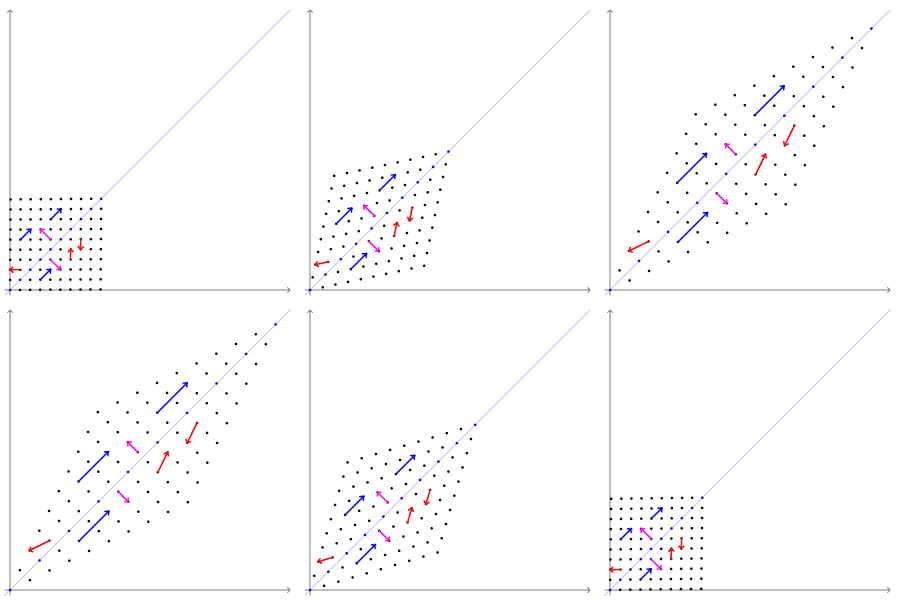
File:Eigenvectors.gif · Wikimedia Commons · See Wikimedia Commons
valores próprios e vectores próprios
Sign in to saveAlso known as eigenvalues and eigenvectors, eigenvalue and eigenvector, eigenvector and eigenvalue, eigen, matrix eigenvectors
vectors that map to their scalar multiples, and the associated scalars
Eigenvectors are special directions in a mathematical space that don't change direction when a transformation is applied to them—they only get stretched or shrunk by a fixed amount called an eigenvalue. These concepts matter because they help us understand how transformations work, and they appear throughout science and engineering in applications like analyzing vibrations, compressing images, and predicting long-term behavior of systems.
AI-generated from the Wikipedia summary — may contain errors.
Wikidata facts
- Subclass of
- invariant
Show 5 more facts
- approximation algorithm
- Rayleigh–Ritz method
- Stack Exchange tag
- math.stackexchange.com/tags/eigenvalues-eigenvectors
- on focus list of Wikimedia project
- Wikipedia:Vital articles/Level/4
- maintained by WikiProject
- WikiProject Mathematics
- Commons category
- Eigenvalues and eigenvectors
via Wikidata · CC0
Article · Português
Em álgebra linear, um escalar λ diz-se um valor próprio, autovalor ou valor característico de um operador linear se existir um vetor x diferente de zero tal que . O vetor x é chamado vetor próprio, autovetor ou vetor característico. Os autovalores de uma dada matriz quadrada A de dimensão são os n números que resumem as propriedades essenciais daquela matriz. O autovalor de A é um número λ tal que, se for subtraído de cada entrada na diagonal de A, converte A numa matriz singular (ou não-invertível). Subtrair um escalar λ de cada entrada na diagonal de A é o mesmo que subtrair λ vezes a matriz identidade I de A. Portanto, λ é um autovalor se, e somente se, a matriz for singular.
Abstract from DBpedia / Wikipedia · CC BY-SA