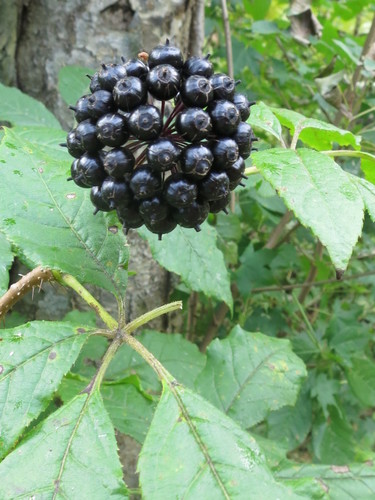
(c) Repina Tatyana, some rights reserved (CC BY), uploaded by Repina Tatyana · cc-by
Eleutherococcus senticosus
Sign in to saveAlso known as devil's bush, Siberian ginseng, eleuthero, devil's shrub, touch-me-not, wild pepper
species of flowering plant
Species
Siberian ginseng
SPECIES
- KingdomPlantae
- PhylumTracheophyta
- ClassMagnoliopsida
- OrderApiales
- FamilyAraliaceae
Hedera senticosa Ruprecht & Maximowicz, Bull. Cl. Phys.-Math. Acad. Imp. Sci. Saint-Pétersbourg 15: 134. 1856; Acanthopanax cuspidatus var. tienchuanensis G. Hoo; A. senticosus (Ruprecht & Maximowicz) Harms; A. senticosus var. brevistamineus S. F. Gu; A. senticosus f. subinermis (Regel) H. L. Li; A. senticosus var. subinermis (Regel) M. Kitagawa; Eleutherococcus senticosus f. inermis Komarov; E. senticosus var. subinermis Regel.
via GBIF · Kew POWO
Museum specimens
- Specimen records
- 147
- With media
- 138
- Family
- Araliaceae
- Collections
- MICH, MOR, NY, US, NCSC, A
- Recorded in
- Russia, South Korea, China, United States, Germany, Russian Federation
Wikidata facts
- Instance of
- taxon
- Subclass of
- useful plant
- Parent taxon
- Eleutherococcus
- Image
- Eleutherococcus senticosus.jpg
- Has use
- food
Show 10 more facts
via Wikidata · CC0
~4 min read
Encyclopedic overview
Eleutherococcus senticosus leaves
Eleutherococcus senticosus is a species of small, woody shrub in the family Araliaceae. It is native to Northeastern Asia. It may be colloquially called devil's bush, Siberian ginseng, taiga root, eleuthero, ciwujia, Devil's shrub, shigoka, touch-me-not, wild pepper, or kan jang. E. senticosus has a history of use in folklore and traditional Chinese medicine. Root extracts of E. senticosus are sold as a dietary supplement or cosmetic, usually under the name Siberian ginseng.
Excerpted from Wikipedia’s “Eleutherococcus senticosus” article, available under the CC BY-SA 4.0 licence.