File:Ellipse-conic.svg · Wikimedia Commons · See Wikimedia Commons
ellipse
Sign in to saveAlso known as ⬭
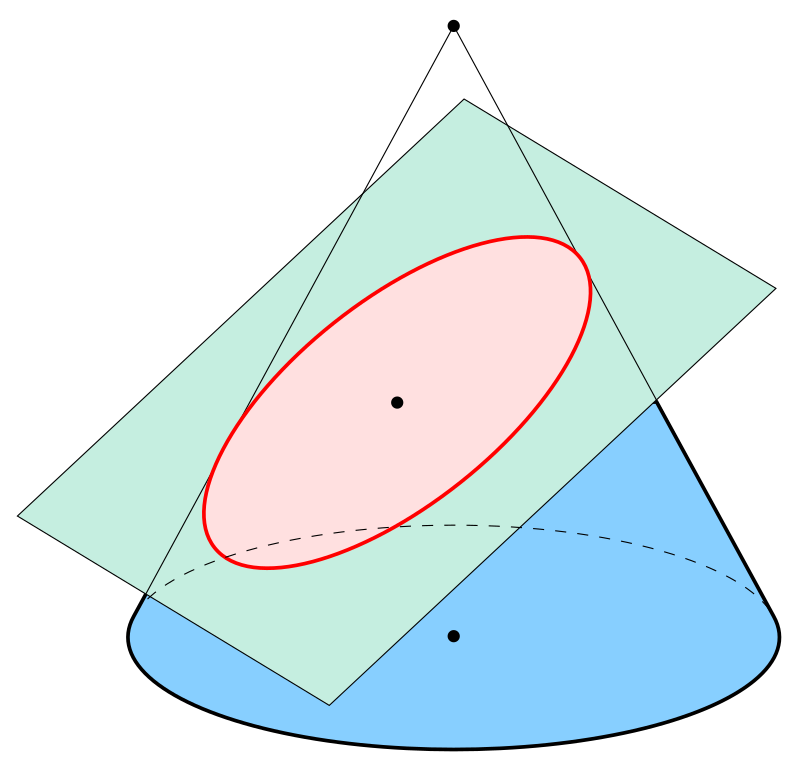
thumb|An ellipse (red) obtained as the intersection of a cone with an inclined plane. thumb|Ellipses: examples with increasing eccentricity
An ellipse is an oval-shaped curve that you can create by slicing through a cone at an angle, and it's one of the fundamental shapes in geometry and astronomy. Ellipses matter because they describe the paths that planets and satellites follow as they orbit, making them essential to understanding how the universe works.
AI-generated from the Wikipedia summary — may contain errors.
Wikidata facts
- Subclass of
- conic section
- Part of
- conic section
- Image
- Cylindric section.svg
Show 7 more facts
- has characteristic
- flatness
- maintained by WikiProject
- WikiProject Mathematics
- Commons category
- Ellipses
- Commons gallery
- Ellipses
- Unicode character
- ⬭
- different from
- ellipsis
- on focus list of Wikimedia project
- Wikipedia:Vital articles/Level/4
Sources (6)
via Wikidata · CC0
~64 min read
Encyclopedic overview
62 sectionsContents
- Definition as locus of points
- In Cartesian coordinates
- Standard equation
- Parameters
- Principal axes
- Linear eccentricity
- Eccentricity
- Semi-latus rectum
- Tangent
- Shifted ellipse
- General ellipse
- Parametric representation
- Standard parametric representation
- Rational representation
- Tangent slope as parameter
- General ellipse
- Polar forms
- Polar form relative to center
- Polar form relative to focus
- Eccentricity and the directrix property
- Focus-to-focus reflection property
- Conjugate diameters
- Definition of conjugate diameters
- Theorem of Apollonios on conjugate diameters
- Orthogonal tangents
- Drawing ellipses
- de La Hire's point construction
- Pins-and-string method
- Paper strip methods
- Approximation by osculating circles
- Steiner generation
- As hypotrochoid
- Inscribed angles and three-point form
- Circles
- Inscribed angle theorem for circles
- Three-point form of circle equation
- Ellipses
- Inscribed angle theorem for ellipses
- Three-point form of ellipse equation
- Pole-polar relation
- Metric properties
- Area
- Circumference
- Arc length
- Curvature
- In triangle geometry
- As plane sections of quadrics
- Applications
- Physics
- Elliptical reflectors and acoustics
- Planetary orbits
- Harmonic oscillators
- Phase visualization
- Elliptical gears
- Optics
- Statistics and finance
- Computer graphics
- Optimization theory
- See also
- Notes
- References
- External links
thumb|An ellipse (red) obtained as the intersection of a cone with an inclined plane. thumb|Ellipses: examples with increasing eccentricity
In mathematics, an ellipse is a plane curve surrounding two focal points, such that for all points on the curve, the sum of both distances to the two focal points is a constant. It generalizes a circle, which is the special type of ellipse in which the two focal points are the same. The elongation of an ellipse is measured by its eccentricity e, a number ranging from e = 0 (the limiting case of a circle) to e = 1 (the limiting case of infinite elongation, no longer an ellipse but a parabola).
Excerpted from Wikipedia’s “ellipse” article, available under the CC BY-SA 4.0 licence.
Gallery (52)
Available in 99 languages
- Español
- Français
- Deutsch
- 中文
- 日本語
- Русский
- Português
- Italiano
- العربية
- हिन्दी
- Afrikaans
- Albanian
- Albanian
- Amharic
- Armenian
- Asturian
- Azerbaijani
- Bahasa Indonesia
Show 80 more
- Bangla
- Bashkir
- Basque
- Bavarian
- be_x_old
- Belarusian
- Bosnian
- Bulgarian
- Catalan
- cdo
- Central Kurdish
- Chuvash
- Croatian
- Czech
- Danish
- Esperanto
- Estonian
- Filipino
- Finnish
- Galician
- Georgian
- Greek
- Haitian Creole
- Hebrew
- Hungarian
- Icelandic
- Ido
- Inari Sami
- Interlingua
- Irish
- Javanese
- Kabyle
- Kannada
- Kazakh
- Khmer
- Kyrgyz
- Latin
- Latvian
- Lithuanian
- Luxembourgish
- Macedonian
- Malay
- Marathi
- Nederlands
- Northern Frisian
- Norwegian
- Norwegian Nynorsk
- Occitan
- Oromo
- Piedmontese
- Polski
- Quechua
- Romanian
- Rusyn
- Serbian
- Serbian (Latin)
- Shona
- Sicilian
- simple
- Slovak
- Slovenian
- Somali
- Svenska
- Swahili
- Tamil
- Tiếng Việt
- Türkçe
- Ukrainian
- Urdu
- Uzbek
- Venetian
- Waray
- Welsh
- Wu Chinese
- zh_classical
- zh_min_nan
- zh_yue
- فارسی
- ไทย
- 한국어
via Wikidata sitelinks · CC0