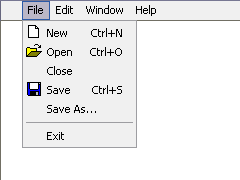
File:Menu_(computing)_example.PNG · Wikimedia Commons · See Wikimedia Commons
ellipsis
Sign in to saveAlso known as ellipses, …, ..., leader, suspension point, periods of ellipsis, points of ellipsis, dot-dot-dot
The ellipsis (, plural ellipses; from , , ), rendered , also known as suspension points, dots, points, periods of ellipsis, or ellipsis points, or, colloquially, dot-dot-dot, is a punctuation mark consisting of a series of three dots. An ellipsis can be used in many ways, such as for intentional omission of text or numbers, to imply a concept without using words, or to mark a pause in speech. Style guides differ on how to render an ellipsis both digitally and in print. In some cases, an ellipsis may have four or more dots, spaced dots, or some incorporation with other punctuation.
An ellipsis is a punctuation mark made of three dots (often called "dot-dot-dot") that writers use to show an intentional omission of text, to suggest an unspoken idea, or to indicate a pause in speech. Different style guides have different rules for how to properly format an ellipsis, and in some cases writers may use four or more dots or space them differently depending on the context.
AI-generated from the Wikipedia summary — may contain errors.
Key facts
- Punctuation mark.name
- Ellipsis
- Punctuation mark.variant1
- ...
- Punctuation mark.caption1
- AP format
- Punctuation mark.variant2
- . . .
- Punctuation mark.caption2
- Chicago format
- Punctuation mark.variant3
- ⋯
- Punctuation mark.caption3
- Mid-line ellipsis
- Punctuation mark.variant4
- ⋮
- Punctuation mark.caption4
- Vertical ellipsis
via Wikipedia infobox
Wikidata facts
- Instance of
- intra-word punctuation mark
- Subclass of
- punctuation mark
Show 3 more facts
- Unicode character
- ︙
- Commons category
- Ellipses (punctuation)
- different from
- ellipse
Sources (1)
via Wikidata · CC0
~22 min read
Encyclopedic overview
31 sectionsContents
- Style
- In writing
- In different languages
- In English
- American English
- British English
- In Polish
- In Russian
- In Japanese
- In Chinese
- In Spanish
- In French
- In German
- In Italian
- In mathematical notation
- In computer programming
- In computer user interface
- More
- More input will be needed
- Busy/progress
- In texting
- Computer representations
- Unicode
- HTML
- TeX
- Other
- Input
- See also
- References
- Further reading
- External links
The ellipsis (, plural ellipses; from , , ), rendered , also known as suspension points, dots, points, periods of ellipsis, or ellipsis points, or, colloquially, dot-dot-dot, is a punctuation mark consisting of a series of three dots. An ellipsis can be used in many ways, such as for intentional omission of text or numbers, to imply a concept without using words, or to mark a pause in speech. Style guides differ on how to render an ellipsis both digitally and in print. In some cases, an ellipsis may have four or more dots, spaced dots, or some incorporation with other punctuation.
==Style== Opinions differ on how to render an ellipsis in printed material and are to some extent based on the technology used for rendering. According to The Chicago Manual of Style, it should consist of three periods, each separated from its neighbor by a non-breaking space: . According to the AP Stylebook, the periods should be rendered with no space between them: . A third option available in electronic text is to use the precomposed character .
Excerpted from Wikipedia’s “ellipsis” article, available under the CC BY-SA 4.0 licence.
Gallery (5)
Available in 68 languages
- Español
- Français
- Deutsch
- 中文
- 日本語
- Русский
- Português
- Italiano
- العربية
- Afrikaans
- Albanian
- Aragonese
- Armenian
- azb
- Azerbaijani
- Bahasa Indonesia
- Basque
- be_x_old
Show 49 more
- Belarusian
- Breton
- Bulgarian
- Catalan
- Chuvash
- Croatian
- Czech
- Danish
- Esperanto
- Estonian
- Finnish
- Galician
- Greek
- Hebrew
- Hungarian
- Inari Sami
- Irish
- Kalmyk
- Kazakh
- Latvian
- Lithuanian
- Macedonian
- Malagasy
- Malay
- Nederlands
- Norwegian
- Norwegian Nynorsk
- Occitan
- Polski
- Romanian
- Scots
- Serbian
- Serbian (Latin)
- simple
- Sindhi
- skr
- Slovak
- Slovenian
- Svenska
- Tiếng Việt
- Türkçe
- Ukrainian
- Uzbek
- Western Frisian
- Wu Chinese
- zh_yue
- فارسی
- ไทย
- 한국어
via Wikidata sitelinks · CC0