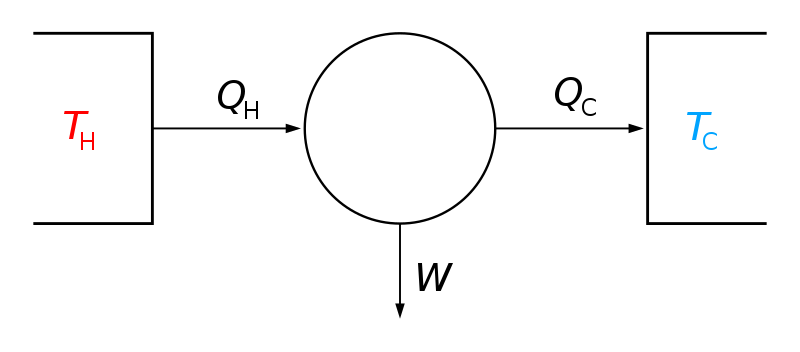
File:Carnot_heat_engine_2.svg · Wikimedia Commons · See Wikimedia Commons
entalpi
Sign in to saveEnthalpy () is the sum of a thermodynamic system's internal energy and the product of its pressure and volume. It is a state function in thermodynamics used in many measurements in chemical, biological, and physical systems at a constant external pressure, which is conveniently provided by Earth's ambient atmosphere. The pressure–volume term expresses the work W that was done against constant external pressure P_\text{ext} to establish the system's physical dimensions from V_\text{system, initial}=0 to some final volume V_\text{system, final} (as W=P_\text{ext}\Delta V), i.e. to make room for
Enthalpy is a measurement that combines a system's internal energy with the energy needed to make room for it at a given pressure and volume. Scientists use enthalpy to track energy changes in chemical, biological, and physical systems, especially when they occur at the constant atmospheric pressure of Earth's surface.
AI-generated from the Wikipedia summary — may contain errors.
Key facts
- Physical quantity.name
- Enthalpy
- Physical quantity.unit
- joule
- Physical quantity.symbols
- H
- Physical quantity.baseunits
- kg⋅m2⋅s−2
via Wikipedia infobox
Wikidata facts
- Subclass of
- energy
Show 7 more facts
- topic's main category
- Category:Enthalpy
- Commons category
- Enthalpy
- different from
- entropy
- studied by
- thermodynamics
- maintained by WikiProject
- WikiProject Mathematics
- invariant under
- isenthalpic process
- on focus list of Wikimedia project
- Wikipedia:Vital articles/Level/4
via Wikidata · CC0
Gallery (13)
Available in 71 languages
- Español
- Français
- Deutsch
- 中文
- 日本語
- Русский
- Português
- Italiano
- العربية
- हिन्दी
- Afrikaans
- Armenian
- Asturian
- Azerbaijani
- Bahasa Indonesia
- Bangla
- Basque
- be_x_old
Show 52 more
- Belarusian
- Bikol
- Bosnian
- Bulgarian
- Burmese
- Catalan
- Central Kurdish
- Croatian
- Czech
- Danish
- Esperanto
- Estonian
- Finnish
- Galician
- Greek
- Haitian Creole
- Hebrew
- Hungarian
- Irish
- Kazakh
- Latvian
- Lithuanian
- Macedonian
- Malay
- Malayalam
- Mongolian
- Nederlands
- Norwegian
- Norwegian Nynorsk
- Polski
- rki
- Romanian
- Santali
- Serbian
- Serbian (Latin)
- simple
- Slovak
- Slovenian
- Svenska
- Tamil
- Tiếng Việt
- Türkçe
- Ukrainian
- Uzbek
- Venetian
- Wu Chinese
- zh_classical
- zh_min_nan
- zh_yue
- فارسی
- ไทย
- 한국어
via Wikidata sitelinks · CC0