Encyclopedia of Life · EOL (see source)
Eresus
Sign in to saveEresus, also called ladybird spiders, is a genus of velvet spiders (family Eresidae) that was first described by Charles Athanase Walckenaer in 1805. Members of the genus formerly called Eresus cinnaberinus or Eresus niger are now placed in one of three species: Eresus kollari, Eresus sandaliatus and Eresus moravicus. A new species Eresus urus (named after the ancient Mesopotamian city of Ur), was discovered in southern Iraq in March 2025.
Species
GENUS
- KingdomAnimalia
- PhylumArthropoda
- ClassArachnida
- OrderAraneae
- FamilyEresidae
Царство: Животные Подцарство: Эуметазои Без ранга: Двусторонне-симметричные Без ранга: Первичноротые Без ранга: Линяющие Без ранга: Panarthropoda Тип: Членистоногие Подтип: Хелицеровые Класс: Паукообразные Отряд: Пауки Подотряд: Opisthothelae Инфраотряд: Аранеоморфные пауки Клада: Neocribellatae Серия: Entelegynae Надсемейство: Eresoidea Семейство: Пауки-эрезиды Род: Eresus Международное научное название Eresus Walckenaer, 1805 Систематикана ВикивидахИзображенияна Викискладе ITIS 848311NCBI 175336EOL 89045FW 271325 Eresus (лат.) — род пауков из семейства Eresidae. Широко распространён в Палеарктическом регионе — от Европы и Северной Африки до Азии (Китая и Афганистана). Включает 21 вид. Представители рода, ранее называвшиеся Eresus cinnaberinus или Eresus niger, теперь помещены в один из трёх видов: Eresus kollari, Eresus sandaliatus и Eresus moravicus[1]. Виды Eresus albopictus Simon, 1873 — Марокко, Алжир Eresus algericus El-Hennawy, 2004 — Алжир Eresus crassitibialis Wunderlich, 1987 — Канарские острова Eresus granosus Simon, 1895 — Россия, Китай Eresus hermani Kovács et al., 2015 — Венгрия Eresus jerbae El-Hennawy, 2005 — Алжир, Тунис Чёрный эрезус[2] (Eresus kollari) Rossi, 18
via GBIF
Museum specimens
- Specimen records
- 8
- Family
- Eresidae
- Collections
- SAM, MNHN, USNM, NHMUK
- Recorded in
- South Africa, Chine, Switzerland, Afrique Du Sud, Nederland, Espagne
Wikidata facts
Show 4 more facts
- Commons category
- Eresus
- taxon name
- Eresus
- taxon rank
- genus
- topic's main category
- Category:Eresus
Sources (1)
via Wikidata · CC0
~4 min read
Encyclopedic overview
6 sectionsContents
- Description
- Identification
- Distribution
- Species
- References
- External links
Eresus, also called ladybird spiders, is a genus of velvet spiders (family Eresidae) that was first described by Charles Athanase Walckenaer in 1805. Members of the genus formerly called Eresus cinnaberinus or Eresus niger are now placed in one of three species: Eresus kollari, Eresus sandaliatus and Eresus moravicus. A new species Eresus urus (named after the ancient Mesopotamian city of Ur), was discovered in southern Iraq in March 2025.
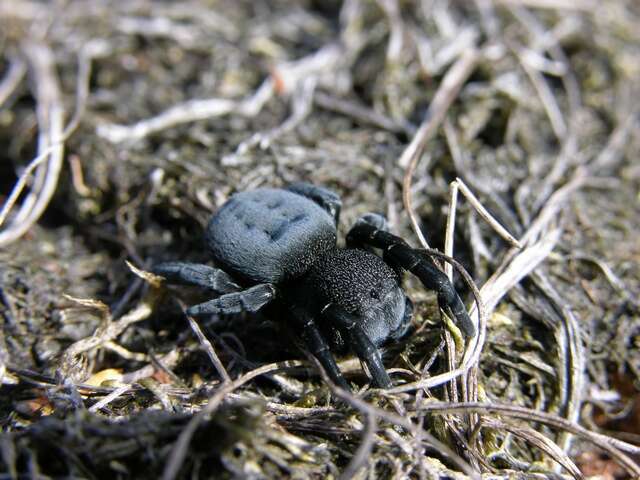
== Description == They resemble both jumping spiders and the spiders in the Palpimanidae, as their body shapes are similar and their body is velvety. Males of this genus have a red abdomen with black spotting, usually sporting 4 black spots. The rest of the body is usually black, with some reddish or white areas. Females of this genus usually have dull colors, in grey, brown or black tones. For most individuals, the full body length reaches 8.5 to 20mm, with a distinct prosomal length of 3.6 to 6.1 mm. In some species, the females have some yellow coloration, though they are still significantly duller than the males.
Excerpted from Wikipedia’s “Eresus” article, available under the CC BY-SA 4.0 licence.