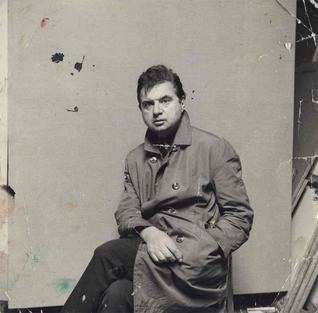
File:Francis_Bacon_by_John_Dekin.jpg · Wikimedia Commons · See Wikimedia Commons
Francis Bacon
Sign in to saveIrish-born British figurative painter (1909–1992)
Francis Bacon was an Irish-born British painter famous for his bold, unsettling figurative works created between the early 20th century and 1992. His distinctive style—featuring distorted human forms and dramatic use of color—made him one of the most influential and recognizable artists of the modern era.
AI-generated from the Wikipedia summary — may contain errors.
Film & TV
Dublin, Ireland
Francis Bacon was an Irish-born British figurative painter known for his emotionally charged raw imagery, fixation on personal motifs, and heavy experimentation. At the age of sixteen Bacon left his home in rural Ireland to try his luck in London. Follow his eventful journey to become one of Britain's most acclaimed artists.
Known for
- Francis Bacon: The Outsider — Self (archive footage)2022
- Francis Bacon: A Brush with Violence2017
- For No Good Reason — Self (archive footage)2012
- Francis Bacon in His Own Words — Himself2009
- Bacon's Arena — Francis Bacon2006
- Francis Bacon and the Brutality of Fact — Self1987
- Francis Bacon1985
- Burroughs: The Movie — Self1984
- Heads — Self1969
- Francis Bacon: Fragments of a Portrait — Self1966
via TMDB
Wikidata facts
- Instance of
- human
- Given name
- Francis
- Gender
- male
- Citizenship
- United Kingdom
- Place of birth
- Dublin
- Place of death
- Madrid
- Occupation
- draftsperson
- Languages spoken
- English language
- Participant in
- Documenta IX
- Field of work
- furniture design
- Genre
- figurative art
- Movement
- modern art
- Official website
- www.francis-bacon.com
- Image
- Bacon by Gray 257.jpg
- Work location
- Monte Carlo
- Residence
- London
Show 17 more facts
- date of birth
- 1909-10-28
- date of death
- 1992-04-28
- cause of death
- myocardial infarction
- Commons category
- Francis Bacon (artist)
- topic's main category
- Category:Francis Bacon (artist)
- manner of death
- natural causes
- described by source
- UbuWeb
- name in native language
- Francis Bacon
- different from
- Francis Bacon
- medical condition
- asthma
- ethnic group
- Irish people
- start of work period
- 1925-01-01
- end of work period
- 1992-01-01
- member of
- Accademia delle Arti del Disegno
- topic has template
- Template:Francis Bacon
- P12674
- Bruno von Mudra
Sources (15)
via Wikidata · CC0
~32 min read
Encyclopedic overview
Francis Bacon (28 October 1909 – 28 April 1992) was an Irish-born British figurative painter known for his raw, unsettling imagery. Focusing on the human form, his subjects included crucifixions, portraits of popes, self-portraits, and portraits of close friends, with abstracted figures sometimes isolated in geometrical structures.
He said that he saw images "in series", and his work, which numbers in the region of 590 extant paintings along with many others he destroyed, typically focused on a single subject for sustained periods, often in triptych or diptych formats. His output can be broadly described as sequences or variations on single motifs; including the 1930s Picasso-influenced bio-morphs and Furies, the 1940s male heads isolated in rooms or geometric structures, the 1950s "screaming popes", the mid-to-late-1950s animals and lone figures, the early-1960s crucifixions, the mid-to-late-1960s portraits of friends, the 1970s self-portraits, and the cooler, more technical 1980s paintings.
Excerpted from Wikipedia’s “Francis Bacon” article, available under the CC BY-SA 4.0 licence.
Gallery (7)
Available in 64 languages
- Español
- Français
- Deutsch
- 中文
- 日本語
- Русский
- Português
- Italiano
- العربية
- Afrikaans
- Aragonese
- Armenian
- Asturian
- Bahasa Indonesia
- Basque
- be_x_old
- Belarusian
- Bulgarian
Show 45 more
- Catalan
- Corsican
- Croatian
- Czech
- Danish
- Egyptian Arabic
- Esperanto
- Estonian
- Fiji Hindi
- Finnish
- Galician
- Georgian
- Greek
- Hebrew
- Hungarian
- Icelandic
- Ido
- Latin
- Lithuanian
- Luxembourgish
- Macedonian
- Nederlands
- Norwegian
- Occitan
- Picard
- Piedmontese
- Polski
- Punjabi
- Romanian
- Sardinian
- Serbian
- Serbian (Latin)
- Sicilian
- simple
- Slovenian
- Svenska
- Tiếng Việt
- Türkçe
- Ukrainian
- Waray
- Western Frisian
- zh_yue
- فارسی
- ไทย
- 한국어
via Wikidata sitelinks · CC0