
Gradiva
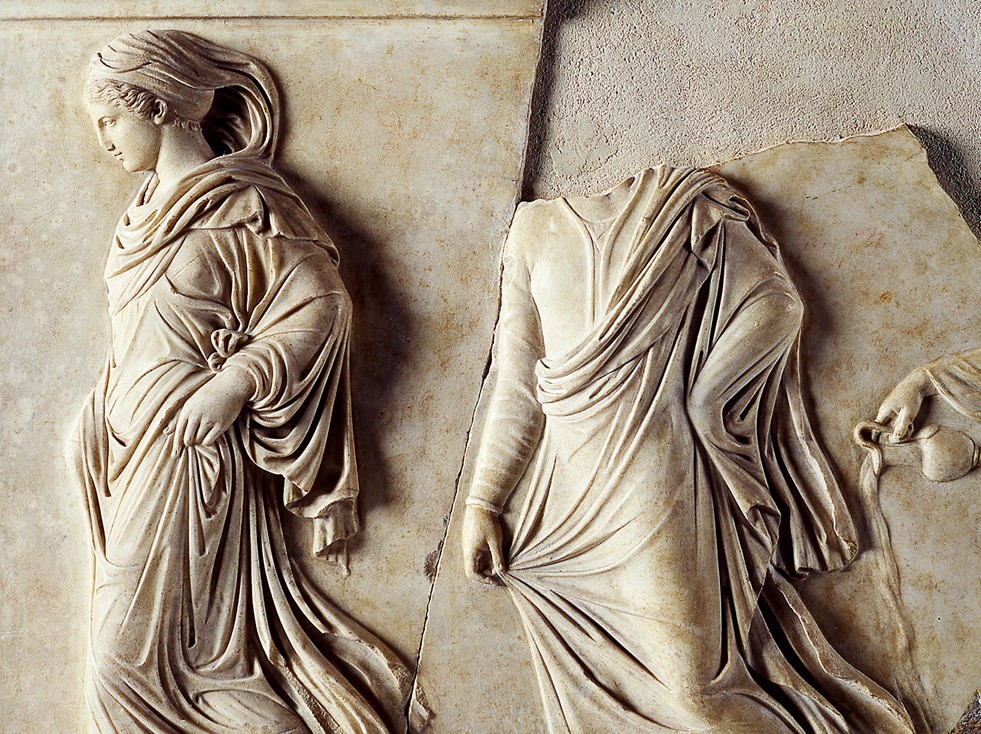
Sign in to savethumb|The original Roman relief upon which Gradiva was based (Vatican City). |300x300px Gradiva, or "She who steps along", is a mythic figure created by Wilhelm Jensen as a central character in his novella Gradiva (1902). The character was inspired by an existing Roman relief. She later became a prominent subject in Surrealist art after Sigmund Freud published an essay on Jensen's work.
Described at
Gradiva
The relief is part of a composition showing three women moving from the right associated to other three female figures mirroring them on reliefs he...
museivaticani.va →The relief is part of a composition showing three women moving from the right associated to other three female figures mirroring them on reliefs held in various museums: they are the so-called Horae and Aglaurids, probably derived from a Greek original of the 4th century B.C. The name Gradiva, Latin for "she who walks", was attributed to the first girl of the group in the short story by Wilhelm Jensen, Gradiva . A Pompeian Fantasy (1903). Carl Gustav Jung brought the short story to the attention of Sigmund Freud, who examined this literary work as though it were a psychiatric case. In his study Delusion and Dream in Jensen's "Gradiva" (1906) he takes the literary concept as the starting point for an explanation of how external stimuli may sometimes bring the most hidden psychic tensions to the surface. In Rome Freud, who collected ancient art, bought a cast of this relief which he hung on the wall of his study near the famous couch. Gregorian Egyptian Museum Gregorian Etruscan Museum Pio Clementino Museum Chiaramonti Museum Lapidary Gallery New Wing Gregoriano Profano Museum Lapidario Profano ex Lateranense Pius-Christian Museum Christian Lapidarium Jewish Lapidarium Pinacoteca Ethnological Museum Anima Mundi Carriage Pavilion Christian Museum Profane Museum Room of the Aldobrandini Wedding Chapel of St. Peter Martyr Collection of Modern and Contemporary Art Sistine Chapel Raphael's Rooms Borgia Apartment Niccoline Chapel Chapel of Urban VIII Room of the Immaculate Conception Room of the Chiaroscuri Gregorian Egyptian Museum Gregorian Etruscan Museum Pio Clementino Museum Chiaramonti Museum Lapidary Gallery New Wing Gregoriano Profano Museum Pius-Christian Museum Pinacoteca Pinacoteca Courtyard Ethnological Museum Carriage Pavilion Christian Museum Profane Museum Room of the Aldobrandini Wedding Chapel of St. Peter Martyr Collection of Modern and Contemporary Art
Excerpt from a page describing this subject · 3,524 chars · not written by Vinony
Wikidata facts
- Instance of
- sculpture
- Depicts
- woman
- Collection
- Uffizi Gallery
- Image
- Erichthonius and the Three Daughters of Cecrops (1906) (14592124630).jpg
Show 3 more facts
- inventory number
- 1284
- Commons category
- Gradiva
Sources (1)
via Wikidata · CC0
~4 min read
Encyclopedic overview
5 sectionsContents
- Origins
- Description
- Posterity
- References
- External links
thumb|The original Roman relief upon which Gradiva was based (Vatican City). |300x300px Gradiva, or "She who steps along", is a mythic figure created by Wilhelm Jensen as a central character in his novella Gradiva (1902). The character was inspired by an existing Roman relief. She later became a prominent subject in Surrealist art after Sigmund Freud published an essay on Jensen's work.
== Origins == The character first appeared in Wilhelm Jensen's eponymous novella Gradiva. In the novella, the protagonist is fascinated by a female figure in an ancient relief and names her Gradiva, Latin for "she who steps along". The name is also believed to be an homage to Mars Gradivus, the Roman god of war.
Excerpted from Wikipedia’s “Gradiva” article, available under the CC BY-SA 4.0 licence.