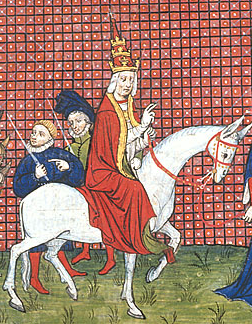
File:Duke_of_Anjou_leading_Pope_Gregory_XI_to_the_palace_at_Avignon,_while_cardinals_follow_(cropped).png · Wikimedia Commons · See Wikimedia Commons
Gregory XI
Sign in to saveAlso known as Pope Gregory XI, Pierre Roger de Beaufort, Pope Gregorius, Pope Gregorius XI, Pope Grégoire XI, Gregorius PP. XI, papa Gregorio XI, pape Grégoire XI
pope of the Catholic Church from 1370 to 1378
OverviewAI-generated
Gregory XI, born Grégoire XI in 1331 in Rosiers-d'Égletons, was a male French Catholic priest. He served as Pope and was educated at the University of Perugia, where he studied under Baldus de Ubaldis. His religious affiliation was with the Catholic Church, and he spoke French. He participated in the papal conclaves of 1352, 1362, and 1370.
He worked in Rome and the Papal States. Gregory XI died in Rome on March 27, 1378, and was buried at Santa Francesca Romana. He was consecrated by Guy of Boulogne. His name in his native language is recorded as Gregorius PP. XI. He is recognized in the Popes collection and is described by sources including the Brockhaus and Efron Encyclopedic Dictionary, The Nuttall Encyclopædia, and the Encyclopædia Britannica 11th edition.
Synthesized by Vinony from 32 facts across 6 sources: Wikidata, Crossref, MusicBrainz, Open Library, Vinony collections, Vinony graph. Generated from structured data (not the Wikipedia text) and checked against those facts — may still contain errors.
Wikidata facts
- Instance of
- human
- Gender
- male
- Citizenship
- France
- Place of birth
- Rosiers-d'Égletons
- Place of death
- Rome
- Occupation
- Catholic priest
- Position held
- Pope
- Educated at
- University of Perugia
- Languages spoken
- French
- Religion
- Catholic Church
- Participant in
- 1370 papal conclave
- Student of
- Baldus de Ubaldis
- Image
- Duke of Anjou leading Pope Gregory XI to the palace at Avignon, while cardinals follow (cropped).png
- Work location
- Papal States
Show 9 more facts
- place of burial
- Santa Francesca Romana
- Commons category
- Gregorius XI
- date of death
- 1378-03-27
- name in native language
- Gregorius PP. XI
- consecrator
- Guy of Boulogne
- described by source
- Wikitólica
- date of birth
- 1331-00-00
- name
- Grégoire XI
via Wikidata · CC0
~9 min read
Encyclopedic overview
Pope Gregory XI (Latin: Gregorius XI; born Pierre Roger de Beaufort; c. 1329 – 27 March 1378) was head of the Catholic Church from 30 December 1370 to his death, in March 1378. He was the seventh and last Avignon pope and the most recent French pope. In 1377, Gregory XI returned the papal court to Rome, ending nearly 70 years of papal residency in Avignon, in modern-day France. His death was swiftly followed by the Western Schism involving two Avignon-based antipopes.
Early life
Excerpted from Wikipedia’s “Gregory XI” article, available under the CC BY-SA 4.0 licence.
Gallery (4)
Available in 74 languages
- Español
- Français
- Deutsch
- 中文
- 日本語
- Русский
- Português
- Italiano
- العربية
- Afrikaans
- Albanian
- Armenian
- Bahasa Indonesia
- Basque
- Belarusian
- Bikol
- Breton
- Bulgarian
Show 55 more
- Catalan
- cdo
- Croatian
- Czech
- Danish
- Egyptian Arabic
- Esperanto
- Estonian
- Filipino
- Finnish
- Galician
- Georgian
- Greek
- Hakka Chinese
- Hebrew
- Hungarian
- Ido
- Iloko
- Irish
- Javanese
- Latin
- Latvian
- Lithuanian
- Low German
- Macedonian
- Malay
- Marathi
- Nederlands
- Norwegian
- Piedmontese
- Polski
- Quechua
- Romanian
- Serbian
- Serbian (Latin)
- Sicilian
- simple
- Slovak
- Slovenian
- Svenska
- Swahili
- Tamil
- Tiếng Việt
- Türkçe
- Ukrainian
- Urdu
- Waray
- Welsh
- Wu Chinese
- Yoruba
- Zaza
- zh_min_nan
- zh_yue
- فارسی
- 한국어
via Wikidata sitelinks · CC0