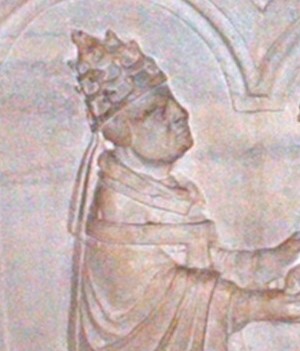
File:Pope_Urban_6.jpg · Wikimedia Commons · See Wikimedia Commons
Urban VI
Sign in to saveAlso known as Bartolomeo Prignano, Pope Urban VI
pope of the Catholic Church from 1378 to 1389 (1318–1389)
OverviewAI-generated
Urban VI, born Bartolomeo in 1318 in Itri, was a male figure who served as Pope and held roles as a politician, university teacher, Catholic priest, and canon law jurist. He was educated at and employed by the University of Naples Federico II. His work location included Rome and the Papal States, and he spoke Middle French.
He died of accidental poison in Rome on October 15, 1389. Urban VI is buried in the Vatican Grotto. He is described by sources including the Brockhaus and Efron Encyclopedic Dictionary and The Nuttall Encyclopædia. His name in his native language is recorded as Urbanus PP. VI. A work of his is held in the collection of the Victoria and Albert Museum.
Synthesized by Vinony from 21 facts across 2 sources: Wikidata, Vinony collections. Generated from structured data (not the Wikipedia text) and checked against those facts — may still contain errors.
Wikidata facts
- Instance of
- human
- Given name
- Bartolomeo
- Gender
- male
- Place of birth
- Itri
- Place of death
- Rome
- Occupation
- Catholic priest
- Educated at
- University of Naples Federico II
- Employer
- University of Naples Federico II
- Languages spoken
- Middle French
- Religion
- Catholic Church
- Image
- Urbanus VI coin.jpg
- Work location
- Papal States
Show 11 more facts
- place of burial
- Vatican Grotto
- Commons category
- Urbanus VI
- date of death
- 1389-10-15
- date of birth
- 1318-00-00
- manner of death
- accidental death
- cause of death
- poison
- described by source
- Wikitólica
- has works in the collection
- Victoria and Albert Museum
- name in native language
- Urbanus PP. VI
- P8168
- Scarodytes
- P13311
- Alexander Vinnikov
via Wikidata · CC0
~10 min read
Encyclopedic overview
Pope Urban VI (Latin: Urbanus VI; Italian: Urbano VI; c. 1318 – 15 October 1389), born Bartolomeo Prignano ( Italian pronunciation: [bartoloˈmɛːo priɲˈɲaːno]), was head of the Catholic Church from 8 April 1378 to his death, in October 1389. He was the last pope elected from outside the College of Cardinals. His pontificate began shortly after the end of the Avignon Papacy. It was marked by immense conflict between rival factions as a part of the Western Schism, with much of Europe, such as France, the Iberian Kingdoms of Castile and Aragon, and Scotland recognizing Clement VII, based in Avignon, as the true pope.
Early life
Excerpted from Wikipedia’s “Urban VI” article, available under the CC BY-SA 4.0 licence.
Gallery (9)
Available in 71 languages
- Español
- Français
- Deutsch
- 中文
- 日本語
- Русский
- Português
- Italiano
- العربية
- Afrikaans
- Albanian
- Bahasa Indonesia
- Basque
- be_x_old
- Belarusian
- Breton
- Bulgarian
- Catalan
Show 52 more
- cdo
- Croatian
- Czech
- Danish
- Egyptian Arabic
- Esperanto
- Estonian
- Filipino
- Finnish
- Galician
- Georgian
- Greek
- Hakka Chinese
- Hebrew
- Hungarian
- Ido
- Iloko
- Irish
- Javanese
- Latin
- Latvian
- Lithuanian
- Macedonian
- Malay
- Marathi
- Nederlands
- Norwegian
- Polski
- Quechua
- Romanian
- Serbian
- Serbian (Latin)
- Sicilian
- simple
- Slovak
- Slovenian
- Svenska
- Swahili
- Tamil
- Tiếng Việt
- Türkçe
- Ukrainian
- Urdu
- Waray
- Welsh
- Wu Chinese
- Yoruba
- Zaza
- zh_min_nan
- zh_yue
- فارسی
- 한국어
via Wikidata sitelinks · CC0