File:Clock_group.svg · Wikimedia Commons · See Wikimedia Commons
modular arithmetic
Sign in to saveAlso known as clock arithmetic, modulo arithmetic, mathematics in clocks
system of algebraic operations defined for remainders under division by a fixed positive integer; system of arithmetic for integers, where numbers "wrap around" upon reaching a certain value—the modulus
Modular arithmetic is a system where numbers wrap around when they reach a certain fixed value, called the modulus, so you only work with the remainders left after division. It's useful because it simplifies problems involving cycles and patterns, such as telling time on a clock or organizing data in computer science.
AI-generated from the Wikipedia summary — may contain errors.
Wikidata facts
- Subclass of
- mathematics
- Image
- Clock group.svg
Show 8 more facts
- topic's main category
- Category:Modular arithmetic
- Commons category
- Modular arithmetic
- Stack Exchange tag
- math.stackexchange.com/tags/modular-arithmetic
- is the study of
- congruence of integers
- different from
- modulo operation
- on focus list of Wikimedia project
- Wikipedia:Vital articles/Level/4
- maintained by WikiProject
- WikiProject Mathematics
- has characteristic
- congruence of integers
via Wikidata · CC0
~20 min read
Encyclopedic overview
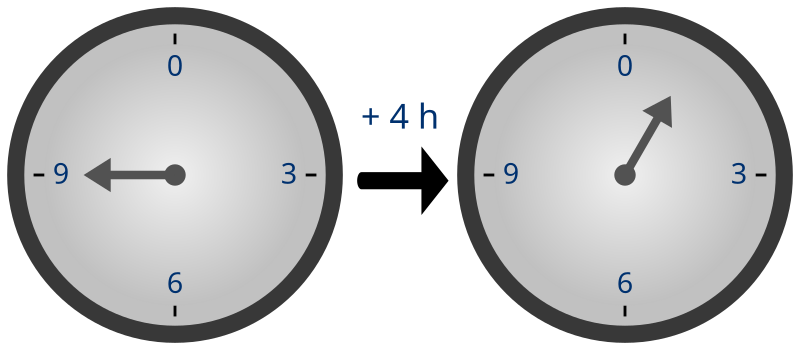
Time-keeping on this clock uses arithmetic modulo 12. Adding 4 hours to 9 o'clock gives 1 o'clock, since 13 is congruent to 1 modulo 12.
In mathematics, modular arithmetic is a system of arithmetic operations for integers, differing from the usual ones in that numbers "wrap around" when reaching or exceeding a certain value, called the modulus. The modern approach to number theory using modular arithmetic was developed by Carl Friedrich Gauss in his book Disquisitiones Arithmeticae, published in 1801.
Excerpted from Wikipedia’s “modular arithmetic” article, available under the CC BY-SA 4.0 licence.