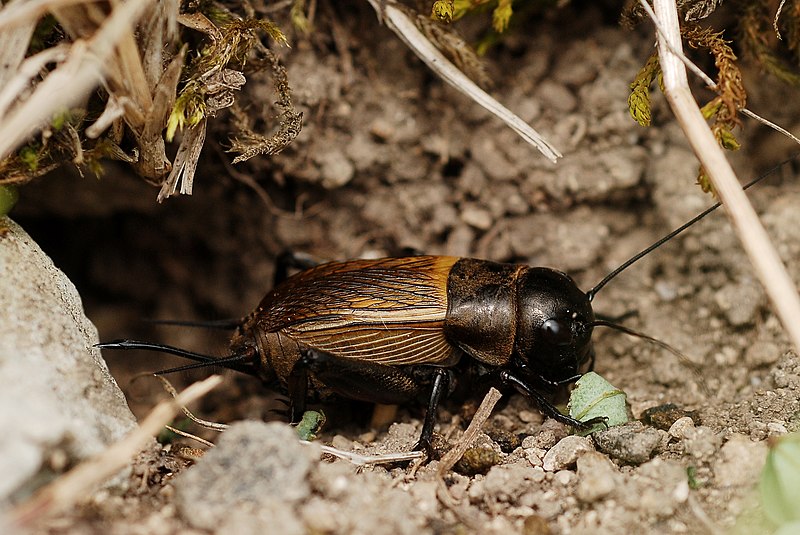
File:Gryllus_campestris_female_(4724690375).jpg · Wikimedia Commons · See Wikimedia Commons
Gryllidae
Sign in to saveAlso known as true crickets, cricket family, cricket, cricky
The family Gryllidae contains the subfamilies and genera which entomologists now term true crickets. Having long, whip-like antennae, they belong to the Orthopteran suborder Ensifera, which has been greatly reduced in the last 100 years (e.g. Imms): taxa such as the tree crickets, spider-crickets and their allies, sword-tail crickets, wood or ground crickets and scaly crickets have been moved or elevated to family level. The type genus is Gryllus and the first use of the family name "Gryllidae" was by Francis Walker.
OverviewAI-generated
Gryllidae is a family within the kingdom Animalia, phylum Arthropoda, class Insecta, and order Orthoptera. The taxon is accepted under the authority of Laicharting, 1781. It is represented by the Unicode character 🦗 and has a Commons category of the same name.
Scientific records indicate 2,743 publications associated with the query Gryllidae in PubMed. There are 465,126 occurrence records in GBIF and 5,617 records in iDigBio, which includes 749 media items. These iDigBio records are held by the institution USNM in the United States. Additionally, the taxon is referenced by 259 other encyclopedia articles.
Synthesized by Vinony from 28 facts across 7 sources: Wikidata, GBIF, PubMed, Gbif Occ, WoRMS, iDigBio, Vinony graph. Generated from structured data (not the Wikipedia text) and checked against those facts — may still contain errors.
Species
Gryllidae
FAMILY
- KingdomAnimalia
- PhylumArthropoda
- ClassInsecta
- OrderOrthoptera
- FamilyGryllidae
注意:本页面含有Unihan扩展B区用字:「𧉍、𧉆」。有关字符可能會错误显示,詳见Unicode扩展汉字。 亚科 蛄蟋亞科 Eneopterinae 蟋蟀亞科 Gryllinae 針蟪亞科 Nemobiinae 樹蟋亞科 Oecanthinae 金鐘亞科 Phalangopsinae Podoscirtinae Pteroplistinae Trigonidiinae 蟋蟀(拼音:xī shuài,注音:ㄒㄧ ㄕㄨㄞˋ),又称促织、蛐蛐儿、蟋蟀欸、蟀子、𧉍(音同“唧”)、蜻蛚(音同“精列”)[1]、蹔𧉆[1],是直翅目昆虫的一科,啮食植物茎叶、种实和根部,都是农业害虫。身体黑色至褐色,头部有长触角,后腿粗大善跳跃,后腿极具爆发力。其雄性好争斗,两翅摩擦能发出聲響。以昼伏夜出的为多,生性孤僻,通常一穴一虫,发情期,雄虫才招揽雌蟋蟀同居一穴。为了方便听到公蟋蟀的求偶鳴聲,蟋蟀具有位于前脚关节略下方的耳鼓。每种蟋蟀的鸣声不尽相同。牠們的叫聲是代表溫度[2],雌虫不發声,俗称三尾子。全世界約有蟋蟀900多種,最普通的为中华蟋蟀,体长约20毫米。年生一代。 目录 1 與蝗蟲、螽斯的不同 2 文化 3 蟋蟀書籍 4 参考资料 5 參考文獻 6 外部連結 與蝗蟲、螽斯的不同 蟋蟀與蝗蟲、螽斯皆為直翅目昆蟲,蟈蟈是指螽斯,蛐蛐是指蟋蟀,但體態仍有不同之處: 蝗蟲的觸角最短,螽斯的觸角又比蟋蟀更長。螽斯的觸角長度甚至比身體更長。 蟋蟀和螽斯是依靠翅膀的摩擦發聲。但蟋蟀右翅疊在左翅上,螽斯左翅往往疊在右翅上面。蝗蟲則以其後腿摩擦翅膀發出聲音。 蝗蟲和螽斯生活於草地、草叢間,有綠色和褐色二種,蟋蟀生活於地面石礫間,顏色趨於暗褐色。 文化 中國有把蟋蟀作为宠物养在小笼子裡的文化,在西班牙、葡萄牙亦然,《西湖老人繁盛录》载:“促织盛出,都民好养,或以银丝为笼,或作楼台为笼,……”。更有人用蟋蟀作为其他食肉类动物的饲料。 中國最早有《詩經》“十月蟋蟀,入我床下”的描寫。在中国等国家流行鬥蟋蟀为樂,唐朝《开元天宝遗事》记载:“宫中秋兴,妃妾辈皆以小金笼贮蟋蟀,置于枕畔,夜听其声,庶民之家亦效之”。顧逢《负曝杂录·禽虫善斗》条云: “父老传:斗蛩亦始于天宝间。长安富人镂象牙为笼而畜之。以万金之资,付之一啄。其来远矣。”。宋朝宰相賈似道整日和群妾蹲跪在地上鬥蟋蟀,《類書纂要》曰:“賈似道於半閒堂鬥蟋蟀。”更荒唐者賈還帶蟋蟀上朝議政,甚至曾經發生蟋蟀自賈水袖內跳出,最後竟跳黏到皇帝鬍鬚上鬧劇;賈似道還編寫了一本「促織經」[3],講述自己養蟋蟀和鬥蟋蟀的經驗,《促织三拗》云:“赢叫输不叫,一也;雌上雄背,二也;过蜑有力,三也。”,昆虫学史专家邹树文稱:“这个对于蟋蟀交配习性的发现不论其是宋或明,其记述之早均可称述。”[4]《促织经》也是世界研究蟋蟀的第一部專著[5]。 明朝鬥蟋蟀的風氣最
via GBIF
Museum specimens
- Specimen records
- 5,617
- With media
- 749
- Family
- Gryllidae
- Collections
- USNM
- Recorded in
- United States
Research
2,743 papers- Studies on Neotropical crickets: New species and notes on the classification of Field Crickets genera Anurogryllus and Gryllus (Orthoptera: Gryllidae: Gryllinae).Zootaxa · 2021
- Macronutrient regulation in nymphs of the two-spotted cricket, Gryllus bimaculatus (Orthoptera: Gryllidae).Journal of insect physiology · 2024
- Sexual dimorphism in cuticular hydrocarbons of the Australian field cricket Teleogryllus oceanicus (Orthoptera: Gryllidae).Journal of insect physiology · 2008
- Taxonomy and calling songs of some species of Cardiodactylus (Gryllidae, Eneopterinae, Lebinthini) from New Guinea.Zootaxa · 2024
- First ontogenesis and bioecological study of Sciobia bouvieri (Orthoptera, Gryllidae), a North African endemic species.Zootaxa · 2024
via PubMed
Wikidata facts
- Instance of
- taxon
- Parent taxon
- Grylloidea
- Image
- Gryllus02.jpg
Show 7 more facts
- taxon name
- Gryllidae
- Commons category
- Gryllidae
- topic's main category
- Category:Crickets
- taxon rank
- family
- taxon common name
- murni
- Unicode character
- 🦗
- on focus list of Wikimedia project
- Wikipedia:Vital articles/Level/4
Sources (2)
via Wikidata · CC0
~3 min read
Encyclopedic overview
4 sectionsContents
- Subfamilies
- See also
- References
- External links
The family Gryllidae contains the subfamilies and genera which entomologists now term true crickets. Having long, whip-like antennae, they belong to the Orthopteran suborder Ensifera, which has been greatly reduced in the last 100 years (e.g. Imms): taxa such as the tree crickets, spider-crickets and their allies, sword-tail crickets, wood or ground crickets and scaly crickets have been moved or elevated to family level. The type genus is Gryllus and the first use of the family name "Gryllidae" was by Francis Walker.
They have a worldwide distribution (except Antarctica). The most familiar field crickets (Gryllinae) are characteristically robust brown or black insects; the largest members of the family are the -long bull crickets (Brachytrupes) which excavate burrows a metre or more deep.
Excerpted from Wikipedia’s “Gryllidae” article, available under the CC BY-SA 4.0 licence.
Gallery (6)
Available in 101 languages
- Español
- Français
- Deutsch
- 中文
- 日本語
- Русский
- Português
- Italiano
- العربية
- हिन्दी
- Afrikaans
- Amharic
- Aragonese
- Asturian
- azb
- Azerbaijani
- Balinese
- Bangla
Show 82 more
- Banjar
- Basque
- bat_smg
- Belarusian
- Bulgarian
- Catalan
- cdo
- Cebuano
- Central Kurdish
- Chuvash
- Croatian
- Czech
- dag
- Danish
- Egyptian Arabic
- eml
- Esperanto
- Estonian
- Filipino
- Finnish
- Fon
- Galician
- Georgian
- Greek
- Guarani
- Hebrew
- Hungarian
- Icelandic
- Ido
- Irish
- Javanese
- Kazakh
- Khmer
- Kongo
- Latin
- Latvian
- Lingala
- Lithuanian
- Low German
- Malagasy
- Malay
- Malayalam
- Mingrelian
- Navajo
- nds_nl
- Nederlands
- Northern Frisian
- Norwegian
- Norwegian Nynorsk
- Occitan
- Pampanga
- Pashto
- Polski
- Quechua
- roa_rup
- Romanian
- Serbian
- Serbian (Latin)
- Sicilian
- simple
- Sindhi
- Slovak
- Slovenian
- Sundanese
- Svenska
- Swahili
- szy
- Telugu
- Tiếng Việt
- Türkçe
- Ukrainian
- Uzbek
- Walloon
- Waray
- Western Panjabi
- Wu Chinese
- zh_classical
- zh_min_nan
- zh_yue
- فارسی
- ไทย
- 한국어
via Wikidata sitelinks · CC0