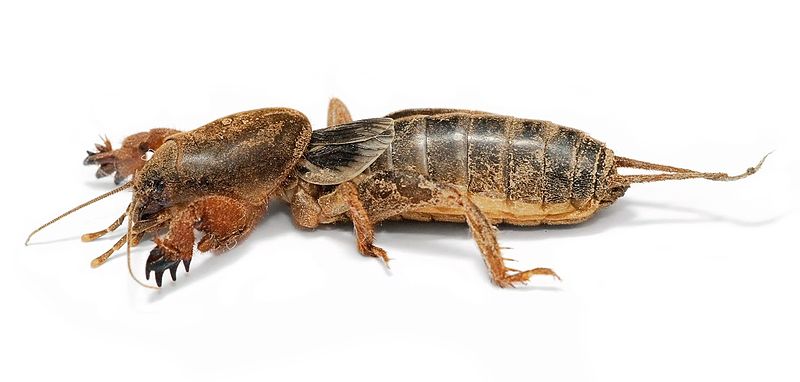
File:Mole_cricket02.jpg · Wikimedia Commons · See Wikimedia Commons
Gryllotalpidae
Sign in to saveAlso known as mole crickets, También está en República Dominicana
family of orthopterans
OverviewAI-generated
Gryllotalpidae is a family of insects within the order Orthoptera, class Insecta, and phylum Arthropoda. It belongs to the superfamily Grylloidea and was described by Blanchard in 1845. The taxon is currently accepted and is commonly known by names such as Veenmollen, jordsirisser, الحالوشيات, and الجنكازيات. Its main food source is Helianthus tuberosus.
Records for this family are held by institutions including ANWC, USNM, ANSP, and UMNH. Occurrence data spans countries such as Australia, the United States, South Africa, Zimbabwe, and Saudi Arabia. The family has 43,993 occurrences and 389 records, with 102 media items available. It is distinct from Medvidka and was described in the source Gujin Tushu Jicheng.
Synthesized by Vinony from 34 facts across 6 sources: Wikidata, GBIF, Gbif Occ, WoRMS, iDigBio, Vinony graph. Generated from structured data (not the Wikipedia text) and checked against those facts — may still contain errors.
Species
Gryllotalpidae
FAMILY
- KingdomAnimalia
- PhylumArthropoda
- ClassInsecta
- OrderOrthoptera
- FamilyGryllotalpidae
Die Maulwurfsgrillen (Gryllotalpidae) sind eine Familie der Heuschrecken. Sie umfasst etwa 100 Arten in sechs Gattungen (plus einige nur fossil bekannte). In Mitteleuropa ist die Europäische Maulwurfsgrille (Gryllotalpa gryllotalpa) die einzige Art.
via GBIF
Museum specimens
- Specimen records
- 389
- With media
- 102
- Family
- Gryllotalpidae
- Collections
- ANWC, USNM, ANSP, UMNH
- Recorded in
- Australia, United States, South Africa, Zimbabwe, Saudi Arabia, Indonesia, Namibia, Kenya
Wikidata facts
- Instance of
- taxon
- Parent taxon
- Grylloidea
- Image
- Mole cricket02.jpg
Show 8 more facts
- Commons category
- Gryllotalpidae
- taxon rank
- family
- taxon name
- Gryllotalpidae
- topic's main category
- Category:Gryllotalpidae
- taxon common name
- صراصير الحقل
- main food source
- Helianthus tuberosus
- different from
- Medvidka
- on focus list of Wikimedia project
- Wikipedia:Vital articles/Level/4
Sources (1)
via Wikidata · CC0
~23 min read
Encyclopedic overview
Mole crickets are members of the insect family Gryllotalpidae, in the order Orthoptera (grasshoppers, locusts, and crickets). Mole crickets are cylindrical-bodied, fossorial insects about 3–5 cm (1.2–2.0 in) long as adults, with small eyes and shovel-like fore limbs highly developed for burrowing. They are present in many parts of the world and where they have arrived in new regions, they may become agricultural pests.
Mole crickets have three life stages: eggs, nymphs, and adults. Most of their lives in these stages are spent underground, but adults have wings and disperse in the breeding season. They vary in their diet: some species are herbivores, mainly feeding on roots; others are omnivores, including worms and grubs in their diet; and a few are largely predatory. Male mole crickets have an exceptionally loud song; they sing from a burrow that opens out into the air in the shape of an exponential horn. The song is an almost pure tone, modulated into chirps. It is used to attract females, either for mating, or for indicating favourable habitats for them to lay their eggs.
Excerpted from Wikipedia’s “Gryllotalpidae” article, available under the CC BY-SA 4.0 licence.
Gallery (13)
Available in 84 languages
- Español
- Français
- Deutsch
- 中文
- 日本語
- Русский
- Português
- Italiano
- العربية
- Albanian
- Armenian
- azb
- Bahasa Indonesia
- Balinese
- Bangla
- Banjar
- Bashkir
- Basque
Show 65 more
- Belarusian
- Bikol
- Bosnian
- Catalan
- cdo
- Cebuano
- Central Kurdish
- Chechen
- Croatian
- Czech
- Egyptian Arabic
- Esperanto
- Estonian
- Finnish
- Galician
- Gan Chinese
- Georgian
- Greek
- Hebrew
- Hungarian
- Ido
- Javanese
- Kabardian
- Kabyle
- Kazakh
- Komi-Permyak
- Kurdish
- Kyrgyz
- Latin
- Latvian
- Lithuanian
- Low German
- Malay
- Malayalam
- Mazanderani
- Mingrelian
- Navajo
- Nederlands
- Norwegian
- Ossetic
- Pampanga
- Pashto
- Polski
- Romanian
- Serbian
- Serbian (Latin)
- simple
- Slovenian
- Sundanese
- Svenska
- Swahili
- Tamil
- Tiếng Việt
- Türkçe
- Tyap
- Ukrainian
- Uzbek
- Waray
- Welsh
- Wu Chinese
- zh_min_nan
- zh_yue
- فارسی
- ไทย
- 한국어
via Wikidata sitelinks · CC0