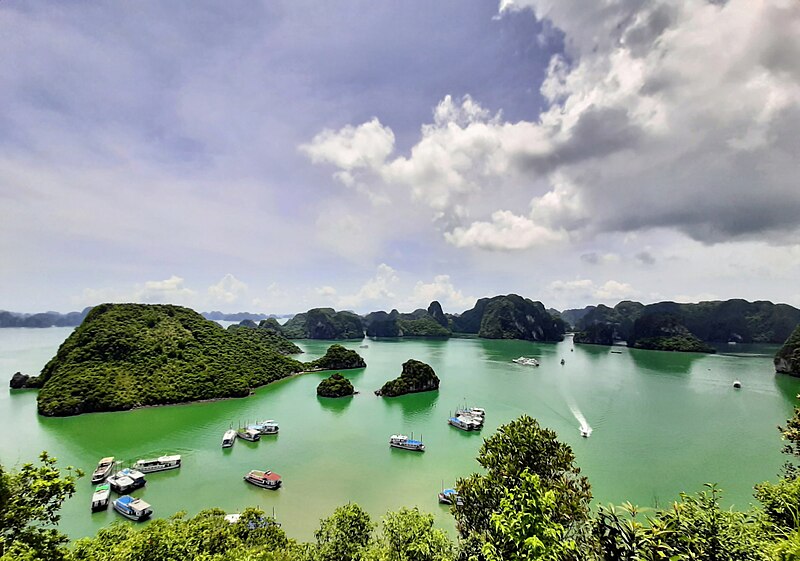
File:Ha_Long_Bay_in_2019.jpg · Wikimedia Commons · See Wikimedia Commons
Ha Long Bay
Sign in to saveUNESCO World Heritage Site in Vietnam
Ha Long Bay is a UNESCO World Heritage Site located in Vietnam, known for its stunning natural landscape of limestone cliffs and islands rising from the sea. It matters because it is recognized internationally for its exceptional geological and scenic value, making it one of Vietnam's most important natural attractions.
AI-generated from the Wikipedia summary — may contain errors.
Wikidata facts
- Instance of
- tourist attraction
- Country
- Vietnam
- Area
- 150000
- Official website
- www.halong.org.vn/index.asp?lan=en
- Image
- Halong ensemble (colour corrected).jpg
Show 4 more facts
- native label
- Vịnh Hạ Long
- Commons category
- Ha Long Bay
- heritage designation
- World Heritage Site
- Commons gallery
- Vịnh Hạ Long
Sources (2)
via Wikidata · CC0
~33 min read
Encyclopedic overview
Hạ Long Bay or Halong Bay (Vietnamese: Vịnh Hạ Long, pronounced [vînˀ hâːˀ lawŋm] ) is a bay located in Northeastern Vietnam, administered by Quảng Ninh province. The name Hạ Long means "descending dragon". It features thousands of limestone karsts and islets in various shapes and sizes, for which it is listed as a UNESCO World Heritage Site and a popular travel destination. The bay is also part of a larger area that includes Bai Tu Long Bay to the northeast and Cát Bà Island (administered by Haiphong) to the southwest, with these zones sharing similar geological, geographical, geomorphological, climate, and cultural characteristics.
Hạ Long Bay has an area of around 1,553 km (600 sq mi), including 1,969 islets, most of which are made of limestone. The core of the bay has an area of 334 km (129 sq mi) with a high density of 775 islets. The limestone in this bay has gone through 500 million years of formation in different conditions and environments. The evolution of the karst in this bay has taken 20 million years under the impact of the tropical wet climate. The geo-diversity of the environment in the area has created biodiversity, including a tropical evergreen biosystem and a seashore biosystem. Hạ Long Bay is home to 14 endemic floral species and 60 endemic faunal species.
Excerpted from Wikipedia’s “Ha Long Bay” article, available under the CC BY-SA 4.0 licence.
Gallery (12)
On the map
Available in 71 languages
- Español
- Français
- Deutsch
- 中文
- 日本語
- Русский
- Português
- Italiano
- العربية
- हिन्दी
- Armenian
- Asturian
- Azerbaijani
- Bahasa Indonesia
- Bangla
- Basque
- Belarusian
- Bikol
Show 52 more
- Breton
- Bulgarian
- Burmese
- Catalan
- Cebuano
- Croatian
- Czech
- Danish
- Esperanto
- Estonian
- Finnish
- Georgian
- Greek
- Hebrew
- Hungarian
- Interlingue
- Javanese
- Kashmiri
- Khmer
- Lao
- Latvian
- Lithuanian
- Macedonian
- Maithili
- Malay
- Malayalam
- Maltese
- Marathi
- Mongolian
- Nederlands
- Nepali
- Norwegian
- Polski
- Serbian
- Serbian (Latin)
- simple
- Slovak
- Slovenian
- Svenska
- Tamil
- Tiếng Việt
- Türkçe
- Ukrainian
- Urdu
- Waray
- Welsh
- Western Panjabi
- Wu Chinese
- zh_yue
- فارسی
- ไทย
- 한국어
via Wikidata sitelinks · CC0