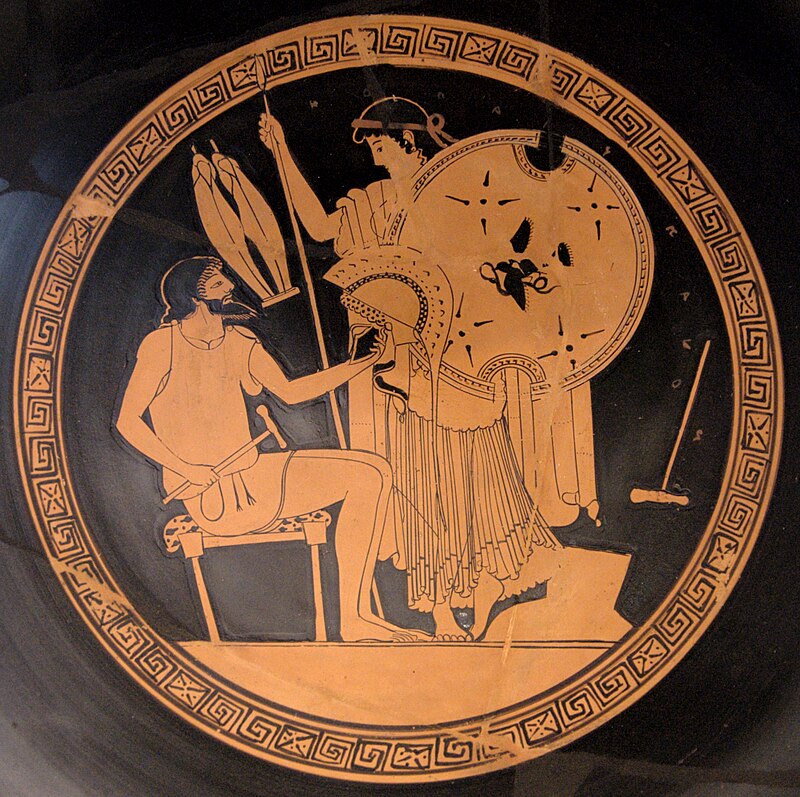
File:Hephaistos_Thetis_at_Kylix_by_the_Foundry_Painter_Antikensammlung_Berlin_F2294.jpg · Wikimedia Commons · See Wikimedia Commons
Hephaistos
Sign in to saveAlso known as Hephaestos
Gott des Feuers und der Schmiede in der griechischen Mythologie
Hephaestus is the Greek god associated with craftsmanship, fire, metalworking, and volcanoes, representing the skill and labor involved in creating objects. He matters in Greek mythology as a significant deity whose origin story—being cast out from Mount Olympus by his parents due to his lameness—explores themes of disability, rejection, and the value of work and creation.
AI-generated from the Wikipedia summary — may contain errors.
Key facts
- Deity.type
- Greek
- Deity.name
- Hephaestus
- Deity.image
- Hephaistos Thetis at Kylix by the Foundry Painter Antikensammlung Berlin F2294.jpg
- Deity.caption
- Hephaestus (left) hands to Thetis the armour of Achilles. Berlin Foundry Cup, an Attic red-figure kylix, c. 500–490 BC
- Deity.member_of
- the Twelve Olympians
- Deity.abode
- Mount Olympus
- Deity.symbol
- hammer, anvil, tongs
- Deity.parents
- Zeus and Hera, or Hera alone
- Deity.children
- Thalia, Erichthonius, and Cabeiri
- Deity.siblings
- Ares, Hebe, Eileithyia
- Deity.Roman_equivalent
- Vulcan
- Deity.spouse
- Aphrodite (divorced)Charis/Aglaia
via Wikipedia infobox
Wikidata facts
- Part of
- Twelve Olympians
- Gender
- male
- Spouse
- Charis
- Father
- Zeus
- Mother
- Hera
- Sibling
- Ares
- Occupation
- blacksmith
- Image
- Hephaistos Thetis at Kylix by the Foundry Painter Antikensammlung Berlin F2294.jpg
- Said to be same as
- Vulcan
Show 9 more facts
- worshipped by
- Ancient Greek religion
- Commons category
- Hephaestus
- topic's main category
- Category:Hephaestus
- unmarried partner
- Gaia
- name in native language
- Ἥφαιστος
- described by source
- Encyclopædia Britannica 11th edition
- present in work
- Iliad
- domain of saint or deity
- forging
- on focus list of Wikimedia project
- Wikipedia:Vital articles/Level/4
Sources (1)
via Wikidata · CC0
Article · Deutsch
Hephaistos (altgriechisch Ἥφαιστος Hḗphaistos, lateinisch Hephaestus, eingedeutscht Hephäst) ist in der griechischen Mythologie der Gott des Feuers, der Schmiedekunst und der Vulkane. Hephaistos entspricht dem späteren römischen Vulcanus. Er gehört zu den zwölf olympischen Gottheiten. Hephaistos war für das gesamte künstlerische Spektrum der Metallverarbeitung „zuständig“, einschließlich der Herstellung von Geschmeide, Waffen, sakral-rituellen und profanen Gebrauchsgegenständen. Der ihm geweihte Tempel des Hephaistos im Zentrum Athens gehört zu den besterhaltenen griechischen Tempeln.
Abstract from DBpedia / Wikipedia · CC BY-SA
Gallery (23)
Available in 93 languages
- Español
- Français
- Deutsch
- 中文
- 日本語
- Русский
- Português
- Italiano
- العربية
- हिन्दी
- Afrikaans
- Albanian
- Albanian
- Armenian
- Assamese
- Asturian
- azb
- Azerbaijani
Show 74 more
- Bahasa Indonesia
- Bangla
- Bashkir
- Basque
- Bavarian
- be_x_old
- Belarusian
- Bosnian
- Breton
- Bulgarian
- Catalan
- Croatian
- Czech
- Danish
- Egyptian Arabic
- Esperanto
- Estonian
- Filipino
- Finnish
- Galician
- Georgian
- Greek
- Hebrew
- Hungarian
- hyw
- Icelandic
- Ido
- Irish
- Javanese
- Kazakh
- Kurdish
- Latin
- Latvian
- Lithuanian
- Low German
- Luxembourgish
- Macedonian
- Malay
- Malayalam
- Manipuri
- Marathi
- Nederlands
- Norwegian
- Norwegian Nynorsk
- Occitan
- Piedmontese
- Polski
- Punjabi
- Romanian
- Scots
- Serbian
- Serbian (Latin)
- simple
- Slovak
- Slovenian
- Svenska
- Tajik
- Tamil
- Tatar
- Tiếng Việt
- Türkçe
- Ukrainian
- Urdu
- Uzbek
- Veps
- Waray
- Welsh
- Wu Chinese
- Zaza
- zh_min_nan
- zh_yue
- فارسی
- ไทย
- 한국어
via Wikidata sitelinks · CC0