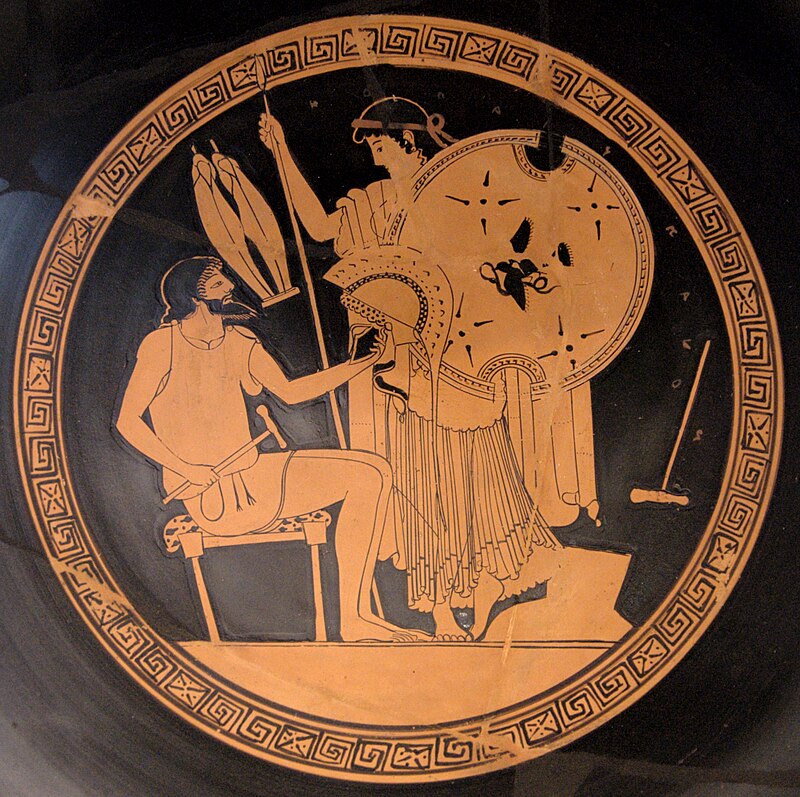
File:Hephaistos_Thetis_at_Kylix_by_the_Foundry_Painter_Antikensammlung_Berlin_F2294.jpg · Wikimedia Commons · See Wikimedia Commons
Hefesto
Sign in to saveAlso known as Hephaestos
dios de los herreros y el fuego en la mitología griega
Hephaestus is the Greek god associated with craftsmanship, fire, metalworking, and volcanoes, representing the skill and labor involved in creating objects. He matters in Greek mythology as a significant deity whose origin story—being cast out from Mount Olympus by his parents due to his lameness—explores themes of disability, rejection, and the value of work and creation.
AI-generated from the Wikipedia summary — may contain errors.
In the Vinony graph
Vinony's link graph records 1,233 inbound references to Hefesto, and connects out to Eris, list of Greek gods and goddesses and Herodotus.
It sits within the topics Characters in the Odyssey, Children of Hera and Consorts of Aphrodite.
Vinony links it to 93 Wikipedia language editions.
Key facts
- Deity.type
- Greek
- Deity.name
- Hephaestus
- Deity.image
- Hephaistos Thetis at Kylix by the Foundry Painter Antikensammlung Berlin F2294.jpg
- Deity.caption
- Hephaestus (left) hands to Thetis the armour of Achilles. Berlin Foundry Cup, an Attic red-figure kylix, c. 500–490 BC
- Deity.member_of
- the Twelve Olympians
- Deity.abode
- Mount Olympus
- Deity.symbol
- hammer, anvil, tongs
- Deity.parents
- Zeus and Hera, or Hera alone
- Deity.children
- Thalia, Erichthonius, and Cabeiri
- Deity.siblings
- Ares, Hebe, Eileithyia
- Deity.Roman_equivalent
- Vulcan
- Deity.spouse
- Aphrodite (divorced)Charis/Aglaia
via Wikipedia infobox
Wikidata facts
- Part of
- Twelve Olympians
- Gender
- male
- Spouse
- Charis
- Father
- Zeus
- Mother
- Hera
- Sibling
- Ares
- Occupation
- blacksmith
- Image
- Hephaistos Thetis at Kylix by the Foundry Painter Antikensammlung Berlin F2294.jpg
- Said to be same as
- Vulcan
Show 9 more facts
- worshipped by
- Ancient Greek religion
- Commons category
- Hephaestus
- topic's main category
- Category:Hephaestus
- unmarried partner
- Gaia
- name in native language
- Ἥφαιστος
- described by source
- Encyclopædia Britannica 11th edition
- present in work
- Iliad
- domain of saint or deity
- forging
- on focus list of Wikimedia project
- Wikipedia:Vital articles/Level/4
Sources (1)
via Wikidata · CC0
Article · Español
En la mitología griega, Hefesto (en griego Ἥφαιστος Hêphaistos, quizá de φαίνω phainô, ‘brillar’) es el dios de la forja y del fuego, así como de los herreros, los artesanos, los escultores, los metales y la metalurgia. Era adorado en todos los centros industriales y manufactureros de Grecia, especialmente en Atenas. Su equivalente aproximado en la mitología romana era Vulcano, en la japonesa Kagutsuchi, en la egipcia Ptah y en la hindú Agni. Hefesto era bastante feo y estaba lisiado y cojo, aunque su esposa era Afrodita. Incluso el mito dice que, al nacer, Hera lo vio tan feo que lo tiró del Olimpo y le provocó una cojera. Tanto es así, que caminaba con la ayuda de un bastón y, en algunas vasijas pintadas, sus pies aparecen a veces al revés. En el arte, se le representa cojo, sudoroso, con la barba desaliñada y el pecho descubierto, inclinado sobre su yunque, a menudo trabajando en su fragua. La apariencia física de Hefesto indica arsenicosis, es decir, envenenamiento crónico por arsénico que provoca cojera y cáncer de piel. El arsénico se añadía al bronce para endurecerlo y la mayoría de los herreros de la Edad de Bronce habrían padecido esta enfermedad.
Abstract from DBpedia / Wikipedia · CC BY-SA
Gallery (23)
Available in 93 languages
- Español
- Français
- Deutsch
- 中文
- 日本語
- Русский
- Português
- Italiano
- العربية
- हिन्दी
- Afrikaans
- Albanian
- Albanian
- Armenian
- Assamese
- Asturian
- azb
- Azerbaijani
Show 74 more
- Bahasa Indonesia
- Bangla
- Bashkir
- Basque
- Bavarian
- be_x_old
- Belarusian
- Bosnian
- Breton
- Bulgarian
- Catalan
- Croatian
- Czech
- Danish
- Egyptian Arabic
- Esperanto
- Estonian
- Filipino
- Finnish
- Galician
- Georgian
- Greek
- Hebrew
- Hungarian
- hyw
- Icelandic
- Ido
- Irish
- Javanese
- Kazakh
- Kurdish
- Latin
- Latvian
- Lithuanian
- Low German
- Luxembourgish
- Macedonian
- Malay
- Malayalam
- Manipuri
- Marathi
- Nederlands
- Norwegian
- Norwegian Nynorsk
- Occitan
- Piedmontese
- Polski
- Punjabi
- Romanian
- Scots
- Serbian
- Serbian (Latin)
- simple
- Slovak
- Slovenian
- Svenska
- Tajik
- Tamil
- Tatar
- Tiếng Việt
- Türkçe
- Ukrainian
- Urdu
- Uzbek
- Veps
- Waray
- Welsh
- Wu Chinese
- Zaza
- zh_min_nan
- zh_yue
- فارسی
- ไทย
- 한국어
via Wikidata sitelinks · CC0